
Published 2026-05-02
Keywords
- neuroarchitecture,
- age-friendly,
- urban governance
How to Cite
Copyright (c) 2026 Rengin Aslanoğlu

This work is licensed under a Creative Commons Attribution 4.0 International License.
Accepted 2026-05-01
Published 2026-05-02
Abstract
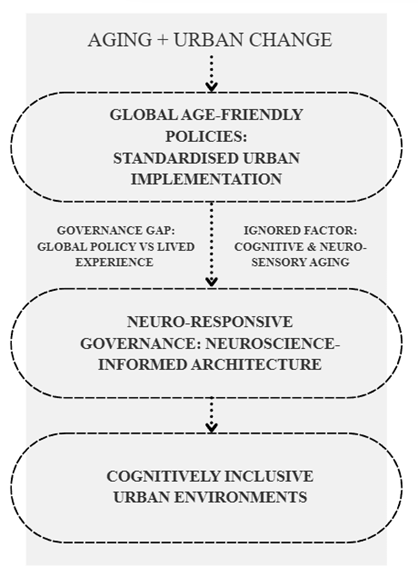
Global policy frameworks such as the WHO Age-Friendly Cities initiative and the Sustainable Development Goals have played a significant role in shaping contemporary urban responses to population aging. These frameworks promote inclusive, healthy, and accessible cities, yet they are often translated into practice through standardized design checklists and physical accessibility measures. This study argues that such approaches are insufficient to address the cognitive and neuro-sensory dimensions of aging, resulting in a governance gap between global standards and local lived experience. It examines how age-friendly policies are mediated by urban environments based on concepts from neuroarchitecture, an interdisciplinary approach that focuses on psychological and physiological dimensions of human experience in the built environment, health geography, and urban governance. It introduces the notion of neuro-responsiveness as an evaluative lens for assessing whether urban governance structures meaningfully engage with aging-related cognitive diversity. As a result, neuroarchitectural considerations are frequently marginalized, despite their relevance to well-being, and everyday mobility for older adults. In the context of a shifting world order, marked by demographic aging, decentralization, and increasing demands on local governments, the study calls for a reorientation of age-friendly governance toward neuro-informed planning methods. This involves integrating cognitive criteria into urban policy, fostering cross-sector collaboration, and recognizing neuroarchitecture as a form of necessity embedded in local decision-making. The study concludes by identifying pathways to more cognitively equitable and contextually sensitive urban governance, to empower the next generation of designers, planners, and future decision-makers, to navigate complex social change.
Highlights:
- Standardized age-friendly frameworks overlook cognitive and neuro-sensory dimensions.
- Neuro-responsiveness of governance bridges global policy and lived urban experience of aging.
- Neuro-informed architecture can empower inclusivity in urban environments.
Downloads




References
- Alzheimer’s Disease International. (2019). World Alzheimer Report 2019: Attitudes to dementia. London: Alzheimer’s Disease International. https://www.alzint.org/resource/world-alzheimer-report-2019/
- Andrews, G. J., & Phillips, D. R. (2005). Ageing and place: Perspectives, policy, practice. Routledge. ISBN 9780415481656
- Andrews, G. J., Cutchin, M., McCracken, K., Phillips, D. R., & Wiles, J. (2007). Geographical gerontology: The constitution of a discipline. Social Science & Medicine, 65(1), 151-168. https://doi.org/10.1016/j.socscimed.2007.02.047
- Annear, M., Fristedt, S., & Laddawong, T. (2024). Walkability in Japan’s aging neighborhoods: A comparative audit anal-ysis of pedestrian journeys in urban Tokyo. Journal of Transport & Health, 35, 101755. https://doi.org/10.1016/j.jth.2024.101755
- Aslanoğlu, R. (2025). Principles of neuroarchitecture in the city: Insights into urban ageing through photoproduction. Urban Studies, 00420980251379204. https://doi.org/10.1177/00420980251379204
- Aslanoğlu R., Kazak J.K., van Hoof J. (2025). Mindful design for well-being: Exploring neuroarchitecture in the built envi-ronment. Indoor and Built Environment, 34(8), 1447-1452. https://doi.org/10.1177/1420326X251313892
- Bendl, T., Krajňáková, L., Marada, M., & Řezníčková, D. (2025). Geographical thinking in geography education: A sys-tematic review. International Research in Geographical and Environmental Education, 34(4), 326-352. https://doi.org/10.1080/10382046.2024.2354097
- Bloom, D. E., Canning, D., & Fink, G. (2010). Implications of population ageing for economic growth. Oxford Review of Economic Policy, 26(4), 583–612. https://doi.org/10.1093/oxrep/grq038
- Biesta, G. (2013). The beautiful risk of education. Paradigm Publishers. ISBN 9781315635866
- Boubekri, M., Cheung, I. N., Reid, K. J., Wang, C. H., & Zee, P. C. (2014). Impact of windows and daylight exposure on overall health and sleep quality of office workers: A case-control pilot study. Journal of Clinical Sleep Medicine, 10(6), 603–611. https://doi.org/10.5664/jcsm.3780
- Buffel, T., Phillipson, C., & Scharf, T. (2012). Ageing in urban environments: Developing “age-friendly” cities. Critical Social Policy, 32(4), 597–617. https://doi.org/10.1177/0261018311430457
- Buffel, T., & Phillipson, C. (2024). Ageing in place in urban environments: Critical perspectives. Routledge. ISBN 9781032134666
- Brenner, N. (2004). New state spaces: Urban governance and the rescaling of statehood. Oxford University Press. https://doi.org/10.1093/acprof:oso/9780199270057.001.0001
- Choudhury, S. (2024). From traffic to community: The science of superblocks. JPI Urban Europe. Retrieved from https://jpi-urbaneurope.eu/from-traffic-to-community-the-science-of-superblocks/
- City of Vancouver. (2013). Age-friendly action plan. City of Vancouver. https://vancouver.ca/people-programs/age-friendly-action-plan.aspx Last accessed: 17.01.2026.
- Crawford, K. (2021). Atlas of AI: Power, politics, and the planetary costs of artificial intelligence. Yale University Press. ISBN 9780300209570
- Cugurullo, F., Acheampong, R. A., Dusparic, I., & Gueriau, M. (2020). The transition to autonomous cars, the redesign of cities and the future of urban sustainability. Urban Geography, 42(6), 833-859. https://doi.org/10.1080/02723638.2020.1746096
- Cugurullo, F., Caprotti, F., Cook, M., Karvonen, A., MᶜGuirk, P., & Marvin, S. (2024). The rise of AI urbanism in post-smart cities: A critical commentary on urban artificial intelligence. Urban studies, 61(6), 1168-1182. https://doi.org/10.1177/00420980231203386
- Cutchin, M. P. (2003). The process of mediated aging-in-place: A theoretically and empirically grounded model. Social Science & Medicine, 57(6), 1077–1090. https://doi.org/10.1016/S0277-9536(02)00486-0
- Davis, R., & Weisbeck, C. (2016). Creating a supportive environment using cues for wayfinding in dementia. Journal of gerontological nursing, 42(3), 36-44. https://doi.org/10.3928/00989134-20160212-07
- de Paiva, A. (2025). Methodological challenges in neuroarchitecture: towards a better understanding on how architec-ture affects cognitive reserve. Intelligent Buildings International, 17(1), 4-12. https://doi.org/10.1080/17508975.2025.2493696
- Djebbara, Z., Fich, L. B., Petrini, L., & Gramann, K. (2019). Sensorimotor brain dynamics reflect architectural affordanc-es. Proceedings of the National Academy of Sciences, 116(29), 14769-14778. https://doi.org/10.1073/pnas.1900648116
- Eberhard, J. P. (2009). Brain landscape: The coexistence of neuroscience and architecture. Oxford University Press. https://doi.org/10.1093/acprof:oso/9780195331721.001.0001
- Engin, Z., Crowcroft, J., Hand, D., & Treleaven, P. (2025). The Algorithmic State Architecture (ASA): an integrated framework for AI-enabled government. arXiv preprint arXiv:2503.08725. https://doi.org/10.48550/arXiv.2503.08725
- Evans, G. W. (2003). The built environment and mental health. Journal of Urban Health, 80(4), 536–555. https://doi.org/10.1093/jurban/jtg063
- Freire, P. (1970). Pedagogy of the oppressed. Continuum. New York, USA.
- Finlay, J. M., & Kobayashi, L. C. (2018). Social isolation and loneliness in later life: A parallel convergent mixed-methods case study of older adults and their residential contexts in the Minneapolis metropolitan area, USA. Social science & medicine, 208, 25-33. https://doi.org/10.1016/j.socscimed.2018.05.010
- Flores, R., Caballer, A., & Alarcón, A. (2019). Evaluation of an age-friendly city and its effect on life satisfaction: A two-stage study. International journal of environmental research and public health, 16(24), 5073. https://doi.org/10.3390/ijerph16245073
- Florida, R., Adler, P., & Mellander, C. (2021). The city as innovation machine. In Transitions in Regional Economic Devel-opment (1st ed., pp. 20–39). Routledge. https://doi.org/10.4324/9781315143736
- Flyvbjerg, B. (1998). Rationality and power: Democracy in practice. University of Chicago Press. https://doi.org/10.2307/3005579
- Healey, P. (2007). Urban complexity and spatial strategies: Towards a relational planning for our times. Routledge. ISBN 9780415380355
- Hill, P. F. (2023). When landmarks are not enough. ELife, 12, e87771. https://doi.org/10.7554/eLife.87771
- Holmes, K. (2018). Mismatch: How inclusion shapes design. Mit Press. ISBN 9780262038881
- Huovila, A., Bosch, P., & Airaksinen, M. (2019). Comparative analysis of standardized indicators for Smart sustainable cities: What indicators and standards to use and when?. Cities, 89, 141-153. https://doi.org/10.1016/j.cities.2019.01.02
- Imrie, R., & Hall, P. (2001). Inclusive design: Designing and developing accessible environments. Spon Press. https://doi.org/10.4324/9780203362501
- IPCC. (2022). Climate Change 2022: Impacts, Adaptation and Vulnerability. Cambridge University Press. https://doi.org/10.1017/9781009325844
- Kaplan, R., & Kaplan, S. (1989). The experience of nature: A psychological perspective. Cambridge University Press.
- Kitchin, R. (2014). The real-time city? Big data and smart urbanism. GeoJournal, 79(1), 1–14. https://doi.org/10.1007/s10708-013-9516-8
- Kitchin, R. (2023). Urban data power: Capitalism, governance, ethics, and justice. In Data power in action (pp. 21-41). Bristol University Press. https://doi.org/10.51952/9781529233551.ch002
- Latham, A., & Layton, J. (2019). Social infrastructure and the public life of cities: Studying urban sociality and public spaces. Geography Compass, 13(7), e12444. https://doi.org/10.1111/gec3.12444
- Lawton, M. P. (1986). Environment and aging. Center for the Study of Aging, University of Florida. ISBN 0818503785, 9780818503788
- Lawton, M. P., & Nahemow, L. (1973). Ecology and the aging process. In C. Eisdorfer & M. P. Lawton (Eds.), The psy-chology of adult development and aging (pp. 619–674). American Psychological Association. https://doi.org/10.1037/10044-020
- Lui, C. W., Everingham, J. A., Warburton, J., Cuthill, M., & Bartlett, H. (2009). What makes a community age-friendly: A review of international literature. Australasian Journal on Ageing, 28(3), 116–121. https://doi.org/10.1111/j.1741-6612.2009.00355.x
- Lynch, K. (1960). The image of the city. MIT Press. ISBN 9780262620017, 0262620014
- Maas, J., Verheij, R. A., Groenewegen, P. P., de Vries, S., & Spreeuwenberg, P. (2006). Green space, urbanity, and health: How strong is the relation? Journal of Epidemiology & Community Health, 60(7), 587–592. https://doi.org/10.1136/jech.2005.043125
- Macniven, L., Dickson, A., & Gow, A. J. (2024). The potential of low traffic measures for healthy active ageing. Urban, Planning and Transport Research, 12(1), 2329202. https://doi.org/10.1080/21650020.2024.2329202
- Madanipour, A. (2010). Whose public space? International case studies in urban design and development. Routledge. ISBN 9780415553865
- Makanadar, A. (2024). Neuro-adaptive architecture: Buildings and city design that respond to human emotions, cogni-tive states. Research in Globalization, 8, 100222. https://doi.org/10.1016/j.resglo.2024.100222
- Mallgrave, H. F. (2015). Architecture and embodiment: The implications of the new sciences and humanities for design. Routledge. ISBN 9780415810203
- Mallgrave, H. F. (2018). From Object to Experience: The New Culture of Architectural Design. Bloomsbury Publish-ing. ISBN 9781350059542.
- Marquardt, G. (2011). Wayfinding for people with dementia: A review of the role of architectural design. HERD: Health Environments Research & Design Journal, 4(2), 75-90. https://doi.org/10.1177/19375867110040020
- Marquardt, G., Bueter, K., & Motzek, T. (2014). Impact of the design of the built environment on people with demen-tia: An evidence-based review. HERD: Health Environments Research & Design Journal, 8(1), 127–157. https://doi.org/10.1177/193758671400800111
- Marston, H. R., Niles-Yokum, K., & Silva, P. A. (2021). A Commentary on Blue Zones®: A critical review of age-friendly environments in the 21st century and beyond. International journal of environmental research and public health, 18(2), 837. https://doi.org/10.3390/ijerph18020837
- Maton, K. (2014). Knowledge and knowers: Towards a realist sociology of education. Routledge. ISBN 9781138903050
- McCann, E., & Ward, K. (2011). Mobile urbanism: Cities and policymaking in the global age. Environment and Planning. Minneapolis, USA. ISBN 9780816656288
- Means, R. (2007). Safe as houses? Ageing in place and vulnerable older people in the UK. Social Policy & Administration, 41(1), 65-85. https://doi.org/10.1111/j.1467-9515.2007.00539.x
- Menec, V. H., Means, R., Keating, N., Parkhurst, G., & Eales, J. (2011). Conceptualizing age-friendly communities. Cana-dian Journal on Aging, 30(3), 479–493. https://doi.org/10.1017/S0714980811000237
- Metzger, C. (2018). Neuroarchitektur. In Neuroarchitektur. Jovis. ISBN 9783868594683
- Milgram, S. (1982). The experience of living in cities. Science, New Series, Vol. 167, No. 3924. (Mar. 13, 1970), pp. 1461-1468. http://links.jstor.org/sici?sici=0036-8075%2819700313%293%3A167%3A3924%3C1461%3ATEOLIC%3E2.0.CO%3B2-4
- Muller, J. (2012). Forms of knowledge and curriculum coherence. In Educating for the Knowledge Economy? (pp. 114-138). Routledge. https://doi.org/10.4324/9780203817698
- OECD/European Commission. (2015). Ageing in cities. OECD Publishing. OECD Urban Studies, OECD Publishing, Paris. https://doi.org/10.1787/9789264231160-en
- OECD/European Commission (2020). Cities in the World: A New Perspective on Urbanisation. OECD Urban Studies, OECD Publishing, Paris. https://doi.org/10.1787/d0efcbda-en
- OECD/European Commission. (2025). Cities for All Ages (Compact City policy in Japan section). OECD Urban Studies, OECD Publishing, Paris. https://doi.org/10.1787/f0c8fefa-en
- Owsley, C. (2011). Aging and vision. Vision Research, 51(13), 1610–1622. https://doi.org/10.1016/j.visres.2010.10.020
- Park, D. C., & Reuter-Lorenz, P. (2009). The adaptive brain: Aging and neurocognitive scaffolding. Annual Review of Psychology, 60, 173–196. https://doi.org/10.1146/annurev.psych.59.103006.093656
- Peace, S., Holland, C., & Kellaher, L. (2006). Environment and identity in later life. Open University Press. UK. ISBN 0-335-21512-2, 978-0-335-21512-6
- Peck, J., & Theodore, N. (2015). Fast policy: Experimental statecraft at the thresholds of neoliberalism. University of Minnesota Press. ISBN 9780816677313
- Pérez, K., Palència, L., López, M. J., León-Gómez, B. B., Puig-Ribera, A., Gómez-Gutiérrez, A., Nieuwenhuijsen, M., Car-rasco-Turigas, G., & Borrell, C. (2025). Environmental and health effects of the Barcelona superblocks. BMC Pub-lic Health, 25(1), 634.https://doi.org/10.1186/s12889-025-21835-z
- Petersen, R. C., Lopez, O., Armstrong, M. J., et al. (2018). Mild cognitive impairment. Nature Reviews Disease Primers, 4, 17042. https://doi.org/10.1212/CON.0000000000000313
- Phillipson, C. (2010). Globalisation, global ageing and intergenerational change. In Ageing and intergenerational rela-tions (pp. 13-28). Policy Press. https://doi.org/10.51952/9781847422064.ch002
- Power, M. (2007). Organized uncertainty: Designing a world of risk management. Oxford University Press.
- Puyané, M., Chabrera, C., Camón, E. et al. Uncovering the impact of loneliness in ageing populations: a comprehensive scoping review. BMC Geriatr 25, 244 (2025). https://doi.org/10.1186/s12877-025-05846-4
- Rémillard-Boilard, S. (2020). Developing age-friendly cities: a public policy perspective [Unpublished doctoral disserta-tion]. The University of Manchester (United Kingdom).
- Rodrik, D., Juhász, R., & Lane, N. (2023). The new economics of industrial policy. Annual Review of Economics, 16, 213-242. https://doi.org/10.1146/annurev-economics-081023-024638
- Rose, N., & Abi-Rached, J. M. (2013). Neuro: The new brain sciences and the management of the mind. Princeton Uni-versity Press. ISBN 9780691149615
- Rugel, E. J., Chow, C. K., Corsi, D. J., et al. (2022). Developing indicators of age-friendly neighbourhood environments for urban and rural communities across 20 countries. BMC Public Health, 22, 87. https://doi.org/10.1186/s12889-021-12438-5
- Rydin, Y., Bleahu, A., Davies, M., Dávila, J. D., Friel, S., De Grandis, G., Groce, N., Hallal, P. C., Hamilton, I., Howden-Chapman, P., Lai, K. M., Lim, C. J., Martins, J., Osrin, D., Ridley, I., Scott, I., Taylor, M., & Wilkinson, P. (2012). Shaping cities for health: Complexity and the planning of urban environments in the 21st century. The Lancet, 379(9831), 2079–2108. https://doi.org/10.1016/S0140-6736(12)60435-8
- Salthouse, T. A. (2010). Major issues in cognitive aging. Oxford University Press.
- Skinner, M. W., Andrews, G. J., & Cutchin, M. P. (2018). Geographical gerontology: Perspectives, concepts, approaches. Routledge. https://doi.org/10.4324/9781315281216
- Soja, E. W. (2010). Seeking spatial justice. University of Minnesota Press. ISBN 9780816666683
- Stirling, A. (2010). Keep it complex. Nature, 468(7327), 1029–1031. https://doi.org/10.1038/4681029a
- Sugiyama, T., Ward Thompson, C., & Alves, S. (2009). Associations between neighborhood open space attributes and quality of life for older people in Britain. Environment and Behavior, 41(1), 3–21. https://doi.org/10.1177/0013916507311688
- Sun, Y., Fang, Y., Yung, E. H., Chao, T. Y. S., & Chan, E. H. (2020). Investigating the links between environment and older people’s place attachment in densely populated urban areas. Landscape and urban Planning, 203, 103897. https://doi.org/10.1016/j.landurbplan.2020.103897
- Townsend, A. M. (2013). Smart cities: Big data, civic hackers, and the quest for a new utopia. W. W. Norton & Compa-ny. ISBN-10 0393082873
- Ulrich, R. S., Zimring, C., Zhu, X., DuBose, J., Seo, H. B., Choi, Y. S., Quan, X., & Joseph, A. (2008). A review of the re-search literature on evidence-based healthcare design. HERD: Health Environments Research & Design Journal, 1(3), 61–125. https://doi.org/10.1177/193758670800100306
- United Nations. (2015). Transforming our world: The 2030 agenda for sustainable development. United Nations. https://sdgs.un.org/2030agenda
- United Nations. (2020). New Urban Agenda. United Nations. https://unhabitat.org/about-us/new-urban-agenda
- UN-Habitat. (2022). World Cities Report 2022: Envisaging the Future of Cities. United Nations. https://unhabitat.org/world-cities-report-2022-envisaging-the-future-of-cities.
- United Nations, Department of Economic and Social Affairs/DESA. (2019). World population ageing 2019: Highlights. United Nations. https://digitallibrary.un.org/record/3846855?ln=en&v=pdf
- United Nations, Department of Economic and Social Affairs/DESA. (2018). World urbanization prospects: The 2018 revision. United Nations. https://www.un.org/en/desa/2018-revision-world-urbanization-prospects
- UNESCO, Digital learning and transformation of education. https://www.unesco.org/en/digital-education/future-proof
- van Hoof, J., Kazak, J. K., Perek-Białas, J. M., & Peek, S. (2018). The challenges of urban ageing: Making cities age-friendly in Europe. International Journal of Environmental Research and Public Health, 15(11), 2473. https://doi.org/10.3390/ijerph15112473
- van Hoof, J., Dikken, J., Buttigieg, S. C., van den Hoven, R. F. M., Kroon, E., & Marston, H. R. (2020). Age-friendly cities in the Netherlands: An explorative study of facilitators and hindrances in the built environment and ageism in de-sign. Indoor and Built Environment, 29(3), 417–437. https://doi.org/10.1177/1420326X19857216
- Vecchiato, G., Tieri, G., Jelic, A., De Matteis, F., Maglione, A. G., & Babiloni, F. (2015). Electroencephalographic corre-lates of sensorimotor integration and embodiment during the appreciation of virtual architectural environments. Frontiers in psychology, 6, 1944. https://doi.org/10.3389/fpsyg.2015.01944
- Wahl, H.-W., & Lang, F. R. (2003). Aging in context across the adult life course: Integrating physical and social environ-mental research perspectives. Annual Review of Gerontology and Geriatrics, 23, 1–33.
- Webber, S. C., Porter, M. M., & Menec, V. H. (2010). Mobility in older adults: a comprehensive framework. The geron-tologist, 50(4), 443-450. https://doi.org/10.1093/geront/gnq013
- Williams, V. (2011). Disability and discourse: Analysing inclusive conversation with people with intellectual disabilities. John Wiley & Sons. ISBN 9780470682661
- Wiener, J. M., & Pazzaglia, F. (2021). Ageing-and dementia-friendly design: theory and evidence from cognitive psy-chology, neuropsychology and environmental psychology can contribute to design guidelines that minimise spa-tial disorientation. Cognitive processing, 22(4), 715-730. https://doi.org/10.1007/s10339-021-01031-8
- Wolniak, R., & Stecuła, K. (2024). Artificial intelligence in smart cities—applications, barriers, and future directions: a review. Smart cities, 7(3), 1346-1389. https://doi.org/10.3390/smartcities7030057
- World Health Organization. (2007). Global age-friendly cities: A guide. World Health Organization. https://www.who.int/publications/i/item/9789241547307
- World Health Organization. (2007a). WHO age-friendly cities project methodology: Vancouver protocol. World Health Organization. https://www.who.int/ageing/publications/afc_vancouver_protocol.pdf
- World Health Organization. (2015). Measuring the Age-friendliness of Cities: A Guide to Using Core Indicators. WHO. https://www.who.int/publications/i/item/9789241509695.
- World Health Organization, & UN-Habitat. (2018). Global network for age-friendly cities and communities: Looking back over the last decade, looking forward to the next. World Health Organization. https://www.who.int/publications/i/item/WHO-FWC-ALC-18.4
- Yigitcanlar, T., David, A., Li, W., Fookes, C., Bibri, S. E., & Ye, X. (2024). Unlocking artificial intelligence adoption in local governments: Best practice lessons from real-world implementations. Smart Cities, 7(4), 1576-1625. https://doi.org/10.3390/smartcities7040064
- Young, M. (2008). Bringing knowledge back in: From social constructivism to social realism in the sociology of educa-tion. Routledge. ISBN 9780415321211
- Young, M. (2013). Overcoming the crisis in curriculum theory: A knowledge-based approach. Journal of Curriculum Studies, 45(2), 101–118. https://doi.org/10.1080/00220272.2013.764505
- Young, M., & Muller, J. (2010). Three educational scenarios for the future: Lessons from the sociology of knowledge. European Journal of Education, 45(1), 11–27. https://doi.org/10.1111/j.1465-3435.2009.01413.x
- Zeisel, J. (2006). Inquiry by design: Environment/behavior/neuroscience in architecture, interiors, landscape, and plan-ning. W. W. Norton & Company.
- Zuboff, S. (2019). The age of surveillance capitalism: The fight for a human future at the new frontier of power. Publi-cAffairs. ISBN 9781610395694