
Published 2026-09-21
Keywords
- borderlands,
- Bosnia and Herzegovina,
- border effects,
- territorial heterogeneity,
- local perceptions
How to Cite
Copyright (c) 2026 Aida Avdić Marić

This work is licensed under a Creative Commons Attribution 4.0 International License.
Accepted 2026-09-19
Published 2026-09-21
Abstract
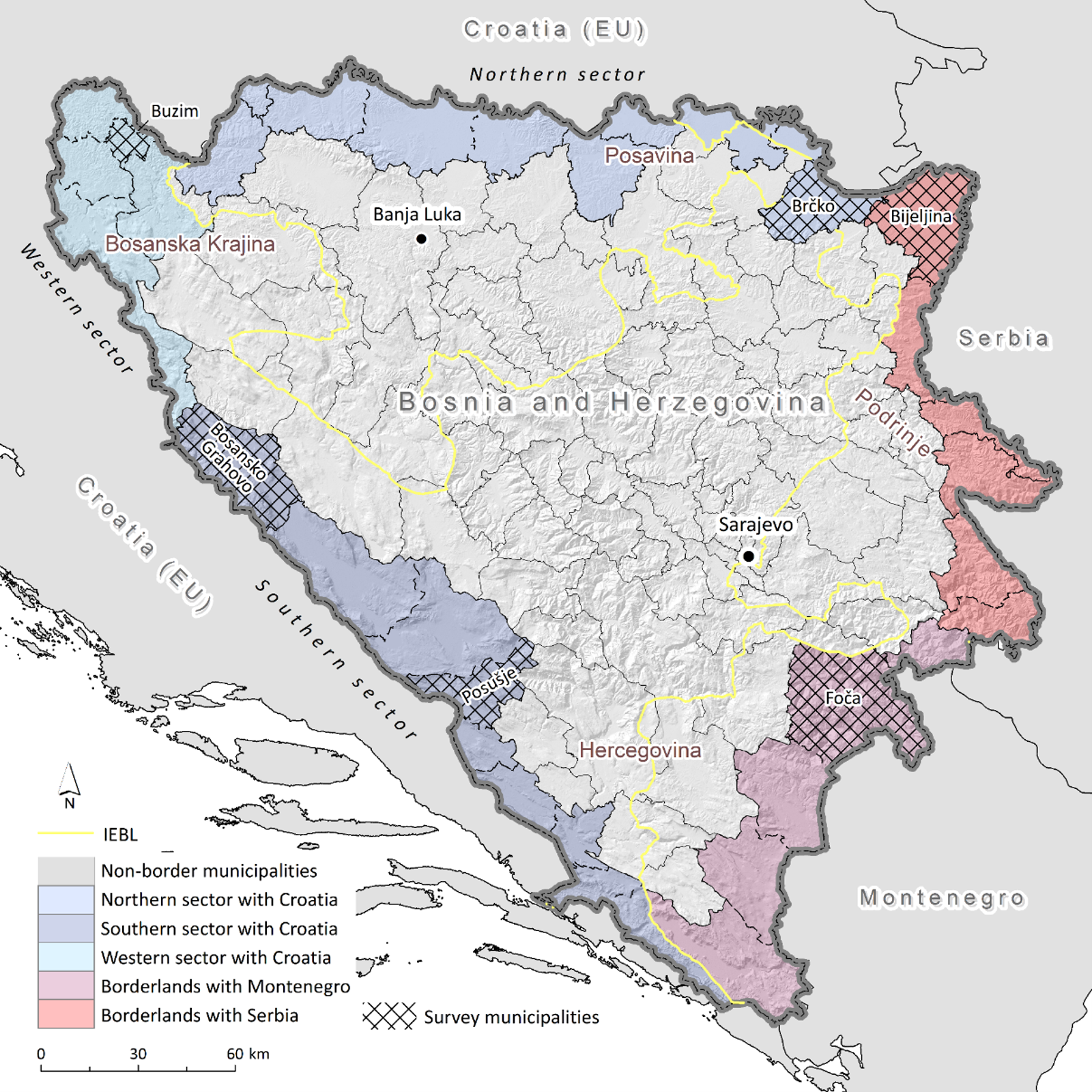
This paper examines the internal heterogeneity of Bosnia and Herzegovina’s borderlands by relating demographic and socio-economic differences across border sectors to residents’ perceptions of the state border. The study combines municipality-level official statistics with a case-based survey in six border municipalities. Eight composite indices were used to assess structural variation, followed by non-parametric comparisons. The results show that the borderlands do not form a uniform belt of disadvantage. After correction for multiple testing, sectoral differences remain significant for vitality, educational attainment and economic vitality, while the EU-facing/non-EU-facing distinction explains only part of the observed variation. Survey findings show that perceptions of development and border opportunity do not correspond directly with structural position. More frequent cross-border mobility is associated with more positive perceptions of the border’s economic role and stronger perceived cultural proximity, while identity patterns remain strongly place-specific.
Highlights:
- Bosnia and Herzegovina’s borderlands do not form a uniform peripheral belt.
- Structural borderland conditions do not consistently correspond with residents’ perceptions and everyday experiences of the border.
- Frequent cross-border mobility is associated with stronger perceptions of border opportunity.
Downloads




References
- Agency for Statistics of Bosnia and Herzegovina. (2016). Census of population, households and dwellings in Bosnia and Herzegovina, 2013: Final results. https://www.popis.gov.ba/popis2013/doc/RezultatiPopisa_BS.pdf
- Agency for Statistics of Bosnia and Herzegovina, Branch Office Brčko District. (2023a). Demografija u Brčko distriktu BiH, 2018–2022 [Demography in the Brčko District of Bosnia and Herzegovina, 2018–2022] (Year XXII, No. 5). https://bhas.gov.ba/data/Publikacije/Bilteni/2023/BRC_07_2022_Y4_1_BS.pdf
- Agency for Statistics of Bosnia and Herzegovina, Branch Office Brčko District. (2023b). Statistika obrazovanja od kraja 2018/2019. do početka 2022/2023. školske godine [Education statistics from the end of the 2018/2019 to the beginning of the 2022/2023 school year] (Year XXI, No. 13). https://bhas.gov.ba/data/Publikacije/Bilteni/2023/BRC_05_2022_TB_2_BS.pdf
- Agency for Statistics of Bosnia and Herzegovina, Branch Office Brčko District. (2023c). Statistički podaci Brčko distrikta BiH [Statistical data of the Brčko District of Bosnia and Herzegovina] (Year XXII, No. 1). https://bhas.gov.ba/data/Publikacije/Bilteni/2023/BRC_00_2023_B1_1_BS.pdf
- Anđelković-Stoilković, M. (2019). Representation of the demographic problems of Serbian border region in public policy. Demografija, 16, 103–118. https://doi.org/10.5937/demografija1916103A
- Anđelković-Stoilković, M., Devedžić, M., & Vojković, G. (2018). The border regions of Serbia: Peripheral or marginal areas. TRAMES, 22(2), 211–227. https://doi.org/10.3176/tr.2018.2.07
- Anderson, J., & O’Dowd, L. (1999). Borders, border regions and territoriality: Contradictory meanings, changing significance. Regional Studies, 33(7), 593–604. https://doi.org/10.1080/00343409950078648
- Avdić Marić, A., Avdić, B., & Zupanc, I. (2026). The vicious circle of spatial marginalization: Bosansko Grahovo in Bosnia and Herzegovina. Revue Roumaine de Géographie / Romanian Journal of Geography, 70(1), 21–40. https://doi.org/10.59277/RRG.2026.1.02
- Avdić, A. (2025). Geografski aspekt proučavanja pograničja – primjer Bosne i Hercegovine [Geographical aspects of borderland research – the case of Bosnia and Herzegovina] [Doctoral dissertation, University of Zagreb, Faculty of Science]. Repository of the Faculty of Science, University of Zagreb. https://urn.nsk.hr/urn:nbn:hr:217:029486
- Avdić, A., & Avdić, B. (2023). Center and periphery in Bosnia and Herzegovina – Social and spatial indicators of regional disparities. Folia Geographica, 65(2), 103–126.
- Avdić, A., Avdić, B., & Zupanc, I. (2022). Socio-demographic analysis of border regions of Bosnia and Herzegovina. Acta geographica Slovenica, 62(3), 7–19. https://doi.org/10.3986/AGS.10859
- Avdić, B., Mirić, R., Gekić, H., & Bidžan Gekić, A. (2022). Municipalities and cities along the entity boundary in Bosnia and Herzegovina: Problems of local and regional development. In S. Gorin & I. Radevski (Eds.), Proceedings of the 8th International Scientific Conference GEOBALCANICA 2022 (pp. 229–239). Geobalcanica Society. https://doi.org/10.18509/GBP22229A
- Berceanu, I.-C., Popa, N., & Crețan, R. (2023). Towards a regional crossover model? The roles played by spatial vicinity and cultural proximity among ethnic minorities in an East-Central European borderland. Journal of Urban and Regional Analysis, 15(2), 159–190. https://doi.org/10.37043/JURA.2023.15.2.1
- Böhm, H., Boháč, A., Novotný, L., Drápela, E., & Opioła, W. (2024). Resilience of cross-border cooperation in the Neisse-Nisa-Nysa Euroregion after the pandemic: Bouncing in-between. Journal of Borderlands Studies, 39(6), 1083–1099. https://doi.org/10.1080/08865655.2023.2276471
- Botić, J., & Grebenar, D. (2021). Contemporary trends in the territorialisation of regional identities in Bosnia and Herzegovina on the example of Croats in Herzegovina. Dela, 55, 107–124. https://doi.org/10.4312/dela.55.107-124
- Brambilla, C. (2015). Exploring the critical potential of the borderscapes concept. Geopolitics, 20(1), 14–34. https://doi.org/10.1080/14650045.2014.884561
- Brambilla, C., & Jones, R. (2020). Rethinking borders, violence, and conflict: From sovereign power to borderscapes as sites of struggles. Environment and Planning D: Society and Space, 38(2), 287–305. https://doi.org/10.1177/0263775819856352
- Crețan, R., Covaci, R. N., & Jucu, I. S. (2023). Articulating ‘otherness’ within multiethnic rural neighbourhoods: Encounters between Roma and non-Roma in an East-Central European borderland. Identities, 30(1), 93–111. https://doi.org/10.1080/1070289X.2021.1920774
- Durand, F. (2015). Theoretical framework of the cross-border space production – The case of the Eurometropolis Lille-Kortrijk-Tournai. Journal of Borderlands Studies, 30(3), 309–328. https://doi.org/10.1080/08865655.2015.1066701
- Federal Institute for Development Programming. (2023). Socioekonomski pokazatelji po općinama FBiH 2022 [Socioeconomic indicators by municipalities of the Federation of Bosnia and Herzegovina 2022]. https://fzzpr.gov.ba/files/Socioekonomski%20pokazatelji%20po%20op%C4%87inama/Socioekonomski%20pokazatelji%202022_web.pdf
- Federal Office of Statistics. (2023a). Kanton 10 u brojkama 2023 [Canton 10 in figures 2023]. https://fzs.ba/wp-content/uploads/2023/07/Kanton-10-u-brojkama.pdf
- Federal Office of Statistics. (2023b). Unsko-sanski kanton u brojkama 2023 [Una-Sana Canton in figures 2023]. https://fzs.ba/wp-content/uploads/2023/07/Unsko-sanski-kanton-u-brojkama.pdf
- Federal Office of Statistics. (2023c). Zapadnohercegovački kanton u brojkama 2023 [West Herzegovina Canton in figures 2023]. https://fzs.ba/wp-content/uploads/2023/07/Zapadnohercegova%C4%8Dki-kanton-po-kantonima.pdf
- Fuerst-Bjeliš, B., & Vukosav, B. (2019). Landscapes of identities in shared spaces of the borderlands. Europa Regional, 26(2), 5–13. https://nbn-resolving.org/urn:nbn:de:0168-ssoar-66829-3
- Jansen, S. (2023). How Bosnia and Herzegovina was bordered: The supervised making of a border/mobility assemblage in the European semiperiphery. Comparative Southeast European Studies, 71(2), 190–209. https://doi.org/10.1515/soeu-2022-0067
- Klemenčić, M. (2000). The boundaries, internal order and identities of Bosnia and Herzegovina. Boundary and Security Bulletin, 8(4), 63–71.
- Kolossov, V., & Scott, J. (2013). Selected conceptual issues in border studies. Belgeo, (1). https://doi.org/10.4000/belgeo.10532
- Leimgruber, W. (2004). Between global and local: Marginality and marginal regions in the context of globalization and deregulation. Ashgate.
- Leutloff-Grandits, C. (2023). “We are not just the border of Croatia; this is the border of the European Union …” The Croatian borderland as “double periphery.” Journal of Borderlands Studies, 38(2), 265–282. https://doi.org/10.1080/08865655.2022.2104340
- Ljubović, E. (2018). Historijski i kulturološki identitet Cazina i Cazinske krajine do 1918. – historija i kultura Cazina i Cazinske krajine i neka prezimena [Historical and cultural identity of Cazin and the Cazin region until 1918 – History and culture of Cazin and the Cazin region and selected surnames]. JU Kulturni centar Cazin.
- Máliková, L., Farrell, M., & McDonagh, J. (2016). Perception of marginality and peripherality in an Irish rural context. Quaestiones Geographicae, 35(4), 93–105. https://doi.org/10.1515/quageo-2016-0037
- Marić, I., & Avdić, A. (2023). Derivation of geographical marginalization index of Bosnia and Herzegovina using GIS multicriteria decision analysis. Geographica Pannonica, 27(4), 239–253. https://doi.org/10.5937/gp27-46223
- Newman, D. (2006). The lines that continue to separate us: Borders in our ‘borderless’ world. Progress in Human Geography, 30(2), 143–161. https://doi.org/10.1191/0309132506ph599xx
- Općina Posušje. (2021). Strategija razvoja općine Posušje za razdoblje 2021–2027. godine [Development strategy of the Municipality of Posušje for the period 2021–2027]. https://www.opcina-posusje.ba/wp-content/uploads/2021/07/Strategija-razvoja-opcine-Posusje-21-27.pdf
- Oppido, S., Ragozino, S., & Esposito De Vita, G. (2023). Peripheral, marginal, or non-core areas? Setting the context to deal with territorial inequalities through a systematic literature review. Sustainability, 15(13), Article 10401. https://doi.org/10.3390/su151310401
- Paasi, A. (1996). Territories, boundaries and consciousness: The changing geographies of the Finnish-Russian border. John Wiley & Sons.
- Paasi, A. (2011). A border theory: An unattainable dream or a realistic aim for border scholars? In D. Wastl-Walter (Ed.), The Ashgate research companion to border studies (pp. 11–31). Ashgate.
- Perkmann, M. (2003). Cross-border regions in Europe: Significance and drivers of regional cross-border co-operation. European Urban and Regional Studies, 10(2), 153–171. https://doi.org/10.1177/0969776403010002004
- Prokkola, E.-K. (2008). Resources and barriers in tourism development: Cross-border cooperation, regionalization and destination building at the Finnish-Swedish border. Fennia – International Journal of Geography, 186(1), 31–46. https://fennia.journal.fi/article/view/3710
- Republika Srpska Institute of Statistics. (2023). Cities and municipalities of Republika Srpska, 2023. https://www.rzs.rs.ba/static/uploads/bilteni/gradovi_i_opstine_republike_srpske/2023/Gradovi_I_Opstine_Republike_Srpske_2023_WEB.pdf
- Riding, J. (2015). Landscape, memory, and the shifting regional geographies of Northwest Bosnia-Herzegovina. GeoHumanities, 1(2), 378–397. https://doi.org/10.1080/2373566X.2015.1093917
- Schönwald, A., Spellerberg, A., & Weber, F. (2022). Borders – identities – home: Theory-based approaches to constructs and concepts in a cross-border context. In K. Pallagst, A. Hartz, & B. Caesar (Eds.), Border futures – Zukunft Grenze – Avenir frontière: The future viability of cross-border cooperation (pp. 141–153). ARL – Academy for Territorial Development in the Leibniz Association. https://nbn-resolving.org/urn:nbn:de:0156-40970927
- Scott, J. W. (Ed.). (2020). A research agenda for border studies. Edward Elgar Publishing. https://doi.org/10.4337/9781788972741
- Sohn, C. (2014). Modelling cross-border integration: The role of borders as a resource. Geopolitics, 19(3), 587–608. https://doi.org/10.1080/14650045.2014.913029
- Sporazum između Bosne i Hercegovine i Republike Hrvatske o pograničnom prometu [Agreement between Bosnia and Herzegovina and the Republic of Croatia on Border Traffic]. (2013). Službeni glasnik Bosne i Hercegovine – Međunarodni ugovori [Official Gazette of Bosnia and Herzegovina – International Treaties], 2/2014.
- Ünay, H., & Alagöz, R. (2026). Introduction: Borders as regime, bordering as experience in Turkey’s borders and borderlands. Journal of Borderlands Studies, 41(1), 1–14. https://doi.org/10.1080/08865655.2026.2617230
- van Houtum, H. (2000). III European perspectives on borderlands: An overview of European geographical research on borders and border regions. Journal of Borderlands Studies, 15(1), 56–83. https://doi.org/10.1080/08865655.2000.9695542
- van Houtum, H. (2011). The mask of the border. In D. Wastl-Walter (Ed.), The Ashgate research companion to border studies (pp. 49 – 61). Ashgate.
- van Houtum, H., & Eker, M. (2016). Redesigning borderlands: Using the Janus-face of borders as a resource. In C. Brambilla, J. Laine, J. W. Scott, & G. Bocchi (Eds.), Borderscaping: Imaginations and practices of border making (pp. 41–521). Routledge. https://doi.org/10.4324/9781315569765
- van Houtum, H., & van der Velde, M. (2004). The power of cross-border labour market immobility. Tijdschrift voor Economische en Sociale Geografie, 95(1), 100–107. https://doi.org/10.1111/j.0040-747X.2004.00296.x
- van Houtum, H., & van Naerssen, T. (2002). Bordering, ordering and othering. Tijdschrift voor Economische en Sociale Geografie, 93(2), 125–136. https://doi.org/10.1111/1467-9663.00189
- Venken, M., Wassenberg, B., & Brunet-Jailly, E. (2026). Border temporalities: Reflections on (post) modernity and age. Journal of Borderlands Studies. Advance online publication. https://doi.org/10.1080/08865655.2026.2637490
- Vlada Unsko-sanskog kantona. (2021). Strategija razvoja Unsko-sanskog kantona za period 2021–2027 [Development strategy of the Una-Sana Canton for the period 2021–2027]. https://strategija.vladausk.ba/files/Strategije%20razvoja/Strategija%20USK.pdf
- Walther, O. J., Amilhat Szary, A.-L., Brambilla, C., Brunet-Jailly, E., Klatt, M., Laine, J. P., Moyo, I., Nugent, P., Ptak, T., & Radil, S. M. (2023). Border studies at 45. Political Geography, 104, Article 102909. https://doi.org/10.1016/j.polgeo.2023.102909
- Wastl-Walter, D. (Ed.). (2011). The Ashgate research companion to border studies. Ashgate.
- Więckowski, M. (2025). The contemporary Polish borders in a state of change. GeoJournal, 90, Article 1. https://doi.org/10.1007/s10708-024-11248-7
- Wille, C. (2022). Borderscapes. In A. M. Fellner & E. Nossem (Eds.), UniGR-CBS online glossary border studies. Saarland University. https://doi.org/10.22028/D291-37379
- Wille, C. (2024). Border complexities: Outlines and perspectives of a complexity shift in border studies. In C. Wille, C. Leutloff-Grandits, F. Bretschneider, S. Grimm-Hamen, & H. Wagner (Eds.), Border complexities and logics of dis/order (pp. 31–56). Nomos. https://doi.org/10.5771/9783748922292-31
- Wille, C. (2025). Border(ing)s: A border-studies perspective: Bringing migration studies and border studies into a fruitful dialogue. Current Issues in Migration Research, 2(1), 18–24. https://doi.org/10.24834/cimr.2025.1.1909
- Wilson, T. M., & Donnan, H. (Eds.). (2012). A companion to border studies. Wiley-Blackwell. https://doi.org/10.1002/9781118255223
- Yuval-Davis, N., Wemyss, G., & Cassidy, K. (2019). Bordering. Polity Press.
- Zakon o graničnoj kontroli [Law on Border Control]. (2025). Službeni glasnik Bosne i Hercegovine [Official Gazette of Bosnia and Herzegovina], 7/2025.
- Žerić, S., & Brunnbauer, U. (2024). “The gastarbeiters built everything for us.” Migrations, memories, and emptiness in the Dalmatian hinterland. Contemporary Southeastern Europe, 11(1), 12–37. https://doi.org/10.25364/02.11:2024.1.2