
The National Interest in the Formation of Geographic Mental Maps: A Conceptual Framework Illustrated by Mahan and Spykman
Published 2026-11-28
Keywords
- national interest,
- geographic perception,
- geopolitical codes,
- geopolitical vision,
- geographic mental maps
- cognitive geography ...More
How to Cite
Copyright (c) 2026 Esteban Vidal Pérez

This work is licensed under a Creative Commons Attribution 4.0 International License.
Accepted 2026-11-26
Published 2026-11-28
Abstract
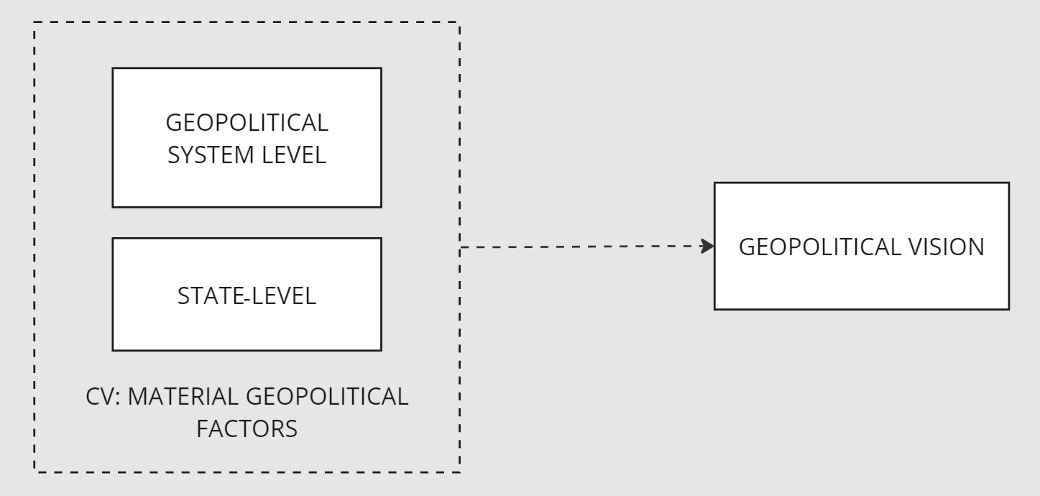
Contributions to the study of geographic mental maps include various definitions of the concept, but most of them do not analyze the role and impact of the national interest in shaping these maps, despite the importance of this notion in leaders' reasoning during the foreign policy-making process. Instead, factors such as past experience, ideas, political context, and culture are considered in these works. This article aims to analyze the role of the national interest in the formation of geographic mental maps. To this end, it seeks to develop an analytical framework that conceptualizes the interactions between the national interest and other variables involved in the formation of geographic mental maps and their impact on foreign policy. As a conceptual contribution, the article identifies and defines the main variables involved in this process and specifies their interrelationships. The geographic mental maps of Alfred T. Mahan and Nicholas J. Spykman are used to illustrate the application of the proposed framework rather than to test its explanatory validity. The national interest guides geographic perception and geopolitical codes toward places and threats relevant to state security. Geographic mental maps represent the resulting geopolitical vision through which leaders interpret international events and assess foreign-policy options. The framework clarifies how geographic mental maps are formed and shows, for political geography, that material constraints shape but do not determine strategic choices.
Highlights:
- National interest shapes which geopolitical possibilities become strategically salient.
- National interest guides selection of security-relevant geographic information.
- Geographic mental maps apply geopolitical vision to foreign policy-making.
Downloads




References
- Agnew, J. (1998). Geopolitics: Re-visioning World Politics. Routledge.
- Agnew, J., & Corbridge, S. (1995). Mastering Space: Hegemony, Territory and International Political Economy. Routledge.
- Aran, A., & Yishayahu, G. (2022). Updating the Study of Foreign Policy Crisis: The Case of the Mavi Marmara Flotilla. For-eign Policy Analysis, 18(3), Article orac007. https://doi.org/10.1093/fpa/orac007
- Axelrod, R. (Ed.). (1976). Structure of Decision: The Cognitive Maps of Political Elites. Princeton University Press.
- Barnett, M., & Duvall, R. (2005). Power in International Politics. International Organization, 59(1), 39–75. https://doi.org/10.1017/S0020818305050010
- Barr, P. S., Stimpert, J. L., & Huff, A. S. (1992). Cognitive Change, Strategic Action, and Organizational Renewal. Strate-gic Management Journal, 13(S1), 15–36. https://doi.org/10.1002/smj.4250131004
- Bialasiewicz, L., Campbell, D., Elden, S., Graham, S., Jeffrey, A., & Williams, A. J. (2007). Performing Security: The Imagi-native Geographies of Current US Strategy. Political Geography, 26(4), 405–422. https://doi.org/10.1016/j.polgeo.2006.12.002
- Bonham, G. M., & Shapiro, M. J. (1976). Exploration of the Unexpected: The Syrian Intervention in Jordan in 1970. In R. Axelrod (Ed.), Structure of Decision: The Cognitive Maps of Political Elites (pp. 113–141). Princeton University Press.
- Bonham, G. M., Shapiro, M. J., & Trumble, T. L. (1979). The October War: Changes in Cognitive Orientation Toward the Middle East Conflict. International Studies Quarterly, 23(1), 3–44. https://doi.org/10.2307/2600273
- Brands, H. (2014). What Good is Grand Strategy? Power and Purpose in American Statecraft from Harry S. Truman to George W. Bush. Cornell University Press.
- Brecher, M., Steinberg, B., & Stein, J. (1969). A Framework for Research on Foreign Policy Behavior. Journal of Conflict Resolution, 13(1), 75–101. https://doi.org/10.1177/002200276901300105
- Breuning, M. (2007). Foreign Policy Analysis: A Comparative Introduction. Palgrave Macmillan.
- Burchill, S. (2005). The National Interest in International Relations Theory. Palgrave Macmillan.
- Casey, S., & Wright, J. (Eds.). (2008). Mental Maps in the Era of Two World Wars. Palgrave Macmillan.
- Casey, S., & Wright, J. (Eds.). (2011). Mental Maps in the Early Cold War Era, 1945–1968. Palgrave Macmillan.
- Casey, S., & Wright, J. (Eds.). (2015). Mental Maps in the Era of Détente and the End of the Cold War 1968–91. Pal-grave Macmillan.
- Cashman, G. (2014). What Causes War? An Introduction to Theories of International Conflict (2nd ed.). Rowman & Littlefield.
- Christensen, T. J. (1997). Perceptions and Alliances in Europe, 1865–1940. International Organization, 51(1), 65–97. https://doi.org/10.1162/002081897550302
- Creswell, J. W. (2014). Research Design: Qualitative, Quantitative, and Mixed Methods Approaches (4th ed.). Sage.
- Criekemans, D. (2022). Where Geopolitics and Foreign Policy Analysis Once Met: The Work of Harold and Margaret Sprout and its Continued Relevance Today. In D. Criekemans (Ed.), Geopolitics and International Relations: Grounding World Politics Anew (pp. 156–193). Brill.
- da Vinha, L. (2010). Acquiring Geographic Knowledge in International Politics. Universitas: Relações Internacionais, 8(2), 53–94. https://doi.org/10.5102/uri.v8i2.1293
- da Vinha, L. (2011). Assessing the Conceptual “Goodness” of Geographic Mental Maps for Foreign Policy Analysis. Re-vista Română de Geografie Politică, 13(2), 133–148.
- da Vinha, L. (2012). Charting Geographic Mental Maps in Foreign Policy Analysis: A Literature Review. Human Geogra-phies, 6(1), 5–17. https://doi.org/10.5719/hgeo.2012.61.5
- da Vinha, L. (2017). Geographic Mental Maps and Foreign Policy Change: Re-Mapping the Carter Doctrine. De Gruy-ter Oldenbourg.
- da Vinha, L. (2019). Maps of War and Peace: Rethinking Geography in International Affairs. Brown Journal of World Affairs, 25(2), 73–89.
- Dalby, S. (1991). Critical Geopolitics: Discourse, Difference and Dissent. Environment and Planning D: Society and Space, 9(3), 261–283. https://doi.org/10.1068/d090261
- Davis, J. W., & McDermott, R. (2021). The Past, Present, and Future of Behavioral IR. International Organization, 75(1), 147–177. https://doi.org/10.1017/S0020818320000272
- Dijkink, G. (1996). National Identity and Geopolitical Visions: Maps of Pride and Pain. Routledge.
- Dijkink, G. (1998). Geopolitical Codes and Popular Representations. GeoJournal, 46, 293–299. https://doi.org/10.1023/A:1006999221884
- Dodds, K. (1994). Geopolitics and Foreign Policy: Recent Developments in Anglo-American Political Geography and International Relations. Progress in Human Geography, 18(2), 186–208. https://doi.org/10.1177/030913259401800204
- Dodds, K. (2005). Global Geopolitics: A Critical Introduction. Pearson.
- Downs, R. M., & Stea, D. (2011). Cognitive Maps and Spatial Behaviour: Process and Products. In M. Dodge, R. Kitchin, & C. Perkins (Eds.), The Map Reader: Theories of Mapping Practice and Cartographic Representation (pp. 312–317). John Wiley and Sons. (Original work published 1973)
- Ekirch, A. A., Jr. (1966). Ideas, Ideals, and American Diplomacy: A History of Their Growth and Interaction. Appleton-Century-Crofts.
- Erforth, B. (2016). Mental Maps and Foreign Policy Decision-Making: Eurafrique and the French Military Intervention in Mali. European Review of International Studies, 3(2), 38–57.
- Finnemore, M. (1996). National Interests in International Society. Cornell University Press.
- Flint, C. (2022). Introduction to Geopolitics (4th ed.). Routledge.
- Flint, C., & Taylor, P. J. (2018). Political Geography: World-Economy, Nation-state and Locality (7th ed.). Routledge.
- Friedberg, A. L. (1988). The Weary Titan: Britain and the Experience of Relative Decline, 1895–1905. Princeton Univer-sity Press.
- George, A. L. (1969). The “Operational Code”: A Neglected Approach to the Study of Political Leaders and Decision-Making. International Studies Quarterly, 13(2), 190–222. https://doi.org/10.2307/3013944
- George, A. L. (1980). Presidential Decisionmaking in Foreign Policy: The Effective Use of Information and Advice. Westview Press.
- Goldhamer, H. (1934). The Psychological Analysis of War. The Sociological Review, 26(3), 249–267. https://doi.org/10.1111/j.1467-954X.1934.tb01911.x
- Golledge, R. G., & Stimson, R. J. (1997). Spatial Behavior: A Geographic Perspective. The Guilford Press.
- Gomez, M. A., & Whyte, C. (2022). Unpacking strategic behavior in cyberspace: a schema-driven approach. Journal of Cybersecurity, 8(1), Article tyac005. https://doi.org/10.1093/cybsec/tyac005
- Götz, E. (2021). Neoclassical Realist Theories, Intervening Variables, and Paradigmatic Boundaries. Foreign Policy Analy-sis, 17(2), Article oraa026. https://doi.org/10.1093/fpa/oraa026
- Götz, E., & Staun, J. (2022). Why Russia attacked Ukraine: Strategic culture and radicalized narratives. Contemporary Security Policy, 43(3), 482–497. https://doi.org/10.1080/13523260.2022.2082633
- Hafner-Burton, E. M., Hughes, D. A., & Victor, D. G. (2013). The Cognitive Revolution and the Political Psychology of Elite Decision Making. Perspectives on Politics, 11(2), 368–386. https://doi.org/10.1017/S1537592713001084
- Haverluk, T. W., Beauchemin, K. M., & Mueller, B. A. (2014). The three critical flaws of critical geopolitics: Towards a neo-classical geopolitics. Geopolitics, 19(1), 19–39. https://doi.org/10.1080/14650045.2013.803192
- He, K. (2017). Explaining United States-China Relations: Neoclassical Realism and the Nexus of Threat-interest Percep-tions. The Pacific Review, 30(2), 133–151. https://doi.org/10.1080/09512748.2016.1201130
- Henrikson, A. K. (1980). The Geographical “Mental Maps” of American Foreign Policy Makers. International Political Science Review, 1(4), 495–530. https://doi.org/10.1177/019251218000100405
- Henrikson, A. K. (2002). Distance and Foreign Policy: A Political Geography Approach. International Political Science Review, 23(4), 437–466. https://doi.org/10.1177/0192512102023004007
- Henrikson, A. K. (2008). FDR and the “World-Wide Arena”. In D. B. Woolner, W. F. Kimball, & D. Reynolds (Eds.), FDR’s World: War, Peace, and Legacies (pp. 35–61). Palgrave Macmillan.
- Herrmann, R. K. (1985). Analyzing Soviet Images of the United States: A Psychological Theory and Empirical Study. Journal of Conflict Resolution, 29(4), 665–697. https://doi.org/10.1177/0022002785029004008
- Herrmann, R. K. (2017). How Attachments to the Nation Shape Beliefs About the World: A Theory of Motivated Rea-soning. International Organization, 71(S1), S61–S84. https://doi.org/10.1017/S0020818316000382
- Herrmann, R. K., Tetlock, P. E., & Visser, P. S. (1999). Mass public decisions to go to war: A cognitive-interactionist framework. American Political Science Review, 93(3), 553–573. https://doi.org/10.2307/2585574
- Holmila, A. (2020). Re-thinking Nicholas J. Spykman: From historical sociology to balance of power. The International History Review, 42(5), 951–966. https://doi.org/10.1080/07075332.2019.1655469
- Holsti, O. R. (1962). The Belief System and National Images: A Case Study. Journal of Conflict Resolution, 6(3), 244–252. https://doi.org/10.1177/002200276200600306
- Holsti, O. R. (1968). Cognitive Dynamics and Images of the Enemy: Dulles and Russia. In J. C. Farrell & A. P. Smith (Eds.), Image and Reality in World Politics (pp. 16–39). Columbia University Press.
- Holsti, O. R. (1976). Foreign Policy Formation Viewed Cognitively. In R. Axelrod (Ed.), Structure of Decision: The Cogni-tive Maps of Political Elites (pp. 18–54). Princeton University Press.
- Holsti, O. R. (2006). Cognitive Process Approaches to Decision-Making: Foreign Policy Actors Viewed Psychologically. In Making American Foreign Policy (pp. 33–51). Routledge. (Original work published 1976)
- Hudson, V. M., & Vore, C. S. (1995). Foreign Policy Analysis Yesterday, Today, and Tomorrow. Mershon International Studies Review, 39(2), 209–238. https://doi.org/10.2307/222751
- Jervis, R. (1970). The Logic of Images in International Relations. Princeton University Press.
- Jervis, R. (1976). Perception and Misperception in International Politics. Princeton University Press.
- Jost, T., Kertzer, J. D., Min, E., & Schub, R. (2024). Advisers and Aggregation in Foreign Policy Decision Making. Interna-tional Organization, 78(1), 1–37. https://doi.org/10.1017/S0020818323000280
- Kelly, P. (2006). A critique of critical geopolitics. Geopolitics, 11(1), 24–53. https://doi.org/10.1080/14650040500524053
- Kelman, H. C. (1965). Social-Psychological Approaches to the Study of International Relations: Definition of Scope. In H. C. Kelman (Ed.), International Behavior: A Social-Psychological Analysis (pp. 3–39). Holt, Rinehart and Winston.
- Kennan, G. F. (1947). The Sources of Soviet Conduct. Foreign Affairs, 25(4), 566–582. https://doi.org/10.2307/20030065
- Kertzer, J. D., Holmes, M., LeVeck, B. L., & Wayne, C. (2022). Hawkish Biases and Group Decision Making. International Organization, 76(3), 513–548. https://doi.org/10.1017/S0020818322000017
- Kertzer, J. D., Rathbun, B. C., & Rathbun, N. S. (2020). The Price of Peace: Motivated Reasoning and Costly Signaling in International Relations. International Organization, 74(1), 95–118. https://doi.org/10.1017/S0020818319000328
- Kertzer, J. D., & Tingley, D. (2018). Political Psychology in International Relations: Beyond the Paradigms. Annual Review of Political Science, 21, 319–339. https://doi.org/10.1146/annurev-polisci-041916-020042
- Kitchen, N. (2012). Ideas of power and the power of ideas: Systematising Neoclassical Realist Theory. In A. Toje & B. Kunz (Eds.), Neoclassical realism in European politics: Bringing power back in (pp. 79–95). Manchester Universi-ty Press.
- Kofroň, J. (2012). Geopolitics at the border of geography and international relations: Between intersubjective and ob-jective space. Czech Journal of International Relations, 47(2), 57–78. https://doi.org/10.32422/cjir.360
- Kurfürst, J., Solik, M., Baar, V., Baarová, B., & Graf, J. (2024). Critical geopolitics in the era of identitarian populism. Geo-Journal, 89, Article 14. https://doi.org/10.1007/s10708-024-11009-6
- Landau-Wells, M. (2024). Building from the Brain: Advancing the Study of Threat Perception in International Relations. International Organization, 78(4), 627–667. https://doi.org/10.1017/S0020818324000328
- Latham, A. A. (2001). China in the Contemporary American Geopolitical Imagination. Asian Affairs: An American Re-view, 28(3), 138–145. https://doi.org/10.1080/00927670109601492
- Lee, S. (2024). Domestic Distributional Roots of National Interest. American Political Science Review, 118(4), 1824–1839. https://doi.org/10.1017/S0003055423001284
- Leffler, M. P. (1984). The American Conception of National Security and the Beginnings of the Cold War, 1945–48. American Historical Review, 89(2), 346–381. https://doi.org/10.2307/1862556
- Leffler, M. P. (1992). A Preponderance of Power: National Security, the Truman Administration, and the Cold War. Stanford University Press.
- Lewis, M. W., & Wigen, K. (1997). The Myth of Continents: A Critique of Metageography. University of California Press.
- Lobell, S. E., Ripsman, N. M., & Taliaferro, J. W. (Eds.). (2009). Neoclassical Realism, the State, and Foreign Policy. Cam-bridge University Press.
- Lowenthal, D. (1961). Geography, Experience, and Imagination: Toward a Geographical Epistemology. Annals of the Association of American Geographers, 51(3), 241–260. https://doi.org/10.1111/j.1467-8306.1961.tb00377.x
- Mahan, A. T. (1897). The Interest of America in Sea Power, Present and Future. Little, Brown, and Company.
- McComb, S. A. (2007). Mental Model Convergence: The Shift from Being an Individual to Being a Team Member. In F. Dansereau & F. J. Yammarino (Eds.), Multi-Level Issues in Organizations and Time (Vol. 6, pp. 95–147). Elsevier.
- Mead, W. R. (2002). Special Providence: American Foreign Policy and How It Changed the World. Routledge. (Original work published 2001)
- Meibauer, G. (2020). Interests, Ideas, and the Study of State Behaviour in Neoclassical Realism. Review of International Studies, 46(1), 20–36. https://doi.org/10.1017/S0260210519000214
- Mohammed, S., Ferzandi, L., & Hamilton, K. (2010). Metaphor No More: A 15-Year Review of the Team Mental Model Construct. Journal of Management, 36(4), 876–910. https://doi.org/10.1177/0149206309356804
- Mokry, S. (2024). Grand Strategy and the Construction of the National Interest: The Underpinnings of Sino-US Strategic Competition. International Politics, 61(4), 742–760. https://doi.org/10.1057/s41311-023-00452-w
- Morgado, N. (2023). Modelling Neoclassical Geopolitics: An Alternative Theoretical Tradition for Geopolitical Culture and Literacy. European Journal of Geography, 14(4), 13–21. https://doi.org/10.48088/ejg.n.mor.14.4.013.021
- Morgenthau, H. J. (1946). Scientific Man vs. Power Politics. The University of Chicago Press.
- Morgenthau, H. J. (1951). In Defense of the National Interest: A Critical Examination of American Foreign Policy. Knopf.
- Morgenthau, H. J. (1952). Another “Great Debate”: The National Interest of the United States. American Political Sci-ence Review, 46(4), 961–988. https://doi.org/10.2307/1952108
- Morgenthau, H. J. (1985). Politics Among Nations: The Struggle for Power and Peace (K. W. Thompson, Rev.; 6th ed.). Knopf.
- Morin, J.-F., & Paquin, J. (2018). Foreign Policy Analysis: A Toolbox. Palgrave Macmillan.
- Nuechterlein, D. E. (1978). National Interests and Presidential Leadership: The Setting of Priorities. Westview Press.
- O'Loughlin, J., & Grant, R. (1990). The Political Geography of Presidential Speeches, 1946–87. Annals of the Association of American Geographers, 80(4), 504–530. https://doi.org/10.1111/j.1467-8306.1990.tb00315.x
- Ó Tuathail, G. (1996). Critical Geopolitics: The Politics of Writing Global Space. Routledge.
- Ó Tuathail, G. (2002). Theorizing Practical Geopolitical Reasoning: The Case of the United States’ Response to the War in Bosnia. Political Geography, 21(5), 601–628. https://doi.org/10.1016/S0962-6298(02)00009-4
- Ortmann, S. (2023). Russian spatial imaginaries and the invasion of Ukraine: Geopolitics and nationalist fantasies [View-point]. Political Geography, 101, Article 102784. https://doi.org/10.1016/j.polgeo.2022.102784
- Pomeroy, C. (2025). The Damocles Delusion: The Sense of Power Inflates Threat Perception in World Politics. Interna-tional Organization, 79(1), 1–35. https://doi.org/10.1017/S0020818324000407
- Ripley, B. (1993). Psychology, Foreign Policy, and International Relations Theory. Political Psychology, 14(3), 403–416. https://doi.org/10.2307/3791705
- Ripsman, N. M. (2009). Neoclassical Realism and Domestic Interest Groups. In S. E. Lobell, N. M. Ripsman, & J. W. Taliaferro (Eds.), Neoclassical Realism, the State, and Foreign Policy (pp. 170–193). Cambridge University Press.
- Ripsman, N. M., Taliaferro, J. W., & Lobell, S. E. (2016). Neoclassical Realist Theory of International Politics. Oxford Uni-versity Press.
- Rofe, J. S. (2008). “Under the influence of Mahan”: Theodore and Franklin Roosevelt and their understanding of Ameri-can national interest. Diplomacy & Statecraft, 19(4), 732–745. https://doi.org/10.1080/09592290802564536
- Rosati, J. A. (1995). A Cognitive Approach to the Study of Foreign Policy. In L. Neack, J. A. K. Hey, & P. J. Haney (Eds.), Foreign Policy Analysis: Continuity and Change in Its Second Generation (pp. 49–70). Prentice Hall.
- Rose, G. (1998). Neoclassical Realism and Theories of Foreign Policy. World Politics, 51(1), 144–172. https://doi.org/10.1017/S0043887100007814
- Rudolf, P. (2021). U.S. geopolitics and nuclear deterrence in the era of great power competitions. Political Science Quarterly, 136(1), 129–153. https://doi.org/10.1002/polq.13132
- Sapienza, A. M. (1987). Imagery and Strategy. Journal of Management, 13(3), 543–555. https://doi.org/10.1177/014920638701300310
- Schub, R. (2022). Informing the Leader: Bureaucracies and International Crises. American Political Science Review, 116(4), 1460–1476. https://doi.org/10.1017/S0003055422000168
- Schweller, R. L. (2004). Unanswered Threats: A Neoclassical Realist Theory of Underbalancing. International Security, 29(2), 159–201. https://doi.org/10.1162/0162288042879913
- Shapiro, M. J., & Bonham, G. M. (1973). Cognitive Process and Foreign Policy Decision-Making. International Studies Quarterly, 17(2), 147–174. https://doi.org/10.2307/2600226
- Snyder, J. (1991). Myths of Empire: Domestic Politics and International Ambition. Cornell University Press.
- Sprout, H., & Sprout, M. (1957). Environmental Factors in the Study of International Politics. Journal of Conflict Reso-lution, 1(4), 309–328. https://doi.org/10.1177/002200275700100401
- Sprout, H., & Sprout, M. (1965). The Ecological Perspective on Human Affairs: With Special Reference to International Politics. Princeton University Press.
- Sprout, H., & Sprout, M. (1968). An Ecological Paradigm for the Study of International Politics (Research Monograph No. 30). Center of International Studies, Princeton University.
- Spykman, N. J. (1938). Geography and Foreign Policy, I. The American Political Science Review, 32(1), 28–50. https://doi.org/10.2307/1949029
- Spykman, N. J. (1942). America's Strategy in World Politics: The United States and the Balance of Power. Harcourt, Brace and Company.
- Spykman, N. J. (1944). The Geography of the Peace (H. R. Nicholl, Ed.). Harcourt, Brace and Company.
- Squire, V. (2015). Reshaping critical geopolitics? The materialist challenge. Review of International Studies, 41(1), 139–159. https://doi.org/10.1017/S0260210514000102
- Stein, J. G. (2016). Foreign Policy Decision Making: Rational, Psychological, and Neurological Models. In S. Smith, A. Had-field, & T. Dunne (Eds.), Foreign Policy: Theories, Actors, Cases (3rd ed., pp. 130–146). Oxford University Press.
- Stein, J. G. (2023). Perceiving threat: Cognition, emotion, and judgment. In L. Huddy, D. O. Sears, J. S. Levy, & J. Jerit (Eds.), The Oxford handbook of political psychology (3rd ed., pp. 392–425). Oxford University Press. https://doi.org/10.1093/oxfordhb/9780197541302.013.10
- Sylvan, D. A., & Voss, J. F. (Eds.). (1998). Problem Representation in Foreign Policy Decision-Making. Cambridge Univer-sity Press.
- Taliaferro, J. W. (2004). Balancing Risks: Great Power Intervention in the Periphery. Cornell University Press.
- Taylor, P. J. (1988). Geopolitics Revived (Seminar Paper No. 53). Department of Geography, University of Newcastle upon Tyne.
- Taylor, P. J. (1990). Britain and the Cold War: 1945 as Geopolitical Transition. Pinter.
- Tetlock, P. E. (2000). Cognitive biases and organizational correctives: Do both disease and cure depend on the politics of the beholder? Administrative Science Quarterly, 45(2), 293–326. https://doi.org/10.2307/2667073
- Tetlock, P. E., & McGuire, C., Jr. (1986). Cognitive Perspectives on Foreign Policy. In S. Long (Ed.), Political Behavior Annual (Vol. 1, pp. 147–179). Westview Press.
- Toal, G. (2021). Una reflexión sobre las críticas a la Geopolítica Crítica [Reflection on Criticisms of Critical Geopolitics]. Geopolítica(s). Revista de estudios sobre espacio y poder, 12(2), 191–206. https://doi.org/10.5209/geop.78616
- Trubowitz, P. (1998). Defining the National Interest: Conflict and Change in American Foreign Policy. The University of Chicago Press.
- Turk, R. W. (1987). The ambiguous relationship: Theodore Roosevelt and Alfred Thayer Mahan. Greenwood Press.
- Van Evera, S. (1997). Guide to Methods for Students of Political Science. Cornell University Press.
- Vertzberger, Y. (1982). Misperception in international politics: A typological framework for analysis. International In-teractions, 9(3), 207–234. https://doi.org/10.1080/03050628208434596
- Vertzberger, Y. (1990). The World in their Minds: Information Processing, Cognition, and Perception in Foreign Policy Decisionmaking. Stanford University Press.
- Vidal de la Blache, P. (1911). Les genres de vie dans la géographie humaine [Ways of life in human geography]. Annales de géographie, 20(112), 289–304. https://doi.org/10.3406/geo.1911.7312
- Vidal de la Blache, P. (1922). Principes de géographie humaine [Principles of human geography] (E. de Martonne, Ed.). Armand Colin.
- Vidal Pérez, E. (2024a). The Influence of Geographic Perception on Shaping Geopolitical Codes: The Case of the People’s Republic of China. GeoJournal, 89, Article 226. https://doi.org/10.1007/s10708-024-11229-w
- Vidal Pérez, E. (2024b). Las causas de la invasión rusa de Ucrania: una aproximación geopolítica desde el realismo neo-clásico [The causes of the Russian invasion of Ukraine: a geopolitical approach from neoclassical realism]. Revista de Paz y Conflictos, 17, 155–182. https://doi.org/10.30827/revpaz.17.26337
- Vidal Pérez, E. (2026). The geopolitical vision of Chinese leaders: geopolitical codes and geographic mental maps. Asian Geographer. Advance online publication. https://doi.org/10.1080/10225706.2026.2691850
- Voss, J. F., & Dorsey, E. (2019). Perception and International Relations: An Overview. In E. Singer & V. M. Hudson (Eds.), Political Psychology and Foreign Policy (pp. 3–30). Routledge. (Original work published 1992)
- Waltz, K. N. (1959). Man, the State, and War: A Theoretical Analysis. Columbia University Press.
- Waltz, K. N. (1979). Theory of International Politics. Addison-Wesley.
- Weldes, J. (1999). Constructing National Interests: The United States and the Cuban Missile Crisis. University of Minne-sota Press.
- Wohlforth, W. C. (1993). The Elusive Balance: Power and Perceptions during the Cold War. Cornell University Press.
- Yarhi-Milo, K. (2014). Knowing the Adversary: Leaders, Intelligence, and Assessment of Intentions in International Relations. Princeton University Press.
- Zakaria, F. (1998). From Wealth to Power: The Unusual Origins of America’s World Role. Princeton University Press.
- Zimmermann, W. (2002). First great triumph: How five Americans made their country a world power. Farrar, Straus and Giroux.