
Research Article
Cluster Analysis of Neighborhood-Level Earthquake Risk Profiles in Istanbul: A Data-Driven Approach to a Magnitude 7.5 Mw Scenario
Published 2026-02-21
Keywords
- earthquake risk; clustering analysis; Istanbul; neighborhood based risk
How to Cite
Avcı, Rıdvan, and Filiz Ersöz. 2026. “Cluster Analysis of Neighborhood-Level Earthquake Risk Profiles in Istanbul: A Data-Driven Approach to a Magnitude 7.5 Mw Scenario”. European Journal of Geography 17 (1):17-34. https://doi.org/10.48088/ejg.r.avc.17.1.017.034.
Copyright (c) 2026 Rıdvan Avcı, Filiz Ersöz

This work is licensed under a Creative Commons Attribution 4.0 International License.
Received 2025-09-23
Accepted 2026-02-15
Published 2026-02-21
Accepted 2026-02-15
Published 2026-02-21
Abstract
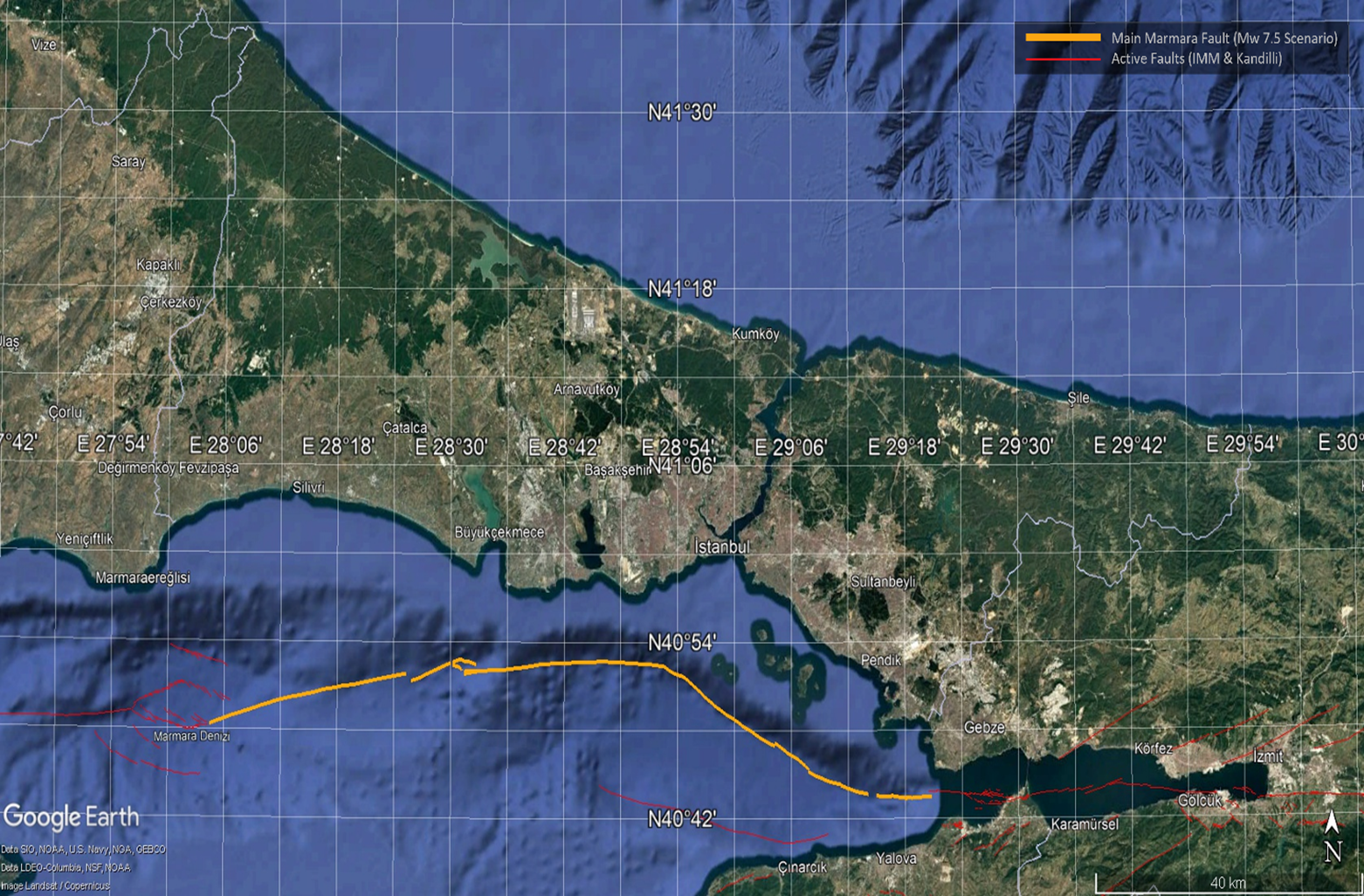
Urban seismic risk assessments in Istanbul have predominantly focused on district level loss estimates, even though mitigation and emergency response decisions are implemented at much finer administrative units. This study develops a neighborhood-based classification of earthquake risk for all 959 neighborhoods under a deterministic Mw 7.5 scenario. The analysis relies on the official Istanbul Earthquake Loss Estimation Update dataset prepared by Istanbul Metropolitan Municipality in cooperation with the Kandilli Observatory. Eight scenario-based outcome indicators, including four structural damage and four human impact variables, are first transformed using Yeo-Johnson and Min-Max scaling and then reduced through Principal Component Analysis, which explains 96.3 percent of the total variance in two components. Within this reduced space, K-Means, K-Medoids, Gaussian Mixture Models, Spectral Clustering, and HDBSCAN are systematically compared. Model selection is guided by internal validation criteria, the Gap Statistic, and bootstrap stability analysis. Based on this combined assessment, K-Medoids with k equal to 2 emerges as the most parsimonious and stable clustering solution. The resulting High Impact and Low Impact profiles show statistically significant differences across all indicators and remain highly consistent across 300 bootstrap resamples, with a mean Adjusted Rand Index of 0.976. The identified medoid neighborhoods provide concrete reference cases for targeted planning interventions. Spatially, higher impact areas are concentrated along the Marmara coastal corridor and older urban cores, whereas lower impact neighborhoods are more common in northern districts. By converting detailed scenario outputs into stable neighborhood level risk categories, the study provides a structured basis for prioritizing mitigation investments, preparedness actions, and emergency response planning at the local scale.- Highlights:
- Classified 959 Istanbul neighborhoods into data driven risk profiles under a Mw 7.5 scenario
- Compared five clustering algorithms and identified K-Medoids (k = 2) as the most consistent solution
- Demonstrated high cluster stability with a mean Adjusted Rand Index of 0.976
- Identified real medoid neighborhoods as actionable reference cases for planning
Downloads
Download data is not yet available.




References
- Adu-Gyamfi, B., & Shaw, R. (2021). Utilizing population distribution patterns for disaster vulnerability assessment: Case of foreign residents in the Tokyo Metropolitan Area of Japan. International Journal of Environmental Research and Public Health, 18(8), Article 4061. https://doi.org/10.3390/ijerph18084061
- Ansal, A., Akinci, A., Cultrera, G., Erdik, M., Pessina, V., Tönük, G., & Ameri, G. (2009). Loss estimation in Istanbul based on deterministic earthquake scenarios of the Marmara Sea region (Turkey). Soil Dynamics and Earthquake Engi-neering, 29(4), 699–709. https://doi.org/10.1016/j.soildyn.2008.07.006
- Caliński, T., & Harabasz, J. (1974). A dendrite method for cluster analysis. Communications in Statistics—Theory and Methods, 3(1), 1–27. https://doi.org/10.1080/03610927408827101
- Campello, R. J. G. B., Moulavi, D., Zimek, A., & Sander, J. (2015). Hierarchical density estimates for data clustering, visu-alization, and outlier detection. ACM Transactions on Knowledge Discovery from Data, 10(1), Article 5, 1–51. https://doi.org/10.1145/2733381
- Davies, D. L., & Bouldin, D. W. (1979). A cluster separation measure. IEEE Transactions on Pattern Analysis and Ma-chine Intelligence, 1(2), 224–227. https://doi.org/10.1109/TPAMI.1979.4766909
- Erdik, M., Aydinoglu, N., Fahjan, Y., Sesetyan, K., Demircioglu, M., Siyahi, B., Durukal, E., Ozbey, C., Biro, Y., Akman, H., & Yuzugullu, O. (2003). Earthquake risk assessment for Istanbul metropolitan area. Earthquake Engineering and Engineering Vibration, 2(1), 1–23. https://doi.org/10.1007/BF02857534
- Erdik, M., Hancılar, U., & Tüzün, C. (2010). ELER software—A new tool for urban earthquake loss assessment. Natural Hazards and Earth System Sciences, 10(12), 2677–2696. https://doi.org/10.5194/nhess-10-2677-2010
- Ersoz, T., & Bayrak, G. (2023). Investigation of possible earthquake risk in districts of istanbul using the Fine-Kinney method. Uluslararası Sürdürülebilir Mühendislik ve Teknoloji Dergisi, 7(2), 139-151. https://izlik.org/JA67AP77YG
- Fraley, C., & Raftery, A. E. (2002). Model-Based Clustering, Discriminant Analysis, and Density Estimation. Journal of the American Statistical Association, 97(458), 611–631. https://doi.org/10.1198/016214502760047131
- Ghaffarian, S., Shafapourtehrany, M., Lagap, U. (2025). Earthquake-based multi-hazard resilience assessment: a case study of Istanbul, Turkey (neighborhood level). npj Nat. Hazard, 2, 15. https://doi.org/10.1038/s44304-025-00065-8
- Gürfidan, S., & Yalçınkaya, A. (2024). Scenario-based estimation of earthquake fatalities for Istanbul using machine learning. Karaelmas Fen ve Mühendislik Dergisi, 14(1), 23–33. https://doi.org/10.7212/karaelmasfen.1494349
- Hubert, L., & Arabie, P. (1985). Comparing partitions. Journal of Classification, 2, 193–218. https://doi.org/10.1007/BF01908075
- Istanbul Metropolitan Municipality. (n.d.-a). Istanbul Province Possible Earthquake Loss Estimates Update Project (2019). Deprem Zemin. https://depremzemin.ibb.istanbul/en/istanbul-province-possible-earthquake-loss-estimates-update-project
- Istanbul Metropolitan Municipality. (n.d.-b). Possible Earthquake Loss Estimates District Booklets. Deprem Zemin. https://depremzemin.ibb.istanbul/en/possible-earthquake-loss-estimates-district-booklets
- Jain, A. K. (2010). Data clustering: 50 years beyond k-means. Pattern Recognition Letters, 31(8), 651–666. https://doi.org/10.1016/j.patrec.2009.09.011
- Jena, R. K., Pradhan, B., Beydoun, G., Alamri, A. M., & Sofyan, H. (2020). Earthquake hazard and risk assessment using machine learning approaches at Palu, Indonesia. Science of the Total Environment, 749, Article 141582. https://doi.org/10.1016/j.scitotenv.2020.141582
- Jolliffe, I. T. (2002). Principal component analysis (2nd ed.). Springer.
- Kalaycıoğlu, E., Tanganelli, M., Viti, S., & Martinelli, E. (2023). Social vulnerability and urban resilience assessment for Istanbul: A neighborhood-scale approach. Natural Hazards and Earth System Sciences, 23(7), 2563–2583. https://doi.org/10.5194/nhess-23-2563-2023
- Kalaycıoğlu, O., Akhanlı, S. E., Menteşe, E. Y., Kalaycıoğlu, M., & Kalaycıoğlu, S. (2023). Using machine learning algo-rithms to identify predictors of social vulnerability in the event of a hazard: Istanbul case study. Natural Hazards and Earth System Sciences, 23(6), 2133–2156. https://doi.org/10.5194/nhess-23-2133-2023
- Kalkan, E., Gülkan, P., Yılmaz, N., & Çelebi, M. (2009). Reassessment of probabilistic seismic hazard in the Marmara Re-gion. Bulletin of the Seismological Society of America, 99(4), 2127–2146. https://doi.org/10.1785/0120080285
- Kaufman, L., & Rousseeuw, P. J. (1990). Finding groups in data: An introduction to cluster analysis. Wiley.
- Li, Y., Zhai, G., Huang, Q., Liu, Y., & Chen, J. (2016). Measuring county resilience after the 2008 Wenchuan earthquake. International Journal of Disaster Risk Science, 7(4), 393–412. https://doi.org/10.1007/s13753-016-0109-2
- MacQueen, J. (1967). Some methods for classification and analysis of multivariate observations. In Proceedings of the Fifth Berkeley Symposium on Mathematical Statistics and Probability (Vol. 1, pp. 281–297). University of Califor-nia Press. http://projecteuclid.org/euclid.bsmsp/1200512992
- Monti, S., Tamayo, P., Mesirov, J., & Golub, T. (2003). Consensus clustering: A resampling-based method for class dis-covery and visualization of gene expression microarray data. Machine Learning, 52, 91–118. https://doi.org/10.1023/A:1023949509487
- Ng, A. Y., Jordan, M. I., & Weiss, Y. (2002). On spectral clustering: Analysis and an algorithm. Advances in Neural Infor-mation Processing Systems, 14, 849-856.
- Rousseeuw, P. J. (1987). Silhouettes: A graphical aid to the interpretation and validation of cluster analysis. Journal of Computational and Applied Mathematics, 20, 53–65. https://doi.org/10.1016/0377-0427(87)90125-7
- Olivares-Palomares, Á. B., Aguirre, J., & Ramírez-Guzmán, L. (2025). Southern Mexico City shear-wave velocity estima-tion using ambient seismic noise. Seismological Research Letters. https://doi.org/10.1785/0220240488
- Tibshirani, R., Walther, G., & Hastie, T. (2001). Estimating the number of clusters in a dataset via the gap statistic. Jour-nal of the Royal Statistical Society: Series B (Statistical Methodology), 63(2), 411–423. https://doi.org/10.1111/1467-9868.00293
- Xu, R., & Wunsch, D. I. (2005). Survey of clustering algorithms. IEEE Transactions on Neural Networks, 16(3), 645–678. https://doi.org/10.1109/TNN.2005.845141
- Von Luxburg, U. (2010). Clustering stability: An overview. Foundations and Trends in Machine Learning, 2(3), 235–274. https://doi.org/10.1561/2200000018
- Yeo, I.-K., & Johnson, R. A. (2000). A new family of power transformations to improve normality or symmetry. Bio-metrika, 87(4), 954–959. https://doi.org/10.1093/biomet/87.4.954