
Published 2026-04-03
Keywords
- Croatia,
- European regionalisation,
- border identities,
- transition zone,
- geo-cultural spheres
How to Cite
Copyright (c) 2026 Jurica Botić

This work is licensed under a Creative Commons Attribution 4.0 International License.
Accepted 2026-03-27
Published 2026-04-03
Abstract
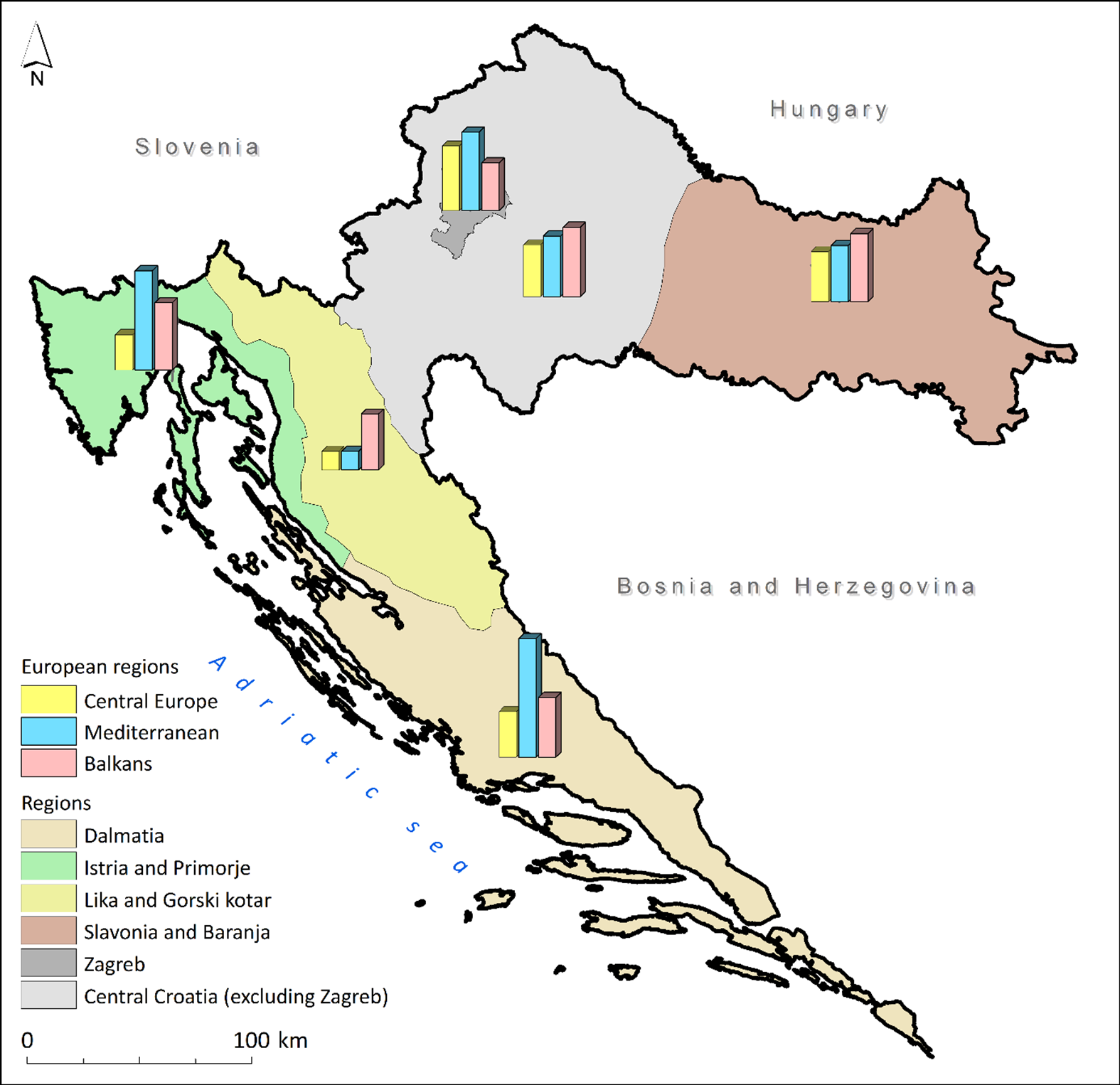
Historically situated at the geographic crossroads of former Austro-Hungarian and Venetian territories along the westernmost Ottoman border and having experienced two Yugoslav states in the 20th century, contemporary Croatia is shaped by diverse spatial identity influences. Drawing on the theoretical frameworks of border identities and regional institutionalisation, this paper explores the identity profiling of modern Croatia within the context of European regionalisation. The research employs a methodological triangulation of diverse discursive sources—including an analysis of geography textbooks, official state documents, and tourism branding—contrasted with media reports and an extensive public survey conducted among a sample of 456 respondents. Specifically, Croatia’s official discourse prioritises its affiliation with the Central European and Mediterranean spheres while strategically marginalising the Balkan context often using Southeast Europe as a more neutral geopolitical substitute. Conversely, the findings reveal a layered identity construct among the public, where Mediterranean, Central European, and Balkan geo-cultural spheres overlap. The results suggest that contemporary Croatia functions as a geographic transition zone where multiple regional frameworks interweave into a multidimensional sense of place, without the territory being fixed within a single regional entity.
Highlights:
- A gap exists between official discourse and public perception of Croatia’s regional affiliation.
- Croatia functions as a geographic transition zone with overlapping regional spheres.
- The strategic significance of Mediterranean rebranding for Croatia.
Downloads




References
- Anderson, B. (1983). Imagined Communities: Reflections on the Origin and Spread of Nationalism. Verso.
- Anholt, S. (2010). Places: Identity, Image and Reputation. Palgrave Macmillan.
- Baker, C. (2006). The Politics of Performance: Transnationalism and its Limits in Former Yugoslav Popular Music, 1999–2004. Ethnopolitics, 5(3), 275–293. https://doi.org/10.1080/17449050600911075
- Baker, C. (2010). Sounds of the borderland: Popular music, war and nationalism in Croatia since 1991. Ashgate.
- Banini, T., & Ilovan, O.-R. (2021). Introduction: Dealing with territorial/place identity representations. In T. Banini & O.-R. Ilovan (Eds.), Representing place and territorial identities in Europe: Discourses, images, and practices (pp. 1–18). Springer. https://doi.org/10.1007/978-3-030-66766-5_1
- Cohen, S. B. (2003). Geopolitics of the World System. Rowman & Littlefield Publishers.
- Curić, Z., Glamuzina, N., & Opačić, V. T. (2013). Geografija turizma [Geography of tourism]. Naklada Ljevak.
- Cvijić, J. (1922). Balkansko poluostvro i južnoslovenske zemlje: Osnove antropogeografije, knjiga prva [The Balkan Peninsula and South Slavic lands: Foundations of anthropogeography, book one]. Hrvatski štamparski zavod.
- Čokonaj, E., & Feletar, D. (2014). Geografija 2: udžbenik iz geografije za 2. razred srednjih strukovnih škola [Geography 2: Geography textbook for the 2nd grade of vocational secondary schools]. Meridijani.
- Čokonaj, E., & Vuk, R. (2014). Turistička geografija Hrvatske: udžbenik iz geografije za srednje turističke škole [Tourism geography of Croatia: Geography textbook for secondary tourism schools]. Meridijani.
- Ćaleta, J. (1999). The ethnomusicological approach to the concept of the Mediterranean in music in Croatia. Narodna umjetnost, 36(1), 183-195. https://hrcak.srce.hr/file/53534
- de Jong, M., & Lu, H. (2022). City branding, regional identity and public space: What historical and cultural symbols in urban architecture reveal. Global Public Policy and Governance, 2(2), 203–231. https://doi.org/10.1007/s43508-022-00043-0
- Dittmer, J., & Bos, A. (2019). Popular Culture, Geopolitics, and Identity. Bloomsbury Publishing.
- Dugin, A. (2004). Osnovi geopolitike: Knjiga 1: Geopolitička budućnost Rusije [Foundations of geopolitics: Book 1: The geopolitical future of Russia]. Ekopres.
- Dugin, A. (2017). Geopolitika multipolarnoga svijeta [Geopolitics of the multipolar world]. Zadruga Eneagram.
- Gal, H., Jukopila, D., & Kralj, P. (2021). Geo 4: udžbenik geografije u četvrtom razredu gimnazija i strukovnih škola [Geo 4: Geography textbook for the fourth grade of grammar and vocational schools]. Školska knjiga.
- Gambiroža, I., Jukić, J., Marin, D., & Mesić, A. (2020). Moja Zemlja 1: udžbenik iz geografije za peti razred osnovne škole [My Earth 1: Geography textbook for the fifth grade of primary school]. Alfa.
- Glamuzina, N., & Fuerst-Bjeliš, B. (2015). Historijska geografija Hrvatske [Historical geography of Croatia]. Sveučilište u Splitu: Filozofski fakultet.
- Hobsbawm, E., & Ranger, T. (Eds.) (2012). The Invention of Tradition. Cambridge University Press.
- Jean, C. (2012). Geopolitica del mondo contemporaneo [Geopolitics of the contemporary world]. Editori Laterza
- Kavaratzis, M, Warnaby, G., & Ashworth, G. J. (eds.) (2015). Rethinking Place Branding: Comprehensive Brand Development for Cities and Regions. Springer. https://doi.org/10.1007/978-3-319-12424-7
- King, B., Richards, G., & Chu, A. M. C. (2025). Developing a tourism region through tourism and culture: Bordering, branding, placemaking and governance processes. Tourism Recreation Research, 50(1), 24–38. https://doi.org/10.1080/02508281.2023.2207156
- Kuus, M. (2014). Geopolitics and Expertise: Knowledge and Authority in European Diplomacy. Wiley-Blackwell.
- Lalić, D. (2003). Split kontra Splita: Pogled sociologa na probleme jednoga grada [Split versus Split: A sociologist’s view on the problems of a city]. Naklada Jesenski i Turk.
- Lu, H., de Jong, M., Song, Y., & Zhao, M. (2020). The multi-level governance of formulating regional brand identities: Evidence from three Mega City Regions in China. Cities, 104, 102668. https://doi.org/10.1016/j.cities.2020.102668
- Magaš, D. (2013). Geografija Hrvatske [Geography of Croatia]. University of Zadar, Meridijani.
- Matvejević, P. (2007). Mediteranski brevijar [Mediterranean breviary]. VBZ.
- Melegh, A. (2006). On the East-West Slope: Globalization, Nationalism, Racism and Discourses on Central and Eastern Europe. Central European University Press.
- Melissen, J. (Ed.) (2005). The New Public Diplomacy: Soft Power in International Relations. Palgrave Macmillan.
- Morgado, N. (2023). Modelling neoclassical geopolitics: An alternative theoretical tradition for geopolitical culture and literacy. European Journal of Geography, 14(4), 13-21. https://doi.org/10.48088/ejg.n.mor.14.4.013.021
- Orešić, D., Tišma, I., Vuk, R., & Buljan, A. (2020). Gea 1: udžbenik geografije u petom razredu osnovne škole [Gea 1: Geography textbook for the fifth grade of primary school]. Školska knjiga.
- Orešić, D., Tišma, I., Vuk, R., & Buljan, A. (2021). Gea 3: udžbenik geografije u sedmom razredu osnovne škole [Gea 3: Geography textbook for the seventh grade of primary school]. Školska knjiga.
- Paasi, A. (2009). The resurgence of the ‘Region’ and ‘Regional Identity’: Theoretical perspectives and empirical observations on regional dynamics in Europe. Review of International Studies, 35(S1), 121–146. https://doi.org/10.1017/S0260210509008456
- Paasi, A. (2019). Afterword: Mobilities, Place, and Beyond. Journal of Finnish Studies, 22, 283-289. https://doi.org/10.5406/28315081.22.1.2.15
- Petrović, N., Bilić, J., & Fila, F. (2022). Kulturno-civilizacijske i geopolitičke orijentacije hrvatskih stranaka i građana [Cultural-civilisational and geopolitical orientations of Croatian parties and citizens]. Političke analize, 11(41), 50-63. https://hrcak.srce.hr/file/403839
- Relph, E. (2008). Place and Placelessness. Pion.
- Rihtman-Auguštin (1999). A Croatian controversy: Mediterranean-Danube-Balkans. Narodna umjetnost, 36(1), 103-119.
- Rivera, L. A. (2008). Managing “Spoiled” National Identity: War, Tourism, and Memory in Croatia. American Sociological Review, 73(4), 613-634. https://doi.org/10.1177/000312240807300405
- Rotaru, M.-A., Creţan, R., & Ianăş, A.-N. (2023). Ethnicities in Post-Communist Romania: Spatial Dynamics, Fractionalisation, and Polarisation at the NUTS-3 Level. Land, 12(6), 1133. https://doi.org/10.3390/land12061133
- Săgeată, R., & Crețan, R. (2025). The Role of Territorial Cohesion and Administrative Organization in Regional Sustainability: The Case of Romania. Sustainability, 17(20), 9006. https://doi.org/10.3390/su17209006
- Scott, J. W., & Sohn, C. (2018). Place-making and the bordering of urban space: Interpreting the emergence of new neighbourhoods in Berlin and Budapest. European Urban and Regional Studies, 26(3), 297-313. https://doi.org/10.1177/0969776418764577
- Sohn, C. (2022). How to brand a border despite its wall? A social semiotics approach to cross-border place branding. Geoforum, 135, 82–92. https://doi.org/10.1016/j.geoforum.2022.07.016
- Stroschein, S. (2012). Ethnic Struggle, Coexistence, and Democratization in Eastern Europe. Cambridge University Press.
- Todorova, M. (2006). Imaginarni Balkan [Imagining the Balkans]. Biblioteka XX vek, Krug.
- Tomić-Koludrović, I., & Petrić, M. (2007). Da societa in transizione a societa mista: la Croazia tra due modernizzazioni [From society in transition to mixed society: Croatia between two modernisations]. In F. Botta, I. Garzia, & P. Guaragnella (Eds.), La questione adriatica e l’allargamento dell’Unione europea [The Adriatic question and the enlargement of the European Union] (pp. 127–161). Franco Angeli.
- Tunjić, F. (2004). Vmesna Evropa: Konfliktnost državnih teritorialnih meja [Europe-in-between: Conflictuality of state territorial borders]. Univerza na Primorskem, Znanstveno-raziskovalno središče, Zgodovinsko društvo za južno Primorsko.
- UNESCO (2025, July): Croatia. https://whc.unesco.org/en/statesparties/hr
- Zarycki, T. (2014). Ideologies of Eastness in Central and Eastern Europe. Routledge. https://doi.org/10.4324/9781315819006
- Zupančič, J. (2015). Geografija Balkana in njegova obrobja [Geography of the Balkans and its periphery]. Znanstvena založba Filozofske fakultete.