
A Comparative Assessment of Spatial Factors Influencing Women's Access to High-Skilled Employment in Albania, Bulgaria, and Türkiye
Published 2026-03-28
Keywords
- women,
- employment,
- spatial analysis,
- Albania,
- Bulgaria
- Türkiye ...More
How to Cite
Copyright (c) 2026 Carolina Mayen Huerta, Clara Ivanescu, Dragos Gontariu

This work is licensed under a Creative Commons Attribution 4.0 International License.
Accepted 2026-03-27
Published 2026-03-28
Abstract
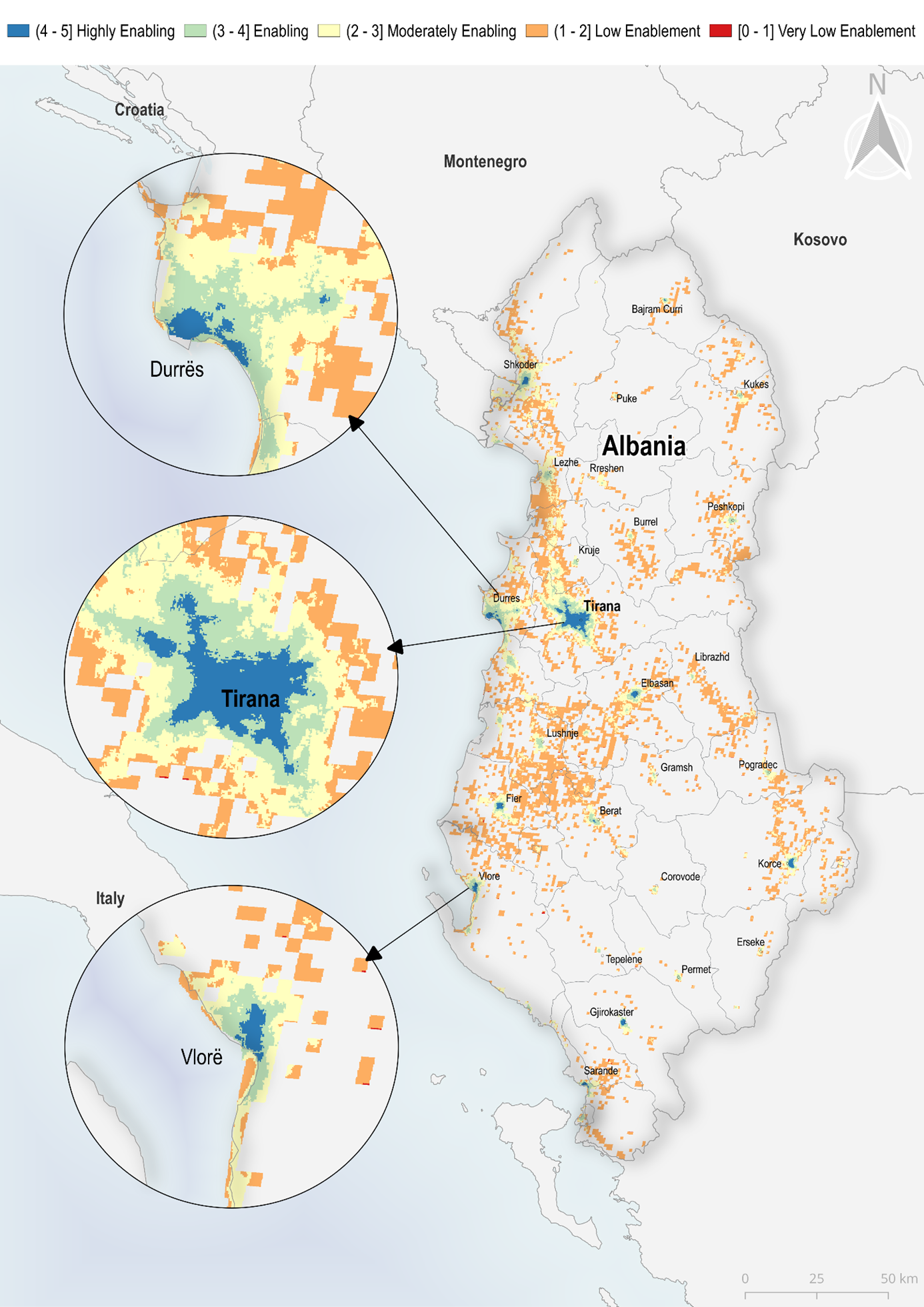
Women’s labor force participation remains limited in many parts of Southeast Europe and surrounding regions, including Albania, Bulgaria, and Türkiye. While prior research has examined social and institutional drivers of low female labor force participation, the influence of geographic factors on women’s access to employment has received comparatively less attention. This study addresses that gap by applying the Geospatial Women’s Employment Analytical Framework (GeoWEAF) to assess how place-based factors shape women’s high-skilled employment opportunities in Albania, Bulgaria, and Türkiye. These countries were selected due to their shared challenges in advancing gender equality in employment, as well as their differing institutional contexts, development trajectories, and stages of European Union integration, making them a valuable basis for comparative analysis. This application modifies the original framework by excluding the environmental hazards factor, given its ambiguous and non-directional effects, and by introducing spatially disaggregated representations of attitudes toward women in STEM and digital inclusion, which were originally applied at the national level. It also revises the methodology for assessing active transport to address data limitations and adjusts both the scoring and weighting schemes to better capture the contextual and spatial variation in the selected countries. The analysis reveals that, although urban areas generally exhibit higher levels of enablement, substantial intra-urban variation persists, with some areas within cities displaying levels of enablement comparable to rural regions. These findings highlight the importance of incorporating spatial analysis into gender and labor market research. Mapping underserved areas in services and infrastructure, and those exhibiting heightened vulnerability to risks, can enhance the targeting of interventions to accelerate women’s inclusion in the workforce.
Highlights:
- This study used GeoWEAF to examine spatial inequalities in women's access to high-skilled employment.
- The results reveal persistent spatial disparities, including within major urban areas.
- Spatial analysis should play a central role in gender-focused labor diagnostics to inform inclusive development policies.
Downloads




References
- ACLED. (2025). Conflict Exposure Calculator. https://acleddata.com/platform/conflict-exposure-calculator
- Aktaş, A., & Uysal, G. (2016). THE GENDER WAGE GAP IN TURKEY. M U Iktisadi ve Idari Bilimler Dergisi, 38(2), 1–1. https://doi.org/10.14780/muiibd.280227
- Akter, S. (2021). Do catastrophic floods change the gender division of labor? Panel data evidence from Pakistan. International Journal of Disaster Risk Reduction, 60, 102296. https://doi.org/10.1016/j.ijdrr.2021.102296
- Akyelken, N. (2020). Living with urban floods in Metro Manila: A gender approach to mobilities, work and climatic events. Gender, Place & Culture, 27(11), 1580–1601. https://doi.org/10.1080/0966369X.2020.1726880
- Algül, Y., & Yarbaşi, İ. Y. (2021). THE EFFECTS OF EMPLOYMENT AND FINANCIAL EMPOWERMENT OF WOMEN ON DOMESTIC VIOLENCE: THE CASE OF TURKEY. Erciyes Üniversitesi İktisadi ve İdari Bilimler Fakültesi Dergisi, (59), 197–220. https://doi.org/10.18070/erciyesiibd.935635
- Alibhai, S., Donald, A., Goldstein, M., Oguz, A., Pankov, A., & Strobbe, F. (2019). Gender Bias in SME Lending: Experimental Evidence from Turkey [World Bank Policy Research Working Paper No. 9100]. https://ssrn.com/abstract=3512295
- Arslan, A. (2020). Labour informality, patriarchal gender regimes and neoliberalism in Turkey. In S. Huang & K. N. Ruwanpura (Eds.), Handbook on Gender in Asia. Edward Elgar Publishing. https://doi.org/10.4337/9781788112918.00018
- Avlijaš, S., Ivanović, N., Vladislavjević, M., & Vujić, S. (Eds.). (2013). The gender pay gap in the Western Balkan Countries: Evidence from Serbia, Montenegro and Macedonia. FREN - Foundation for the Advancement of Economics.
- Banks, J., Sweeney, S., & Meiring, W. (2022). The Geography of Women’s Empowerment in West Africa. Spatial Demography, 10(2), 387–412. https://doi.org/10.1007/s40980-021-00099-2
- Bastiaanssen, J. (2020). Systematic Review table of studies on transport and employment outcomes (p. 277 kB) [Application/pdf]. University of Leeds. https://doi.org/10.5518/762
- Bilici, I. (2025). Patriarchal Norms in Turkey and Their Influence on Women’s Development and Domestic Roles: A Literature Review. American Journal of Student Research, 713–720. https://doi.org/10.70251/HYJR2348.36713720
- Bimrose, J., McMahon, M., & Watson, M. (Eds.). (2015). Women’s career development throughout the lifespan: An international exploration. Routledge. https://doi.org/10.4324/9780203587898
- Blau, F. D., & Kahn, L. M. (2017). The Gender Wage Gap: Extent, Trends, and Explanations. Journal of Economic Literature, 55(3), 789–865. https://doi.org/10.1257/jel.20160995
- Bučan, S., & Ramić-Mesihović, L. (2023). Effects of Perceived Gender Roles on Female Poverty, the Case of Bosnia and Herzegovina. MAP Social Sciences, 4(1), 82–97. https://doi.org/10.53880/2744-2454.2023.4.82
- Caglayan-Akay, E., & Komuryakan, F. (2024). Gender Wage Gap Among Couples and the Role of Parenthood Across the Wage Distribution in Turkey. Journal of Family and Economic Issues, 45(1), 21–34. https://doi.org/10.1007/s10834-023-09901-3
- Canessa, E., & Giannelli, G. C. (2021). Women’s Employment and Natural Shocks (IZA Discussion Papers No. 14055). Institute of Labor Economics (IZA). https://hdl.handle.net/10419/232807
- Casado-Díaz, J. M., Simón-Albert, R., & Simón, H. (2023). Gender Differences in Commuting: New Evidence from Spain. Social Indicators Research, 169(3), 907–941. https://doi.org/10.1007/s11205-023-03183-w
- Chowdhury, J. R., Parida, Y., & Agarwal, P. (2022). How flood affects rural employment in India: A gender analysis. International Journal of Disaster Risk Reduction, 73, 102881. https://doi.org/10.1016/j.ijdrr.2022.102881
- Cinque, A., Poggi, C., & Miluka, J. (2024). How Does Fertility Affect Female Employment? Evidence from Albania. The Journal of Development Studies, 60(8), 1227–1245. https://doi.org/10.1080/00220388.2024.2322969
- Contreras, I., Dinarte-Diaz, L., Palacios-Lopez, A., Costa, V., & Romero, S. (2026). Reproducibility package for Beyond Wages: What Matters Most In Job Choice For Women In El Salvador. World Bank. https://doi.org/10.60572/8069-W010
- Copernicus EU. (2025). GHSL - Global Human Settlement Layer. https://human-settlement.emergency.copernicus.eu/ghs_smod2019.php
- Cuberes, D., & Teignier, M. (2016). How Costly are Labor Gender Gaps? Estimates for the Balkans and Turkey. World Bank Policy Research Working Paper, 7319. https://ssrn.com/abstract=2621873
- Dalaman, Z. B. (2024). Women’s Political Participation in Türkiye: A Century of Progress and Ongoing Challenges. https://doi.org/10.5281/ZENODO.13910484
- Davoudian, N. (with Safari, an O’Reilly Media Company). (2019). Urban Lighting for People (1st edition). RIBA Publishing.
- Demsash, A. W., & Walle, A. D. (2023). Women’s health service access and associated factors in Ethiopia: Application of geographical information system and multilevel analysis. BMJ Health & Care Informatics, 30(1), e100720. https://doi.org/10.1136/bmjhci-2022-100720
- Desai, S., & Joshi, O. (2019). The Paradox of Declining Female Work Participation in an Era of Economic Growth. The Indian Journal of Labour Economics, 62(1), 55–71. https://doi.org/10.1007/s41027-019-00162-z
- de Moraes Vestena, K., Camboim, S. P., & dos Santos, D. R. (2023). OSM sidewalkreator: A QGIS plugin for an automated drawing of sidewalk networks for OpenStreetMap. European Journal of Geography, 14(4), 66–84. https://doi.org/10.48088/ejg.k.ves.14.4.066.084
- Farré, L., Jofre-Monseny, J., & Torrecillas, J. (2023). Commuting time and the gender gap in labor market participation. Journal of Economic Geography, 23(4), 847–870. https://doi.org/10.1093/jeg/lbac037
- Feenstra, M. (2021). Women as Change Agents of the Bulgarian Energy Transition. In M. Mišík & V. Oravcová (Eds.), From Economic to Energy Transition (pp. 181–208). Springer International Publishing. https://doi.org/10.1007/978-3-030-55085-1_7
- Franklin, R. S., Delmelle, E. C., Andris, C., Cheng, T., Dodge, S., Franklin, J., Heppenstall, A., Kwan, M., Li, W., McLafferty, S., Miller, J. A., Munroe, D. K., Nelson, T., Öner, Ö., Pumain, D., Stewart, K., Tong, D., & Wentz, E. A. (2023). Making Space in Geographical Analysis. Geographical Analysis, 55(2), 325–341. https://doi.org/10.1111/gean.12325
- Freedman, J., Kıvılcım, Z., & Özgür Baklacıoğlu, N. (2017). A gendered approach to the Syrian refugee crisis. Routledge, Taylor & Francis group.
- Frick, S. A., & Rodríguez‐Pose, A. (2018). Big or Small Cities? On city size and economic growth. Growth and Change, 49(1), 4–32. https://doi.org/10.1111/grow.12232
- Gashi, A., Rizvanolli, A., & Adnett, N. (2019). Bucking the Trend: Female Labor Market Participation in Kosovo. Croatian Economic Survey, 21(2), 85–116. https://doi.org/10.15179/ces.21.2.3
- Golan, Y., Wilkinson, N., Henderson, J. M., & Weverka, A. (2019). Gendered walkability: Building a daytime walkability index for women. Journal of Transport and Land Use, 12(1). https://doi.org/10.5198/jtlu.2019.1472
- Greulich, A., & Dasré, A. (2022). The association between women’s economic participation and physical and/or sexual domestic violence against women: A case study for Turkey. PLOS ONE, 17(11), e0273440. https://doi.org/10.1371/journal.pone.0273440
- Gunes, U., & Chang, W.-W. (2023). Women Leadership in the Transcontinental Country: A Study in Turkey. In C.-H. Mayer, E. Vanderheiden, O. Braun-Lewensohn, G. Chen, K. Sueda, B. Mangolothi, S. Safdar, & S. Kim (Eds.), Women’s Empowerment for a Sustainable Future (pp. 439–455). Springer International Publishing. https://doi.org/10.1007/978-3-031-25924-1_27
- Hanrahan, K. B. (2018). Caregiving as mobility constraint and opportunity: Married daughters providing end of life care in northern Ghana. Social & Cultural Geography, 19(1), 59–80. https://doi.org/10.1080/14649365.2016.1257734
- Harris, R., & Short, T. (Eds.). (2014). Workforce Development: Perspectives and Issues. Springer Singapore. https://doi.org/10.1007/978-981-4560-58-0
- Hegele, Y., Karakaçi, V., Lang, A., & Mushani, A. (2024). Compliance with national standards of decentralized public services: The case of preschool services in Albania. Public Administration and Development, 44(2), 75–90. https://doi.org/10.1002/pad.2037
- HeiGIT. (2026). Ohsome Quality API. Ohsome Quality API. https://dashboard.ohsome.org/en/#backend=oqtApi&topic=building-count&indicators=mapping-saturation
- Ilahi, N., Khachatryan, A., Lindquist, W., Nguyen, N., Raei, F., & Rahman, J. (2019). Lifting Growth in the Western Balkans: The Role of Global Value Chains and Services Exports. Departmental Papers / Policy Papers, 19(13). https://doi.org/10.5089/9781498314916.087
- Ilić, N. (2022). Gender Pay Gap in the Western Balkans: Why Do Women Earn Less Than Men? In M. Davinić & S. Kostić (Eds.), Gender Competent Public Law and Policies (Vol. 2, pp. 69–90). Springer International Publishing. https://doi.org/10.1007/978-3-031-14706-7_4
- Ilieva-Trichkova, P., Stoilova, R., & Boyadjieva☆, P. (2015). Regional Gender Differences in Vocational Education in Bulgaria. In C. Imdorf, K. Hegna, & L. Reisel (Eds.), Comparative Social Research (Vol. 31, pp. 151–180). Emerald Group Publishing Limited. https://doi.org/10.1108/S0195-631020150000031006
- ILOSTAT. (2026). International Standard Classification of Occupations (ISCO). International Labour Organization. https://ilostat.ilo.org/methods/concepts-and-definitions/classification-occupation/
- Imdorf, C., Hegna, K., & Reisel, L. (Eds.). (2015). Gender segregation in vocational education. Emerald Group Publishing Limited.
- Jaba, E., Sandu, C., Plopeanu, A., Robu, I., & Istrate, M. (2017). THE STATISTICAL ANALYSIS OF LABOR MARKET AND FEMALE LABOR FORCE CHARACTERISTICS IN CENTRAL AND EASTERN EUROPEAN COUNTRIES. STUDIES AND SCIENTIFIC RESEARCHES. ECONOMICS EDITION, (25). https://doi.org/10.29358/sceco.v0i25.389
- Johnston, K., & Yarrow, E. (2024). Active representation and identity taxation: Unintended outcome of representative labour? Public Management Review, 26(4), 970–987. https://doi.org/10.1080/14719037.2022.2126881
- Kalafatoglu, T., & Mendoza, X. (2017). The impact of gender and culture on networking and venture creation: An exploratory study in Turkey and MENA region. Cross Cultural & Strategic Management, 24(2), 332–349. https://doi.org/10.1108/CCSM-04-2016-0090
- Kapsoli, J., & Mohona, S. (2025). Labor Market and Gender: Republic of Kosovo. International Monetary Fund. https://doi.org/10.5089/9798400299087.018
- Kawabata, M. (2014). CHILDCARE ACCESS AND EMPLOYMENT: THE CASE OF WOMEN WITH PRESCHOOL‐AGED CHILDREN IN TOKYO. Review of Urban & Regional Development Studies, 26(1), 40–56. https://doi.org/10.1111/rurd.12018
- Kilinç, N., & Işik, H. (2023). GENDER WAGE GAP IN REGIONAL TURKISH LABOR MARKETS: NUTS1 REGIONS. Pamukkale University Journal of Social Sciences Institute. https://doi.org/10.30794/pausbed.1259237
- Kim, K., Ilkkaracan, I., & Kaya, T. (2017). Investing in Social Care Infrastructure and Employment Generation: A Distributional Analysis of the Care Economy in Turkey. SSRN Electronic Journal. https://doi.org/10.2139/ssrn.2924794
- Klasen, S. (2018). The Impact of Gender Inequality on Economic Performance in Developing Countries. Annual Review of Resource Economics, 10(1), 279–298. https://doi.org/10.1146/annurev-resource-100517-023429
- Ligocká, M. (2022). The Gender Wage Gap in EU Countries and its Relation to the Educational Attainment and Type od Employment. ACTA VŠFS, 16(1), 23–42. https://doi.org/10.37355/acta-2022/1-02
- Lino, L. R., & Kanashiro, M. (2024). Where do women choose to walk? Female safety in public spaces. Cadernos Metrópole, 26(60), 781–803. https://doi.org/10.1590/2236-9996.2024-6017.e
- Luli, E. (2024). Albanian Youth Perceptions on the EU Accession Path—Amidst Expectations and Discontent: Exploring the Breeding Ground of Euroscepticism. In B. Alpan & A. Hoti (Eds.), Imagining Europe in Times of War and Crises (pp. 61–79). Springer Nature Switzerland. https://doi.org/10.1007/978-3-031-68771-6_4
- Maden, C. (2015). A gendered lens on entrepreneurship: Women entrepreneurship in Turkey. Gender in Management: An International Journal, 30(4), 312–331. https://doi.org/10.1108/GM-11-2013-0131
- Mahadevia, D., & Advani, D. (2016). Gender differentials in travel pattern – The case of a mid-sized city, Rajkot, India. Transportation Research Part D: Transport and Environment, 44, 292–302. https://doi.org/10.1016/j.trd.2016.01.002
- Manolov, M. N., Ivanov, I. K., & Chavdarova, V. A. (2023). Gender-Role Stereotypes in the Bulgarian Family: Cross-Generational Transmission of Gender Attitudes. Societies, 13(7), 152. https://doi.org/10.3390/soc13070152
- Mapillary. (2025). Mapillary, make better maps. https://www.mapillary.com/
- Mayen Huerta, C., & Cafagna, G. (2021). Snapshot of the Use of Urban Green Spaces in Mexico City during the COVID-19 Pandemic: A Qualitative Study. International Journal of Environmental Research and Public Health, 18(8), 4304. https://doi.org/10.3390/ijerph18084304
- Mayen Huerta, C., Ivanescu, C., Herfort, B., Badowski, P., & Gontariu, D. (2025). Leveraging geospatial data to evaluate women’s employment opportunities in the renewable energy sector. Energy Research & Social Science, 120, 103917. https://doi.org/10.1016/j.erss.2024.103917
- Mayen Huerta, C. (2022). Rethinking the distribution of urban green spaces in Mexico City: Lessons from the COVID-19 outbreak. Urban Forestry & Urban Greening, 70, 127525. https://doi.org/10.1016/j.ufug.2022.127525
- Mazreku, V., Sauku, A., Habersbrunner, K., & Baumann, J. (2024). Current State of Gender in the Energy Sector in Albania. Women Engage for a Common Future.
- McQuaid, R. W., & Chen, T. (2012). Commuting times – The role of gender, children and part-time work. Research in Transportation Economics, 34(1), 66–73. https://doi.org/10.1016/j.retrec.2011.12.001
- Navarrete-Hernandez, P., Vetro, A., & Concha, P. (2021). Building safer public spaces: Exploring gender difference in the perception of safety in public space through urban design interventions. Landscape and Urban Planning, 214, 104180. https://doi.org/10.1016/j.landurbplan.2021.104180
- Nicoletti, L., Sirenko, M., & Verma, T. (2023). Disadvantaged communities have lower access to urban infrastructure. Environment and Planning B: Urban Analytics and City Science, 50(3), 831–849. https://doi.org/10.1177/23998083221131044
- Ogbari, M. E., Folorunso, F., Simon-Ilogho, B., Adebayo, O., Olanrewaju, K., Efegbudu, J., & Omoregbe, M. (2024). Social Empowerment and Its Effect on Poverty Alleviation for Sustainable Development among Women Entrepreneurs in the Nigerian Agricultural Sector. Sustainability, 16(6), 2225. https://doi.org/10.3390/su16062225
- Olsen, J. R., Robinson, M., Corcoran, J., & McDaid, L. (2026). Reducing Health Inequities in Australia: The Role of Place‐Based Action and Spatial Data Infrastructure. Health Promotion Journal of Australia, 37(2), e70156. https://doi.org/10.1002/hpja.70156
- Ookla. (2025). Mean Download Speed. https://www.ookla.com/ookla-for-good/open-data
- OSM. (2025). OpenStreet Map. https://www.openstreetmap.org/about
- Ozasir Kacar, S. (2025). Religiosity and entrepreneurship: Women entrepreneurs in Turkiye. International Journal of Entrepreneurial Behavior & Research, 31(1), 179–196. https://doi.org/10.1108/IJEBR-12-2022-1116
- Özmen, Z. (2024). Social and economic factors and their relationship with gender gap in STEM in higher education: A spatial analysis of Turkey. GeoJournal, 89(4), 179. https://doi.org/10.1007/s10708-024-11153-z
- Ozoguz, S. (2025). The developmental aspirations of women in Turkey: Gender roles, contextual demands and shifting Dreams across the lifespan. Current Psychology. https://doi.org/10.1007/s12144-025-07974-x
- Pereira, A., & Rebelo, E. M. (2024). Women in public spaces: Perceptions and initiatives to promote gender equality. Cities, 154, 105346. https://doi.org/10.1016/j.cities.2024.105346
- Petreski, B., Tanevski, S., & Petreski, M. (2025). Behind the Curtain: Cultural Norms, Gender Stereotypes and Work Attitudes Shaping Women’s Labour-Market Inactivity in North Macedonia. Eastern European Economics, 1–35. https://doi.org/10.1080/00128775.2025.2486039
- Ramazanogullari, H. (2022). After the Protest: Istanbul Park Forums and People’s Engagement in Political Action. Social Movement Studies, 21(4), 420–435. https://doi.org/10.1080/14742837.2021.1894550
- Rexhepi, S., & Vataj, G. (2023). Financial impact on the labor market in the Balkan countries. Corporate and Business Strategy Review, 4(2), 114–123. https://doi.org/10.22495/cbsrv4i2art10
- Robayo, M., Terskaya, A., Vaughan, K. N., & Pena, N. (2020). Encouraging Women’s Economic Opportunities in Croatia: Empirical Evidence of Determinants and Policy Advice (No. 153610). World Bank. http://documents.worldbank.org/curated/en/791821602260137306
- Saad, R., Portnov, B. A., & Trop, T. (2021). Saving energy while maintaining the feeling of safety associated with urban street lighting. Clean Technologies and Environmental Policy, 23(1), 251–269. https://doi.org/10.1007/s10098-020-01974-0
- Sakarya, A. (2025). Regional inequality in Türkiye: A new determination method. European Planning Studies, 1–22. https://doi.org/10.1080/09654313.2025.2564726
- Schwartz, R. B. (2016). The Career Pathways Movement: A Promising Strategy for Increasing Opportunity and Mobility. Journal of Social Issues, 72(4), 740–759. https://doi.org/10.1111/josi.12192
- Selim, R., & Kaya, G. (2018). The gender wage inequality in Turkey. Pressacademia, 7(1), 408–413. https://doi.org/10.17261/Pressacademia.2018.925
- Sezgin, E. (2018). New regionalism in Turkey: Questioning the ‘new’ and the ‘regional.’ European Planning Studies, 26(4), 653–669. https://doi.org/10.1080/09654313.2017.1403571
- Shmelev, S. (Ed.). (2020). Sustainable cities reimagined: Multidimensional assessment and smart solutions. Routledge.
- Spahiu, A., Dhamo, L., & Zavalani, O. (2018). LED Street Lighting Application in Municipality of Tirana. 2018 International IEEE Conference and Workshop in Óbuda on Electrical and Power Engineering (CANDO-EPE), 000211–000216. https://doi.org/10.1109/CANDO-EPE.2018.8601180
- Stoilova, D. (2025). The Impact of European Structural and Investment Funds on Regional Economic Development: The Case of Bulgaria. In A. D’Auria & J. Sanchez-Rivas Garcia (Eds.), Strategies for Sustainable Territorial Development (pp. 105–130). IGI Global. https://doi.org/10.4018/979-8-3693-7081-0.ch006
- Stoilova, R., & Kaloyan, H. (2022). INEQUALITIES AND JUSTICE IN THE BALKANS. A COMPARISON BETWEEN BULGARIA, CROATIA, MONTENEGRO, SLOVENIA AND SERBIA. Sociological Problems, 54(1).
- Svechkina, A., Trop, T., & Portnov, B. A. (2020). How Much Lighting is Required to Feel Safe When Walking Through the Streets at Night? Sustainability, 12(8), 3133. https://doi.org/10.3390/su12083133
- Tahiri, A., & Kovaci, I. (2024). Gender Equality as a Goal of the Sustainable Development. Quality-Access to Success, 25(202). https://doi.org/10.47750/QAS/25.202.25
- Titili, D., Dolani, V., & Margo, L. (2024). Gender mainstreaming in Albanian higher education institutions. Women’s Studies International Forum, 103, 102888. https://doi.org/10.1016/j.wsif.2024.102888
- Toska, M., & Bejko (Gjika), A. (2019). Decentralisation and Local Economic Development in Albania. Annual Review of Territorial Governance in the Western Balkans, (1). https://doi.org/10.32034/CP-TGWBAR-I01-05
- UK Government. (2025). Foreign travel advice Turkey. https://www.gov.uk/foreign-travel-advice/turkey/safety-and-security#:~:text=There%20have%20been%20a%20number,an%20explosion%20in%20central%20Istanbul
- Verma, R. (2024). Advancing the quantitative assessment of transportation equity for planning. 11899651 Bytes. https://doi.org/10.25394/PGS.26321260
- Vullnetari, J., & King, R. (2016). ‘Washing men’s feet’: Gender, care and migration in Albania during and after communism. Gender, Place & Culture, 23(2), 198–215. https://doi.org/10.1080/0966369X.2015.1013447
- Williams, A., & Luginaah, I. N. (Eds.). (2022). Geography, health, and sustainability: Gender matters globally. Routledge.
- World Bank. (2024a). Labor force participation rate, female (% of female population ages 15-64) (modeled ILO estimate)—European Union. ILO Modelled Estimates Database ( ILOEST ), International Labour Organization ( ILO ), Uri: Ilostat.Ilo.Org/Data/Bulk, Publisher: ILOSTAT, Type: External Database, Date Accessed: January 17, 2026. https://data.worldbank.org/indicator/SL.TLF.ACTI.FE.ZS?locations=EU
- World Bank. (2024b). Women, Business, and the Law 2024. https://wbl.worldbank.org/en/wbl
- World Bank. (2025). Gender Data Portal. https://genderdata.worldbank.org/en/economies
- Yılmaz Fındık, L. (2025). Gender equality in Türkiye: A critical analysis and action plan for schools. European Journal of Sustainable Development Research, 9(4), em0318. https://doi.org/10.29333/ejosdr/16578
- Zhelev, P. (2025a). Bulgaria’s Integration in the EU: Benefits and Challenges. In P. Zhelev, Bulgaria in the Global Economy (pp. 45–62). Springer Nature Switzerland. https://doi.org/10.1007/978-3-031-87923-4_4
- Zhelev, P. (2025b). Bulgaria’s Participation in the International Labor Migration. In P. Zhelev, Bulgaria in the Global Economy (pp. 167–184). Springer Nature Switzerland. https://doi.org/10.1007/978-3-031-87923-4_11