
Assessing Coastal Heritage Vulnerability to Sea-Level Rise in the Mediterranean: Towards Usable Knowledge and Integrated Adaptation Frameworks
Published 2026-02-21
Keywords
- Sea-level rise,
- Coastal heritage,
- Vulnerability assessment,
- Mediterranean basin,
- Integrated adaptation frameworks
- Geospatial modelling,
- Archaeology,
- Coastal erosioon,
- Climate change risk,
- Usable knowledge ...More
How to Cite
Copyright (c) 2026 Pablo Fraile Jurado, María José Prados-Velasco, Eirini Marinou , Betty Charalampopoulou

This work is licensed under a Creative Commons Attribution 4.0 International License.
Accepted 2026-02-15
Published 2026-02-21
Abstract
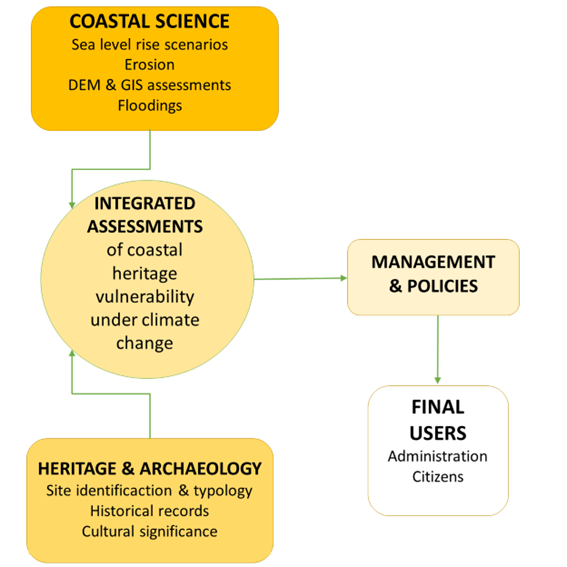
Mediterranean coasts have one of the world’s richest concentrations of cultural heritage, yet this legacy is increasingly threatened by sea-level rise (SLR), coastal erosion and storm impacts. Despite a growing number of local and thematic studies, regional syntheses remain scarce. This paper presents a semi-quantitative review of more than sixty peer-reviewed publications and institutional reports (2010–2024) addressing coastal heritage vulnerability in the Mediterranean. Drawing on a harmonised database, each study has been classified by country, heritage type, threat, temporal horizon and methodological approach, and evaluated through standardised severity (0–5) and risk (1–3) scales. Results reveal three interrelated dimensions of imbalance—geographical, methodological and temporal. Geographically, a pronounced north–south asymmetry persists: Italy, Spain and Greece concentrate more than half of all studies, while North Africa and the eastern Mediterranean remain under-represented. Methodologically, about 45% of works employ DEM-based geospatial modelling, 25% rely on field evidence, and only 10% address management or policy dimensions. Prospectively, most analyses project impacts to 2100 under high-emission scenarios, with more than 70% of assessed sites showing moderate-to-high vulnerability. Although comprehensive, the sample is not systematic, and geographic patterns partly reflect differences in research capacity rather than exposure. A critical weakness identified across the literature is the limited transfer of scientific results into usable frameworks for planners and heritage managers, underscoring the need for performance and usability assessment in future climate-adaptation research. Advancing this field requires standardised indicators, broader regional coverage, and stronger interdisciplinary integration between coastal science, archaeology and heritage management to inform effective adaptation strategies for safeguarding Mediterranean coastal heritage under accelerating climate change.
Highlights:
- Research heavily concentrates in Italy, Spain, and Greece.
- Dominance of geospatial modelling over management and policy.
- Urgent need to transform scientific results into usable management tools.
Downloads




References
- Antonioli, F., Anzidei, M., Amorosi, A., Presti, V. L., Mastronuzzi, G., Deiana, G., & Vecchio, A. (2017). Sea-level rise and potential drowning of the Italian coastal plains: Flooding risk scenarios for 2100. Quaternary Science Reviews, 158, 29-43. https://doi.org/10.1016/j.quascirev.2016.12.021
- Aucelli, P., Cinque, A., Mattei, G., & Pappone, G. (2016). Historical sea level changes and effects on the coasts of Sor-rento Peninsula (Gulf of Naples): New constrains from recent geoarchaeological investigations. Palaeogeography, Palaeoclimatology, Palaeoecology, 463, 112-125. https://doi.org/10.1016/j.palaeo.2016.09.022
- Battisti, A., Figliola, A., & Santarelli, M. L. (2024). Climate Change Impact on Cultural Heritage: A Methodological Framework for Driven Reasoning in Risk Assessment. Preprints. https://doi.org/10.20944/preprints202401.2180.v1
- Castagnino Berlinghieri, E.F., Antonioli, F., Bailey, G. (2020). Italy: The Archaeology of Palaeoshorelines, Coastal Caves and Seafaring Connections. In: Bailey, G., Galanidou, N., Peeters, H., Jöns, H., Mennenga, M. (eds) The Archaeolo-gy of Europe’s Drowned Landscapes. Coastal Research Library, vol 35. Springer, Cham. https://doi.org/10.1007/978-3-030-37367-2_16
- Colette, A. (2007). Climate change and world heritage: Report on predicting and managing the impacts of climate change on World Heritage and Strategy to assist States Parties to implement appropriate management respons-es. UNESCO World Heritage Centre. https://unesdoc.unesco.org/ark:/48223/pf0000160019
- Daly, C., Engel Purcell, C., Donnelly, J., Chan, C., MacDonagh, M., & Cox, P. (2021). Climate change adaptation planning for cultural heritage, a national scale methodology. Journal of Cultural Heritage Management and Sustainable Development, 11(4), 313-329. https://doi.org/10.1108/JCHMSD-04-2020-0053
- Díaz-Cuevas, P., Prieto-Campos, A., Fraile-Jurado, P., Ojeda-Zújar, J. (2020). Shoreline “proxies” evaluation for mid-term erosion rates calculation in mesotidal and microtidal beaches (Andalusia, Spain). Journal of Coastal Research, 95(sp1), 1062–1066. https://doi.org/10.2112/SI95-206.1
- Fatorić, S., & Seekamp, E. (2017). Are cultural heritage and resources threatened by climate change? A systematic liter-ature review. Climatic Change, 149(4), 377–402. https://doi.org/10.1007/s10584-018-2258-2
- Fraile-Jurado, P., & Mejías-García, J. C. (2023). Identification of potential paleoislands in the Mediterranean Sea during the last glacial cycle. European Journal of Geography, 16(2), 241–255. https://doi.org/10.48088/EJG.pfj.16.2.241
- Fraile-Jurado, P., Iglesias-Campos, A., Simón-Colina, A., & Hodgson, N. (2019). Methods for assessing current and fu-ture coastal vulnerability to sea level rise: A review for a case-study in Europe. European Journal of Geography, 10(3), 97–119. https://doi.org/10.48088/EJG.pfj.10.3.97
- Galili, E., & Rosen, B. (2015). Protecting the ancient mariners, cultic artifacts from the Holy Land seas. Archaeologia maritima mediterranea. International Journal on Underwater Archaeology, 12, 35-102.
- Marzeion, B., & Levermann, A. (2014). Loss of cultural world heritage and currently inhabited places to sea-level rise. Environmental Research Letters, 9(3), 034001. https://doi.org/10.1088/1748-9326/9/3/034001
- Mizutori, M. (2020). Reflections on the Sendai framework for disaster risk reduction: Five years since its adoption. In-ternational Journal of Disaster Risk Science, 11(2), 147-151. https://doi.org/10.1007/s13753-020-00261-2
- Mejías-García, J. C., & Fraile-Jurado, P. (2025). Spatial analysis of changing sea levels and its implications for under-standing prehistoric human settlement patterns in the southwestern Iberian Peninsula. Journal of Island and Coas-tal Archaeology, 21(1), 104-129. https://doi.org/10.1080/15564894.2025.2512155
- Ojeda Zújar, J., Álvarez Francoso, J., Martín Cajaraville, D., & Fraile Jurado, P. (2011). El uso de las TIG para el cálculo del índice de vulnerabilidad costera (CVI) ante una potencial subida del nivel del mar en la costa andaluza (España). Geofocus, 11, 83–100. https://doi.org/10.21138/GF.236
- Ojeda-Zújar, J., Fraile-Jurado, P., & Álvarez-Francoso, J. (2021). Sea level rise inundation risk assessment in residential cadastral parcels along the Mediterranean Andalusian coast. Cuadernos de Investigación Geográfica, 47(1), 243–263. https://doi.org/10.18172/cig.4902
- Phillips, H. (2015). The capacity to adapt to climate change at heritage sites—The development of a conceptual frame-work. Environmental Science & Policy, 47, 118–125. https://doi.org/10.1016/j.envsci.2014.11.003
- Reimann, L., Vafeidis, A. T., Brown, S., Hinkel, J., & Tol, R. S. J. (2018). Mediterranean UNESCO World Heritage at risk from coastal flooding and erosion due to sea-level rise. Nature Communications, 9(1), 4161. https://doi.org/10.1038/s41467-018-06645-9
- Rizzo, A., Vandelli, V., Gauci, C., Buhagiar, G., Micallef, A. S., & Soldati, M. (2022). Potential sea level rise inundation in the Mediterranean: From susceptibility assessment to risk scenarios for policy action. Water, 14(3), 416.
- Roy, S., Pandit, S., Papia, M., Rahman, M. M., Ocampo, J. C. O. R., Razi, M. A., ... & Hossain, M. S. (2021). Coastal ero-sion risk assessment in the dynamic estuary: The Meghna estuary case of Bangladesh coast. International Journal of Disaster Risk Reduction, 61, 102364.
- Sánchez, F. G., Sánchez, H. G., & Ribalaygua, C. (2020). Cultural heritage and sea level rise threat: risk assessment of coastal fortifications in the Canary Islands. Journal of Cultural Heritage, 44, 211-217.
- Sesana, E., Gagnon, A. S., Bertolin, C., & Hughes, J. J. (2018). Adapting cultural heritage to climate change risks: Per-spectives of cultural heritage experts in Europe. Geosciences, 8(8), 305. https://doi.org/10.3390/geosciences8080305