
Evaluating Climate Change Fake News in German Primary Education: The Role of Students’ Conceptions
Published 2026-03-06
Keywords
- geography education,
- fake news,
- disinformation,
- misinformation,
- primary school
- conceptions ...More
How to Cite
Copyright (c) 2026 Sabine Lämmer, Ulrike Ohl

This work is licensed under a Creative Commons Attribution 4.0 International License.
Accepted 2026-02-28
Published 2026-03-06
Abstract
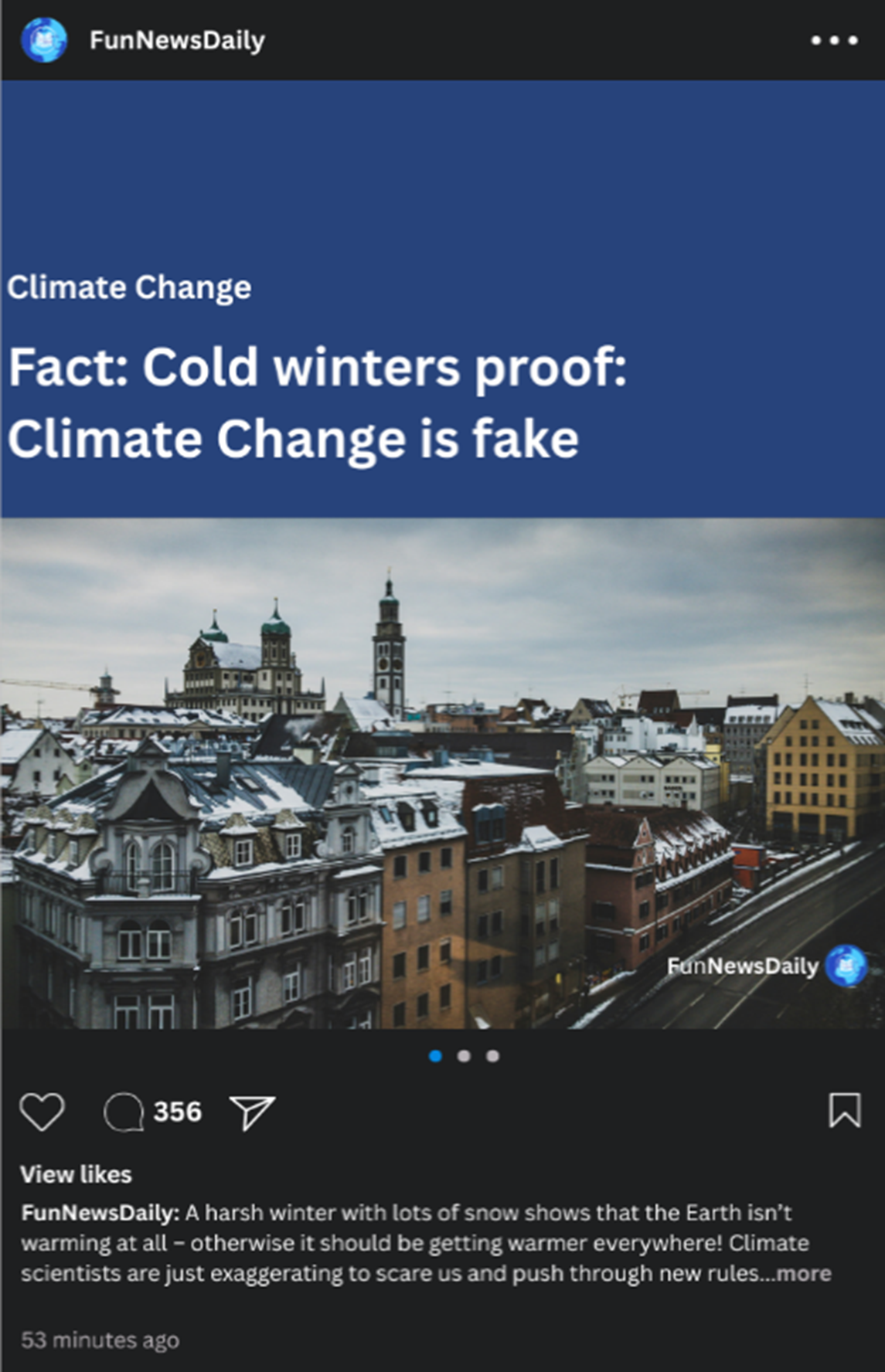
The ability to critically evaluate information related to climate change and to recognise fake news is highly relevant even at primary school age, as children increasingly encounter digital media and climate-related discourses. The aim of this study is to explore primary school students’ conceptions of climate change as well as of fake news and their abilities to evaluate climate change related information, with a focus on the role of the conceptions of climate change in evaluating fake news. A qualitative cross-sectional study was conducted with 28 Year 3 and Year 4 students in Germany using problem-centred interviews and evaluation tasks in June 2025. Almost half of the students were able to describe characteristics of fake news such as manipulative intent or their lack of evidence. However, students’ conceptions of climate change varied considerably in depth and accuracy. Different types of evaluators can be identified, which vary in terms of how differentiated students’ conceptions of climate change are, how they approach the evaluation process, how many decision criteria they apply, whether or not they draw on their conceptions, and the amount of correctly identified news. The study highlights the need for targeted educational strategies to foster climate-related conceptions and evaluation skills at an early age.
Highlights:
- Most students viewed fake news as false or misleading online content.
- Five evaluator types with differing evaluation approaches emerged.
- Climate conceptions influenced how students evaluated climate fake news.
- Students applied diverse criteria when evaluating fake news.
- Findings support fostering evaluation skills in primary education.
Contribution to the Special Issue Topics: This study contributes to the Special Issue by addressing how young learners navigate epistemic uncertainty and mis- and disinformation in complex socio-scientific issues. By examining primary students’ conceptions and their evaluation of climate-related fake news, the paper advances understanding of teaching controversial topics and supports approaches that strengthen critical thinking and powerful geographical knowledge in times of digital disruption and societal transition.
Downloads




References
- Adamina, M. (2008). Vorstellungen von Schülerinnen und Schülern zu raum-, zeit- und geschichtsbezogenen Themen: Eine explorative Studie in Klassen des 1., 3., 5. und 7. Schuljahres im Kanton Bern [Dissertation, Universität Mün-ster]. https://nbn-resolving.de/urn:nbn:de:hbz:6-34589370206
- Aïmeur, E., Amri, S., & Brassard, G. (2023). Fake news, disinformation and misinformation in social media: A review. Social Network Analysis and Mining, 13(1), 1–36. https://doi.org/10.1007/s13278-023-01028-5
- Amazeen, M. A. (2024). The misinformation recognition and response model: An emerging theoretical framework for investigating antecedents to and consequences of misinformation recognition. Human Communication Re-search, 50(2), 218–229. https://doi.org/10.1093/hcr/hqad040
- Babii, A.-N. (2020). The use of critical thinking against fake news. In Proceedings of the NORDSCI Conference (pp. 127–135). http://www.nordsci.org
- Beer, D. de, & Matthee, M. (2021). Approaches to identify fake news: A systematic literature review. In T. Antipova (Ed.), Integrated science in digital age 2020 (Lecture Notes in Networks and Systems, 136, pp. 13–22). Springer International Publishing. https://doi.org/10.1007/978-3-030-49264-9_2
- Brennan, R. L., & Prediger, D. J. (1981). Coefficient kappa: Some uses, misuses, and alternatives. Educational and Psy-chological Measurement, 41, 687–699. https://doi.org/10.1177/001316448104100307
- Cambridge International Education. (2025). Developing the skills to tackle climate change. https://www.cambridgeinternational.org/why-choose-us/benefits-of-a-cambridge-education/climate-change-education/supporting-cambridge-schools/developing-the-skills-to-tackle-climate-change/
- Canva. (2025). Canva Pro [Design software]. Canva. https://www.canva.com
- Cook, J., Ellerton, P., & Kinkead, D. (2018). Deconstructing climate misinformation to identify reasoning errors. Envi-ronmental Research Letters, 13(2), 24018. https://doi.org/10.1088/1748-9326/aaa49f
- Divasson-J, A., Aguayo-Mendoza, A., Quesada, C., Casado-Mansilla, D., & Borges, C. E. (2025). Climate change from B to Z: A cross-generational perception study in Spain. Frontiers in Environmental Science, 13, Article 1511398. https://doi.org/10.3389/fenvs.2025.1511398
- Duit, R. (1997). Alltagsvorstellungen und Konzeptwechsel im naturwissenschaftlichen Unterricht – Forschungsstand und Perspektiven für den Sachunterricht in der Primarstufe. In W. Köhnlein (Hrsg.), Kinder auf dem Wege zum Verstehen von Welt (S. 233–246). Klinkhardt.
- Dumitru, E.-A. (2020). Testing children and adolescents’ ability to identify fake news: A combined design of quasi-experiment and group discussions. Societies, 10(3), 71. https://doi.org/10.3390/soc10030071
- Ecker, U. K. H., Lewandowsky, S., Cook, J., Schmid, P., Fazio, L. K., Brashier, N., Kendeou, P., Vraga, E. K., & Amazeen, M. A. (2022). The psychological drivers of misinformation belief and its resistance to correction. Nature Reviews Psychology, 1(1), 13–29. https://doi.org/10.1038/s44159-021-00006-y
- Einav, S., Levey, A., Patel, P., & Westwood, A. (2020). Epistemic vigilance online: Textual inaccuracy and children’s se-lective trust in webpages. British Journal of Developmental Psychology, 38(4), 566–579. https://doi.org/10.1111/bjdp.12335
- Einsiedler, W. (1997). Probleme und Ergebnisse der empirischen Sachunterrichtsforschung. In B. Marquardt-Mau et al. (Hrsg.), Forschung zum Sachunterricht: Probleme und Perspektiven des Sachunterrichts (Bd. 7, S. 18–42). Klink-hardt.
- Facione, P. (1989). Critical thinking: A statement of expert consensus for purposes of educational assessment and in-struction (The complete American Philosophical Association Delphi research report, pp. 1–21).
- Garrett, R. K., & Weeks, B. E. (2017). Epistemic beliefs' role in promoting misperceptions and conspiracist ideation. PLOS ONE, 12(9), e0184733. https://doi.org/10.1371/journal.pone.0184733
- Gelerstein, D., Del Río, R., Nussbaum, M., Chiuminatto, P., & López, X. (2016). Designing and implementing a test for measuring critical thinking in primary school. Thinking Skills and Creativity, 20, 40–49. https://doi.org/10.1016/j.tsc.2016.02.002
- Girg, R. (1994). Die Bedeutung des Vorverständnisses der Schüler für den Unterricht: Eine Untersuchung zur Didaktik. Klinkhardt.
- Hague, C., & Bouckaert, M. (2022). Creativity, critical thinking & climate education for the green transition. https://oecdedutoday.com/creativity-and-climate-education/
- Hintermann, C., Bergmeister, F. M., & Kessel, V. A. (2020). Critical geographic media literacy in geography education: Findings from the MiDENTITY project in Austria. Journal of Geography, 119(4), 115–126. https://doi.org/10.1080/00221341.2020.1761430
- Housand, B. C. (2021). Fighting fake news! Grades 4–6: Teaching critical thinking and media literacy in a digital age. Routledge. https://doi.org/10.4324/9781003235200
- Kaiser, A., & Milhoffer, P. (1997). Mädchen und Jungen – ihre Selbstwahrnehmung und ihr Zugang zur Welt. In W. Köhnlein et al. (Hrsg.), Kinder auf dem Wege zum Verstehen von Welt (Forschungen zur Didaktik des Sachun-terrichts, Bd. 1, S. 90–109). Klinkhardt.
- Kops, M., Schittenhelm, C., & Wachs, S. (2025). Young people and false information: A scoping review of responses, influential factors, consequences, and prevention programs. Computers in Human Behavior, 169, 108650. https://doi.org/10.1016/j.chb.2025.108650
- Kuckartz, U., & Rädiker, S. (2024). Qualitative Inhaltsanalyse: Methoden, Praxis, Umsetzung mit Software und kün-stlicher Intelligenz (6. Auflage). Juventa Verlag. https://nbn-resolving.org/urn:nbn:de:bsz:31-epflicht-3155932
- Lämmer, S., & Ohl, U. (2024). Facts and fakes – A systematic literature review on how primary school students deal with fake news from the perspective of geography education. International Research in Geographical and Envi-ronmental Education, 1–19. https://doi.org/10.1080/10382046.2024.2438061 511
- Lämmer, S., Schuster, E., & Ohl, U. (in press). The planet is broken – A qualitative cross-sectional study on elementary school students’ conceptions of climate change. In M. Beudels & C. Henrichwark (Eds.), Vorstellungen von Kin-dern zu Themenfeldern der Nachhaltigkeit (pp. 1–14). Julius Klinkhardt.
- Lewandowsky, S., Ecker, U. K. H., & Cook, J. (2017). Beyond misinformation: Understanding and coping with the “post-truth” era. Journal of Applied Research in Memory and Cognition, 6(4), 353–369. https://doi.org/10.1016/j.jarmac.2017.07.008
- Loos, E., Ivan, L., & Leu, D. (2018). “Save the Pacific Northwest tree octopus”: A hoax revisited. Information and Learn-ing Science, 119(9/10), 514–528. https://doi.org/10.1108/ILS-04-2018-0031
- Lutzke, L., Drummond, C., Slovic, P., & Árvai, J. (2019). Priming critical thinking: Simple interventions limit the influence of fake news about climate change on Facebook. Global Environmental Change, 58, 101964. https://doi.org/10.1016/j.gloenvcha.2019.101964
- Machete, P., & Turpin, M. (2020). The use of critical thinking to identify fake news: A systematic literature review. In Birukou & Hattingh (Eds.), Responsible design, implementation and use of information and communication tech-nology (Lecture Notes in Computer Science, Vol. 12067, pp. 235–246). Springer International Publishing. https://doi.org/10.1007/978-3-030-45002-1_20
- McGrew, S., Breakstone, J., Ortega, T., Smith, M., & Wineburg, S. (2018). Can students evaluate online sources? Learn-ing from assessments of civic online reasoning. Theory & Research in Social Education, 46(2), 165–193. https://doi.org/10.1080/00933104.2017.1416320
- Mendoza, G. A. S., Ballar, K. J., Yap, J. K., & Deinla, I. B. (2024). Accuracy or confidence? Analyzing the impact of online misinformation on Filipino youth voting likelihood. Media Asia, 51(3), 470–488. https://doi.org/10.1080/01296612.2023.2279343
- Möller, K. (1999). Konstruktivistisch orientierte Lehr Lernprozessforschung im naturwissenschaftlich-technischen Bereich des Sachunterrichts. In W. Köhnlein (Hrsg.), Vielperspektivisches Denken im Sachunterricht (Forschungen zur Didaktik des Sachunterrichts, Bd. 3, S. 125–191). Klinkhardt.
- Morote, Á.-F., & Hernández, M. (2024). Knowledge and perception of Spanish school children of climate change. Chil-dren’s Geographies, 22(3), 465–479. https://doi.org/10.1080/14733285.2024.2303581
- Niedderer, H. (1988). Schülervorverständnis und historisch-genetisches Lernen. In K. H. Wiebel (Hrsg.), Zur Didaktik der Physik und Chemie: Probleme und Perspektiven (S. 76–107). Leuchtturm.
- Nygren, T., Guath, M., Axelsson, C.-A. W., & Frau Meigs, D. (2021). Combatting visual fake news with a professional fact checking tool in education in France, Romania, Spain and Sweden. Information, 12(5), 201. https://doi.org/10.3390/info12050201
- Nyhan, B., & Reifler, J. (2010). When corrections fail: The persistence of political misperceptions. Political Behavior, 32(2), 303–330. https://doi.org/10.1007/s11109-010-9112-2
- Oğlakcı, B., & Uzun, A. (2025). A decade of artificial intelligence (AI) and geography: Bibliometric insights with AI-powered analysis. European Journal of Geography, 16(2), 372–392. https://doi.org/10.48088/ejg.b.ogl.16.2.372.392
- Ohl, U., & Sprenger, S. (2025). Klimabildung im Schulfach Geographie und in der geographiedidaktischen Forschung. In D. Höttecke, S. Heinicke, 541 H. Martens, A. Nehring, & T. Rabe (Eds.), Handbuch Klimabildung (pp. 141–164). Springer VS; Springer Fachmedien Wiesbaden GmbH. 542 https://doi.org/10.1007/978-3-658-48374-6_7
- O'Mahony, C., Brassil, M., Murphy, G., & Linehan, C. (2023). The efficacy of interventions in reducing belief in conspira-cy theories: A systematic review. PLOS ONE, 18(4), e0280902. https://doi.org/10.1371/journal.pone.0280902
- Paskin, D. (2018). Real or fake news: Who knows? The Journal of Social Media in Society, 7, Article 2.
- Paul, J., Stadtler, M., & Bromme, R. (2019). Effects of a sourcing prompt and conflicts in reading materials on elemen-tary students’ use of source information. Discourse Processes, 56(2), 155–169. https://doi.org/10.1080/0163853X.2017.1402165
- Pilgrim, J., Vasinda, S., Bledsoe, C., & Martinez, E. (2019). Critical thinking is critical: Octopuses, online sources, and reliability reasoning. The Reading Teacher, 73(1), 85–93. https://doi.org/10.1002/trtr.1800
- Pilgrim, J., & Vasinda, S. (2021). Fake news and the “wild wide web”: A study of elementary students’ reliability reason-ing. Societies, 11(4), 121. https://doi.org/10.3390/soc11040121
- Poortinga, W., Demski, C., & Steentjes, K. (2023). Generational differences in climate-related beliefs, risk perceptions and emotions in the UK. Communications Earth & Environment, 4(1). https://doi.org/10.1038/s43247-023-00870-x
- Rijo, A., & Waldzus, S. (2023). That's interesting! The role of epistemic emotions and perceived credibility in the relation between prior beliefs and susceptibility to fake news. Computers in Human Behavior, 141, 107619. https://doi.org/10.1016/j.chb.2022.107619
- Scheufele, D. A., & Krause, N. M. (2019). Science audiences, misinformation, and fake news. Proceedings of the Na-tional Academy of Sciences, 116(16), 7662–7669. https://doi.org/10.1073/pnas.1805871115
- Shepardson, D. P., Roychoudhury, A., & Hirsch, A. S. (Eds.). (2017). Teaching and learning about climate change. Routledge. https://doi.org/10.4324/9781315629841
- Sjöblom, P., Wolff, L.-A., Vuorenpää, S., & Grahn, R. (2022). Primary school students and climate change: An interview study in Finland and Tanzania. Journal of Cleaner Production, 380, 135099. https://doi.org/10.1016/j.jclepro.2022.135099
- Skeirytė, A., Krikštolaitis, R., & Liobikienė, G. (2022). The differences of climate change perception, responsibility and climate-friendly behavior among generations and the main determinants of youth's climate-friendly actions in the EU. Journal of Environmental Management, 323, 116277. https://doi.org/10.1016/j.jenvman.2022.116277
- Škodová, M., Madleňák, T., & Mihoková, M. (2025). Critical spots and misconceptions in students’ understanding of problems and challenges in Europe. European Journal of Geography, 16(2), 406–418. https://doi.org/10.48088/ejg.m.sko.16.2.406.418
- Swim, J. K., Aviste, R., Lengieza, M. L., & Fasano, C. J. (2022). OK boomer: A decade of generational differences in feel-ings about climate change. Global Environmental Change, 73, 102479. https://doi.org/10.1016/j.gloenvcha.2022.102479
- Trott, C. D., Lam, S., Roncker, J., Gray, E.-S., Courtney, R. H., & Even, T. L. (2023). Justice in climate change education: A systematic review. Environmental Education Research, 29(11), 1535–1572. https://doi.org/10.1080/13504622.2023.2181265
- Unsplash. (2019). Hochhäuser unter Wolken [Photograph]. https://unsplash.com/de/fotos/hochhauser-unter-wolken-vePJsyzbLwQ
- Valverde Berrocoso, J., González Fernández, A., & Acevedo Borrega, J. (2022). Disinformation and multiliteracy: A sys-tematic review of the literature: Desinformación y multialfabetización: Una revisión sistemática de la literatura. Comunicar, 93–105. https://doi.org/10.3916/C70-2022-08
- van der Linden, S., Leiserowitz, A., Rosenthal, S., & Maibach, E. (2017). Inoculating the public against misinformation about climate change. Global Challenges, 1(2), 1600008. https://doi.org/10.1002/gch2.201600008
- van Helvoort, J., & Hermans, M. (2020). Effectiveness of educational approaches to elementary school pupils (11 or 12 years old) to combat fake news. Media Literacy and Academic Research, 38–47. https://www.mlar.sk/wp-content/uploads/2020/12/3_Helvoort_Hermans.pdf
- VERBI Software. (2024). MAXQDA 2024 [Computer software]. VERBI Software. Consult. Sozialforschung GmbH. https://www.maxqda.com
- Verhalle, P., & Loos, E. (2025). Fighting disinformation: How to measure the impact of pre- and debunking on Dutch primary school children’s media literacy? Societies, 15(6), 155. https://doi.org/10.3390/soc15060155
- Wang, M. B., & Akin, H. (2025). Effects of epistemic beliefs, science populism, and social media use on climate change misperceptions. Public Understanding of Science. Advance online publication. https://doi.org/10.1177/09636625251343510
- Wildbichler, S., Haagen-Schützenhöfer, C., & Schubatzky, T. (2025). Students’ ideas about the scientific underpinnings of climate change: A systematic review of the literature. Studies in Science Education, 61(1), 117–169. https://doi.org/10.1080/03057267.2024.2395206
- Xu, S., Shtulman, A., & Young, A. (2022). Can children detect fake news? Proceedings of the Annual Meeting of the Cognitive Science Society, 44. Retrieved from https://escholarship.org/uc/item/9bh2z1q9
- Zeidler, D. L., & Nichols, B. H. (2009). Socioscientific issues: Theory and practice. Journal of Elementary Science Educa-tion, 21(2), 49–58. https://doi.org/10.1007/BF03173684
- Zhang, S., & Duke, N. K. (2011). The impact of instruction in the WWWDOT framework on students’ disposition and ability to evaluate web sites as sources of information. The Elementary School Journal, 112(1), 132–154. https://doi.org/10.1086/660687
- Zimmermann, F., & Kohring, M. (2018). „Fake News“ als aktuelle Desinformation: Systematische Bestimmung eines heterogenen Begriffs. Medien & Kommunikationswissenschaft, 66(4), 526–541. https://doi.org/10.5771/1615-634X-2018-4-526