
Climate Change and Geography Education: A Qualitative Study of Expert and Novice Teachers’ Conceptions and Geographical Thinking
Published 2026-05-16
Keywords
- Climate change education,
- Geographical thinking,
- discourse analysis,
- Systems thinking,
- complexity education
- qualitative case study ...More
How to Cite
Copyright (c) 2026 Juan Mar Begueria, María Sebastián-López, Ondrej Kratochvíl, Rafael de Miguel

This work is licensed under a Creative Commons Attribution 4.0 International License.
Accepted 2026-05-03
Published 2026-05-16
Abstract
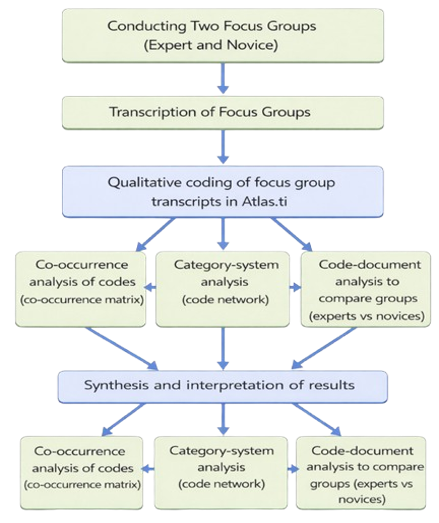
Climate change education represents a significant challenge for geographical education and educators. While there is a a large body of research focused on students’ alternative conceptions, in contrast there is little attention paid to how teachers construct geographical reasoning about climate change. This study aims to analyse how expert and non-expert teachers articulate geographical thinking in relation to climate change education. An interpretative qualitative design was adopted, based on the analysis of two focus groups differentiated by teaching expertise, conducted in the context of the evaluation and discussion of a teacher training course on climate change and GIS. Qualitative data were analysed using a combination of deductive categories derived from the literature and inductively emerging codes due to the thematic analysis. The results reveal clear differences between the two groups. Expert teachers generate a higher density of qualitative data, mobilise systemic and multiscalar reasoning more consistently, and display explicit strategies of epistemic regulation, particularly through theoretical prudence and evidence-based argumentation. In contrast, non-expert teachers tend to frame complexity as a problem to be reduced, relying more frequently on linear or axiological explanations. Importantly, axiological elements are not absent from expert discourse but coexist in tension with non-axiological approaches.
Highlights:
- Expert teachers mobilize systemic and multiscalar reasoning more consistently.
- Theoretical prudence emerges as an exclusive feature of expert discourse.
- Axiological and non-axiological registers coexist within expert reasoning.
- Non-experts frame complexity as a problem to be reduced or simplified.
- Climate change education benefits from powerful geographical knowledge.
Contribution to the Special Issue Topics: This study contributes to the Special Issue by addressing powerful geographical knowledge and spatial thinking through the lens of climate change education. By comparing expert and novice teachers' reasoning, the article engages with critical, future-oriented pedagogies and explores how systems thinking, multiscalarity, and non-axiological reasoning can support geography teaching in uncertain times marked by socio-environmental complexity and contested knowledge.
Downloads




References
- Amin, T. G., & Levrini, O. (2017). Converging perspectives on conceptual change: Mapping an emerging paradigm in the learning sciences. In Converging Perspectives on Conceptual Change: Mapping an Emerging Paradigm in the Learning Sciences. https://doi.org/10.4324/9781315467139
- Butt, G. (2010). Which methods are best suited to the production of high-quality research in geography education? International Research in Geographical and Environmental Education, 19(2), 103–107. https://doi.org/10.1080/10382046.2010.482189
- Carrascosa Alís, J., Martínez Ruedo, S., Alonso, M., & Ruiz Ruiz, J. F. (2022). Análisis de algunas ideas alternativas relacionadas con el cambio climático. Revista Científica, 45(3), 296–314. https://dialnet.unirioja.es/servlet/extart?codigo=8901297
- Catling, S., & Martin, F. (2011). Contesting powerful knowledge: the primary geography curriculum as an articulation between academic and children's (ethno-) geographies. Curriculum Journal, 22(3), 317-335. https://doi.org/10.1080/09585176.2011.601624
- Chang, C.-H., & Pascua, L. (2016). Singapore students’ misconceptions of climate change. International Research in Geographical and Environmental Education, 25(1), 84–96. https://doi.org/10.1080/10382046.2015.1106206
- Charmaz, K. (2006). Constructing grounded theory: A practical guide through qualitative analysis. SAGE. ISBN 9780761973539
- Chi, M. T., Feltovich, P. J., & Glaser, R. (1981). Categorization and representation of physics problems by experts and novices. Cognitive science, 5(2), 121-152. https://www.sciencedirect.com/science/article/pii/S0364021381800298
- Corbin, J., & Strauss, A. (2015). Basics of Qualitative Research. SAGE.
- Danaher, M. (2016). Expanding students’ ability to conceptualize the dynamics of changing places in the teaching of environmental geography. International Research in Geographical and Environmental Education, 25(3), 244–257. https://doi.org/10.1080/10382046.2016.1155324
- De Miguel González, R. (2024). Powerful geography and the future of geographic education. Dialogues in Human Geography, 14(1), 5-8. https://doi.org/10.1177/20438206241229219 (Original work published 2024)
- Dearden, R. F. (1981). Controversial Issues and the Curriculum. Journal of Curriculum Studies, 13(1), 37–44. https://doi.org/10.1080/0022027810130105
- Driver, R., Asoko, H., Leach, J., Scott, P., & Mortimer, E. (1994). Constructing scientific knowledge in the classroom. Educational researcher, 23(7), 5-12. https://doi.org/10.3102/0013189X023007005
- Guzzetti, B. J., & Hynd, C. R. (2013). Perspectives on conceptual change: Multiple ways to understand knowing and learning in a complex world. In Perspectives on Conceptual Change: Multiple Ways to Understand Knowing and Learning in a Complex World. https://doi.org/10.4324/9781315045108
- Havelková, L., & Hanus, M. (2022). Misconceptions and conceptual change in geography teacher education. In Geography teacher education and professionalization (pp. 181-197). Cham: Springer International Publishing. https://doi.org/10.1007/978-3-031-04891-3_12
- Hmelo-Silver, C. E., Marathe, S., & Liu, L. (2007). Fish Swim, Rocks Sit, and Lungs Breathe: Expert-Novice Understanding of Complex Systems. Journal of the Learning Sciences, 16(3), 307–331. https://doi.org/10.1080/10508400701413401
- IPCC AR6 WGI. (2021). Summary for Policymakers. In V. Masson-Delmotte, P. Zhai, A. Pirani, S. L. Connors, C. Péan, S. Berger, B. Zhou (Eds.), The Physical Science Basis. Contribution of Working Group I to the Sixth Assessment Report of the Intergovernmental Panel on Climate Change (pp. 1-41). Cambridge University Press.
- Jacobson, M. J., & Wilensky, U. (2006). Complex Systems in Education: Scientific and Educational Importance and Implications for the Learning Sciences. Journal of the Learning Sciences, 15(1), 11–34. https://doi.org/10.1207/s15327809jls1501_4
- Jakobsson, A., Mäkitalo, Å., & Säljö, R. (2009). Conceptions of knowledge in research on students’ understanding of the greenhouse effect: Methodological positions and their consequences for representations of knowing. Science Education, 93(6), 978–995. https://doi.org/10.1002/sce.20341
- Jasanoff, S. (2004). The idiom of co-production. In States of Knowledge: The Co-Production of Science and the Social Order (pp. 1-12). Routledge Taylor & Francis Group. https://doi.org/10.4324/9780203413845
- Jo, I., & Bednarz, S. W. (2009). Evaluating Geography Textbook Questions from a Spatial Perspective: Using Concepts of Space, Tools of Representation, and Cognitive Processes to Evaluate Spatiality. Journal of Geography, 108(1), 4–13. https://doi.org/10.1080/00221340902758401
- Keller, L., Stötter, J., Oberrauch, A., Kuthe, A., Körfgen, A., & Hüfner, K. (2019). Changing climate change education: Exploring moderate constructivist and transdisciplinary approaches through the research‐education co‐operation kidZ21. Gaia‐Ecological Perspectives for Science and Society, 28(1), 35–43 https://doi.org/10.14512/gaia.28.1.10
- Lambert, D. M., Graves, N., & Slater, F. (2016). Geography as powerful knowledge. International Research in Geographical and Environmental Education, 25(3), 189-194. https://doi.org/10.1080/10382046.2016.1155321
- Leininger-Frézal, C., Oberrauch, A., Keller, L., & Stötter, J. (2023). Global change challenge in the higher education curriculum: An approach through blended learning. European Journal of Geography, 14(2), 1–14. https://doi.org/10.48088/ejg.c.lei.14.2.001.014
- Libarkin, J. C., Anderson, S. W., Science, J. D., Beilfuss, M., & Boone, W. (2005). Qualitative analysis of college students’ ideas about the earth: Interviews and open-ended questionnaires. Journal of Geoscience Education, 53(1), 17–26. https://doi.org/10.5408/1089-9995-53.1.17
- Lincoln, Y. S. & Guba E.G (1985). Naturalistic inquiry (Vol. 75). SAGE.
- López Carrión, A. E., & Llorca-Abad, G. (2025). Desinformación durante la crisis producida por la DANA de 2024 en España: análisis, características, tipologías y desmentidos. Revista Mediterránea De Comunicación, 16(2), e29303. https://doi.org/10.14198/MEDCOM.29303
- Lundholm, C., & Davies, P. (2013). Conceptual Change in the Social Sciences. In International Handbook of Research on Conceptual Change (2nd ed., pp. 288–304). https://doi.org/10.4324/9780203154472-23
- Mambrey, S., Timm, J., Landskron, J. J., & Schmiemann, P. (2020). The impact of system specifics on systems thinking. Journal of Research in Science Teaching, 57(10), 1632–1651. https://doi.org/10.1002/tea.21649
- Maxwell, J. A. (2012). A Realist Approach for Qualitative Research. SAGE.
- Miles, M.B., Huberman, A.M. & Saldana, J. (2014) Qualitative Data Analysis: A Methods Sourcebook. Sage, London. ISBN 978-1-4522-5787-7
- Miller, C. A. (2004). Climate science and the making of a global political order. In States of Knowledge: The Co-Production of Science and the Social Order (pp. 46-66). Routledge Taylor & Francis Group. https://doi.org/10.4324/9780203413845
- Mishra, P., & Koehler, M. J. (2006). Technological pedagogical content knowledge: A framework for teacher knowledge. Teachers College Record, 108(6), 1017–1054. https://doi.org/10.1111/j.1467-9620.2006.00684.x
- Morote, Á. F., & Olcina, J. (2023). Cambio climático y educación. Una revisión de la documentación oficial. Documents d'anàlisi geogràfica, 69(1), 107-134. https://doi.org/10.5565/rev/dag.749
- Murphy, P. K. (2007). The eye of the beholder: The interplay of social and cognitive components in change. Educational Psychologist, 42(1), 41–53. https://doi.org/10.1080/00461520709336917
- OECD. (2019). OECD learning compass 2030: A series of concept notes. OECD Publishing. https://www.oecd.org/education/2030-project/
- Olcina, J., Morote, A.F., & Souto, X.M. (2023). Representaciones sociales y cambio climático en la Geografía escolar. Un estudio de caso desde la formación del profesorado. Scripta Nova. Revista Electronica de Geografia y Ciencias Sociales, 27 (4), 1-32. https://doi.org/10.1344/sn2023.27.39948
- Posner, G. J., Strike, K. A., Hewson, P. W., & Gertzog, W. A. (1982). Accommodation of a scientific conception: Toward a theory of conceptual change. Science Education, 66(2), 211–227. https://doi.org/10.1002/sce.3730660207
- Puertas-Aguilar, M.Á, García Sipols, A. E., & de Lázaro-Torres, M.-L. (2023). Web GIS to Learn Geopolitics in Secondary Education: A case study from Spain. European Journal of Geography, 14(2), 15–31. https://doi.org/10.48088/ejg.m.pue.14.2.015.031
- Renn, O. (2008). Concepts of risk: An interdisciplinary review part 1: Disciplinary risk concepts. GAIA-Ecological Perspectives for Science and Society, 17(1), 50-66. https://doi.org/10.14512/gaia.17.1.13
- Rickles P., Ellul C., & Haklay M. (2017). A suggested framework and guidelines for learning GIS in interdisciplinary research. Geo: Geography and Environment, 4(2). https://doi.org/10.1002/geo2.46
- Rosenshine, B. (2012). Principles of instruction: Research-based strategies that all teachers should know. American educator, 36(1), 12.
- Rousell, D., & Cutter-Mackenzie-Knowles, A. (2020). A systematic review of climate change education: Giving children and young people a ‘voice’ and a ‘hand’ in redressing climate change. Children's Geographies, 18(2), 191-208. https://doi.org/10.1080/14733285.2019.1614532
- Saldaña, J. (2009). The Coding Manual for Qualitative Researchers. Sage
- Scholten, N., Höttecke, D., & Sprenger, S. (2019). Conceptualizing geography teachers’ subject-specific noticing during instruction. European Journal of Geography, 9(3). Retrieved from https://eurogeojournal.eu/index.php/egj/article/view/40
- Schubatzky, T., Wildbichler, S., Haagen-Schützenhöfer, C., Wackermann, R., & Wöhlke, C. (2024). Navigating the complexities of student understanding: Exploring the coherency of students’ conceptions about the greenhouse effect. Science Education, 108(4), 1134–1161. https://doi.org/10.1002/sce.21867
- Shulman, L. S. (1986). Those who understand: Knowledge growth in teaching. Educational Researcher, 15(2), 4–14. https://doi.org/10.3102/0013189X015002004
- Škodová, M., Madleňák, T., & Mihoková M. (2025). “Critical Spots and Misconceptions in Students’ Understanding of Problems and Challenges in Europe”. European Journal of Geography 16 (2), 406-18. https://doi.org/10.48088/ejg.m.sko.16.2.406.418.
- Smit, E., Tuithof, H., Savelsbergh, E., & Béneker, T. (2023). Geography teachers’ pedagogical content knowledge: A systematic review. Journal of Geography, 122(1), 20–29. https://doi.org/10.1080/00221341.2023.2173796
- Smith, G. A. (2002). Place-based education: Learning to be where we are. Phi delta kappan, 83(8), 584-594. https://doi.org/10.1177/003172170208300806
- Spainish Government (2022a). Real Decreto 157/2022, de 1 de marzo, por el que se establece la ordenación y las enseñanzas mínimas de la Educación Primaria. Boletín Oficial del Estado, 52. https://www.boe.es/eli/es/rd/2022/03/01/157
- Spainish Government (2022b). Real Decreto 217/2022, de 29 de marzo, por el que se establece la ordenación y las enseñanzas mínimas de la Educación Secundaria Obligatoria. Boletín Oficial del Estado, 76. https://www.boe.es/eli/es/rd/2022/03/29/217
- Sweeney, L. B., & Sterman, J. D. (2007). Thinking about systems: student and teacher conceptions of natural and social systems. System Dynamics Review, 23(2–3), 285–311. https://doi.org/10.1002/sdr.366
- UNESCO (2025). Education for climate action at COP30. Available in: https://www.unesco.org/en/climate-change/education/cop30?hub=761
- Vosniadou, S. (1994). Capturing and modeling the process of conceptual change. Learning and Instruction, 4(1), 45–69. https://doi.org/10.1016/0959-4752(94)90018-3
- Weber, M. (1949). The methodology of the social sciences. Free Press.
- Zummo, L., Gargroetzi, E., & Garcia, A. (2020). Youth voice on climate change: using factor analysis to understand the intersection of science, politics, and emotion. Environmental Education Research, 26(8), 1207-1226. https://doi.org/10.1080/13504622.2020.1771288