
Developing Geography Teaching Expertise: Perceived Learning Opportunities Among Expert Teachers in Germany
Published 2026-06-14
Keywords
- geography teacher professionalism,
- enablers for geography teaching,
- learning opportunities,
- expert teachers,
- reflective practitioner
How to Cite
Copyright (c) 2026 Lisa Wieczorek, Isabel Höyng, Nina Scholten

This work is licensed under a Creative Commons Attribution 4.0 International License.
Accepted 2026-06-08
Published 2026-06-14
Abstract
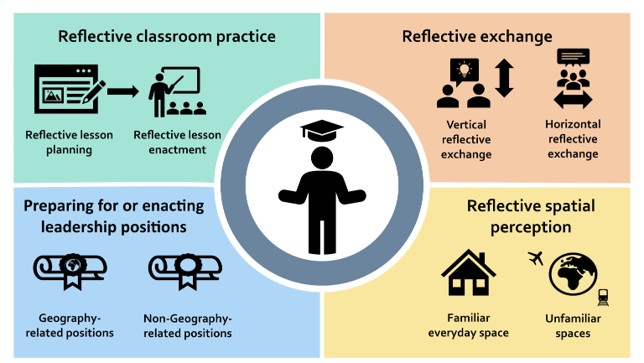
Developing professional expertise in teaching requires more than practical experience or professional knowledge alone; it depends on meaningful enablers or so called learning opportunities. Due to the disciplinary complexity and societal relevance of geography education, geography teachers face specific professional demands. However, systematic insights into the learning opportunities that geography teachers perceive as meaningful remain limited, although such insights could inform geography teacher education and professional development. To address this gap, we conducted an exploratory qualitative and retrospective interview study with seven geography teachers. These teachers were identified as experts based on their experience and qualifications. Semi-structured interviews explored activities, practices, and experiences perceived as crucial for their professional development. Data were analyzed using qualitative content analysis with inductive and deductive coding. The findings indicate four main areas of learning opportunities supporting the development of geography teaching expertise: (1) reflective classroom practice, including lesson planning and lesson enactment; (2) professional exchange, encompassing both horizontal and vertical interactions; (3) the assumption of leadership or specialized roles, which expand perspectives and professional responsibilities; and (4) reflective spatial engagement, including everyday and travel-related experiences that inform subject-specific teaching. The findings support the importance of integrating structured, reflective, and socially embedded learning opportunities into both pre-eservice and in-service teacher education. Professional competence and teaching expertise in geography can therefore be strengthened through subject-specific practices and mentoring—confirming key approaches already discussed in the literature—while suggesting a need for a sharper emphasis on leadership roles and support for the development of reflective engagement with spatial experiences.
Highlights:
- Geography teacher expertise develops through reflexive practice, not just experience.
- Exchange, mentoring, and leadership roles appear to drive professional development.
- Spatial experience is relevant to geography teachers’ professional expertise.
Contribution to the Special Issue Topics: This paper contributes to the special issue by focusing on an important condition for preparing young people to navigate an increasingly complex world: the development of geography teachers’ professional expertise. Drawing on interviews with expert geography teachers, it identifies learning opportunities perceived as particularly meaningful for professional development and highlights how reflective, social, and spatially grounded experiences can support the development of geography teaching expertise.
Downloads




References
- Arnold, E. (2010). Kooperationen zwischen der ersten und zweiten Phase der Lehrerausbildung. Erziehungswissenschaft, 21(40), 69–77. https://doi.org/10.25656/01:2737
- Artvinli, E., Gryl, I., Lee, J., & Mitchell, J. (2022a). Why geography teacher education and professionalization matter. In E. Artvinli, I. Gryl, J. Lee, & J. T. Mitchell (Eds.), Geography teacher education and professionalization. International perspectives on geography education (pp. 1–6). Springer. https://doi.org/10.1007/978-3-031-04891-3_1
- Artvinli, E., Gryl, I., Lee, J., & Mitchell, J. (2022b). Learning from common concerns and the path ahead for geography teacher education and professionalism. In E. Artvinli, I. Gryl, J. Lee, & J. T. Mitchell (Eds.), Geography teacher education and professionalization. International perspectives on geography education (pp. 323–331). Springer. https://doi.org/10.1007/978-3-031-04891-3_21
- Bastian, A. (2024). Teacher noticing of pre-service and in-service secondary mathematics teachers. Springer. https://doi.org/10.1007/978-3-658-45619-1
- Baumert, J., & Kunter, M. (2006). Stichwort: Professionelle Kompetenz von Lehrkräften. Zeitschrift für Erziehungswissenschaft, 9(4), 469–520. https://doi.org/10.1007/s11618-006-0165-2
- Baumert, J., & Kunter, M. (2013). The COACTIV model of teachers’ professional competence. In M. Kunter, J. Baumert, W. Blum, U. Klusmann, & M. Neubrand (Eds.), Cognitive activation in the mathematics classroom and professional competence of teachers (pp. 25–48). Springer. https://doi.org/10.1007/978-1-4614-5149-5_2
- Ben Israel, A. (2022). The atlas and the purple crayon: “Purple mapping” and place-based education in geography teacher-training studies and practice. In E. Artvinli, I. Gryl, J. Lee, & J. T. Mitchell (Eds.), Geography teacher education and professionalization. International perspectives on geography education (pp. 199–212). Springer. https://doi.org/10.1007/978-3-031-04891-3_13
- Bendl, T., Krajňáková, L., Marada, M., & Řezníčková, D. (2025). Geographical thinking in geography education: a systematic review. International Research in Geographical and Environmental Education, 34(4), 326–352. https://doi.org/10.1080/10382046.2024.2354097
- Berliner, D. C. (1986). In pursuit of the expert pedagogue. Educational Researcher, 15(7), 5–13. https://doi.org/10.3102/0013189X015007007
- Berliner, D. C. (2001). Learning about and learning from expert teachers. International Journal of Educational Research, 35(5), 463–482. https://doi.org/10.1016/S0883-0355(02)00004-6
- Blömeke, S., Gustafsson, J.-E., & Shavelson, R. J. (2015). Beyond dichotomies: Competence viewed as a continuum. Zeitschrift für Psychologie, 223(1), 3–13. https://doi.org/10.1027/2151-2604/a000194
- Bromme, R. (1992). Der Lehrer als Experte: Zur Psychologie des professionellen Wissens. Verlag Hans Huber.
- Catling, S. (2024). Learning to understand and teach geography. In S. W. Bednarz, & J. T. Mitchell (Eds.), Handbook of geography education (pp. 609–648). Springer. https://doi.org/10.1007/978-3-031-72366-7_27
- Chihab, L., & Kanwischer, D. (2023). Rassismus und soziale Medien: Dimensionen kritisch-reflexiver Professionalisierung von Geographielehrkräften in der digitalen Migrationsgesellschaft. GW-Unterricht, 169, 22–33. https://doi.org/10.1553/gw-unterricht169s22
- Clarke, L., & Pike, S. (2023). The impact of forming a community of practice on teachers’ attitudes and approaches to primary geography. Irish Educational Studies, 42(4), 911–930. https://doi.org/10.1080/03323315.2023.2258493
- Creswell, J., & Guetterman, T. (2018). Educational research: Planning, conducting and evaluating quantitative and qualitative research (6th ed.). Pearson Education.
- Doyle, W. (1986). Classroom organization and management. In M. C. Wittrock (Ed.), Handbook of research on teaching (3rd ed., pp. 392–431). Macmillan.
- Duit, R., Gropengießer, H., Kattmann, U., Komorek, M., & Parchmann, I. (2012). The model of educational reconstruction – A framework for improving teaching and learning science. In D. Jorde & J. Dillon (Eds.), Science education research and practice in Europe. Cultural perspectives in science education (pp. 13–37). Sense Publishers. https://doi.org/10.1007/978-94-6091-900-8_2
- Ericsson, K. A. (2006). The influence of experience and deliberate practice on the development of superior expert performance. In K. A. Ericsson, N. Charness, R. R. Hoffman, & P. J. Feltovich (Eds.), The Cambridge handbook of expertise and expert performance (pp. 685–706). Cambridge University Press. https://doi.org/10.1017/CBO9780511816796.038
- Ericsson, K. A. (2018). The differential influence of experience, practice, and deliberate practice on the development of superior individual performance of experts. In K. A. Ericsson, R. R. Hoffman, A. Kozbelt, & A. M. Williams (Eds.), The Cambridge handbook of expertise and expert performance (2nd ed., pp. 745–769). Cambridge University Press. https://doi.org/10.1017/9781316480748.038
- Finn, K., Turner-Adams, H., & Webber, M. (2026). Reorienting Aotearoa New Zealand Secondary School Geography Towards Decolonisation and Indigenisation. European Journal of Geography, 17(2), 1–15. https://doi.org/10.48088/ejg.k.fin.17.2.S001.S015
- Fischer, F. (2022). Die zweite Phase der Lehrkräftebildung im Fach Geographie: Eine qualitative Untersuchung der Perspektiven von Fachleiterinnen und Fachleitern in Deutschland (Doctoral dissertation). http://dx.doi.org/10.22029/jlupub-9414
- Golightly, A. (2022). South African geography teachers’ involvement in self-directed professional development activities in geography education. In E. Artvinli, I. Gryl, J. Lee, & J. T. Mitchell (Eds.), Geography teacher education and professionalization. International perspectives on geography education (pp. 305–322). Springer. https://doi.org/10.1007/978-3-031-04891-3_20
- Gröschner, A., & Hascher, T. (2022). Praxisphasen in der Lehrerinnen- und Lehrerbildung. In M. Harring, C. Rohlfs, & M. Gläser-Zikuda (Eds.), Handbuch Schulpädagogik (2nd ed., pp. 706–719). Waxmann. https://www.utb.de/doi/book/10.36198/9783838587967
- Grossmann, P., Hammerness, K., & McDonald, M. (2009). Redefining teaching, re-imagining teacher education. Teachers and Teaching theory and practice, 15(2), 273–289. https://doi.org/10.1080/13540600902875340
- Gueudet, G., & Trouche, L. (2010). Teaching resources and teachers’ professional development: Toward a documentational approach of didactics. arXiv, 1359–1368. https://doi.org/10.48550/arXiv.1006.5782
- Harms, U., & Riese, J. (2018). Professionelle Kompetenz und Professionswissen. In. D. Krüger, I. Parchmann, & H. Schecker (Eds.), Theorien in der naturwissenschaftsdidaktischen Forschung. Springer. (pp. 283–298). https://doi.org/10.1007/978-3-662-56320-5_17
- Hemmer, M., & Uphues, R. (2011). Gemeinsam den Geographieunterricht der Zukunft andenken: Ein idealtypisches Modell für eine kompetenzorientierte Lehrerbildung in der Geographiedidaktik. Geographie und ihre Didaktik, 1, 25–44. https://doi.org/10.18452/25268
- Hof, S. & Hennemann, S. (2013). Geographielehrerinnen und -lehrer im Spannungsfeld zwischen erworbenen und geforderten Kompetenzen. Zeitschrift für Geographiedidaktik, 41(2), 57–80. https://doi.org/10.18452/24615.
- Jackson, P. (2006). Thinking geographically. Geography, 91(3), 199–204. https://de.scribd.com/document/497621862/JACKSON-2006-Thinking-Geographically
- Jo, I. (2024). Geospatial technologies and teacher education. In S. W. Bednarz, & J. T. Mitchell (Eds.), Handbook of geography education (pp. 751–776). Springer. https://doi.org/10.1007/978-3-031-72366-7_31
- Jo, I., & Bednarz, S. W. (2014). Developing pre-service teachers‘ pedagogical content knowledge for teaching spatial thinking through geography. Journal of Geography in Higher Education, 38(2), 301–313. https://doi.org/10.1080/03098265.2014.911828
- Jo, I., & Huh, S. (2022). Pedagogical Reasoning and Action (PR&A): A Framework for Research on Professional Knowledge of Geography Teaching. In. E. Artvinli, I. Gryl, J. Lee, & J.T. Mitchell (Eds.). Geography Teacher Education and Professionalization. International Perspectives on Geographical Education. (pp. 291–303) Springer. https://doi.org/10.1007/978-3-031-04891-3_19
- Lambert, D., Solem, M., & Tani, S. (2014). Achieving human potential through geography education: A capabilities approach to curriculum making in schools. Annals of the Association of American Geographers, 105(4), 723–735. https://doi.org/10.1080/00045608.2015.1022128
- Kraft, M. A., & Papay, J. P. (2014). Can professional environments in schools promote teacher development? Explaining heterogeneity in returns to teaching expertise. Educational Evaluation and Policy Analysis, 36(4), 476–500. https://doi.org/10.3102/0162373713519496
- Krauss, S. (2025). Expertise-Paradigma in der Lehrerinnen- und Lehrerbildung. In C. Cramer, J. König, & M. Rothland (Eds.), Handbuch Lehrerinnen- und Lehrerbildung (2nd ed., pp. 193–201). Julius Klinkhardt Verlag. https://www.utb.de/doi/book/10.36198/9783838554730
- Krauss, S., & Bruckmaier, G. (2014). Das Experten-Paradigma in der Forschung zum Lehrerberuf. In E. Terhart, H. Bennewitz, & M. Rothland (Eds.), Handbuch der Forschung zum Lehrerberuf (pp. 241–261). Waxmann. http://hdl.handle.net/11654/25163
- Kuckartz, U., & Rädiker, S. (2023). Qualitative content analysis. Methods, practice and software. (2nd ed.). Sage Publications Ltd.
- Martínez-Hernández, C., Piskorski, R., & Stoffelen, A. (2023). Designing online workshops for teacher trainees: Heritage mapping with web GIS story maps. European Journal of Geography, 14(3), 68–78. https://doi.org/10.48088/ejg.c.mar.14.3.068.078.
- Mayring, P. (2022). Qualitative content analysis: A step-by-step guide. Sage Publications Ltd.
- Mehren, R., Rempfler, A., Buchholz, J., Hartig, J., & Ulrich-Riedhammer, E. M. (2017). System competence modelling: Theoretical foundation and empirical validation of a model involving natural, social and human-environment systems. Journal of Research in Science Teaching, 55(5), 685–711. https://doi.org/10.1002/tea.21436
- Meurel, M. (2023). Fortbildungsinteressen von Geographielehrkräften – Eine empirische Studie in Nordrhein-Westfalen (Geographiedidaktische Forschungen, Bd. 81). BoD. https://geographiedidaktische-forschungen.de/band-81/
- Molin, L., Grubbström, A., Bladh, G., Westermark, Å., Ojanne, K., Gottfridsson, H.-O., & Karlsson, S. (2023). Do personal experiences have an impact on teaching and didactic choices in geography? European Journal of Geography, 6(4), 6–20. https://eurogeojournal.eu/index.php/egj/article/view/406
- Röhl, S., Groß Ophoff, J., Johannmeyer, K., & Cramer, C. (2023). Nutzung und Bedingungsfaktoren informeller Lerngelegenheiten von Lehrpersonen in Deutschland. Unterrichtswissenschaft, 51, 395–421. https://doi.org/10.1007/s42010-023-00170-5
- Rosendahl, N. (2025). Konzeption eines Lehr-Lern-Labors mittels Design-Based Research. Identifikation von Designprinzipien zur Förderung der Selbstwirksamkeitserwartung angehender Geographielehrkräfte. Die Hochschullehre, 11(4), 38–52. https://doi.org/10.3278/HSL2446W
- Scholten, N., & Sprenger, S. (2020). Teachers’ noticing skills during geography instruction: An expert-novice comparison. Journal of Geography, 19(6), 206–214. https://doi.org/10.1080/00221341.2020.1809695
- Schön, D. A. (1983). The reflective practitioner: How professionals think in action. Basic Books. https://doi.org/10.4324/9781315237473
- Schreier, M. (2012). Qualitative content analysis in practice. Sage Publications Ltd. https://doi.org/10.4135/9781529682571
- Segbers, T., & Eberth, A. (2017). Von der Irritation zur Reflexivität – Zum Potenzial fachdidaktischer Exkursionen für die Professionalisierung angehender Geographielehrkräfte. GW-Unterricht, 145(1), 29–41. https://austriaca.at/?arp=0x003574b8
- Shulman, L. (1986). Those who understand: Knowledge growth in teaching. Educational Researcher, 15(4), 4–14. https://doi.org/10.3102/0013189X015002004
- Shulman, L. (1987). Knowledge and teaching: Foundations of the new reform. Harvard Educational Review, 57(1), 1–23. https://people.ucsc.edu/~ktellez/shulman.pdf
- Smit, E., Hanneke, T., Savelsbergh, E., & Béneker, T. (2023). Geography teachers’ pedagogical content knowledge: A systematic review. Journal of Geography, 122(1), 20–29. https://doi.org/10.1080/00221341.2023.2173796
- Standish, A. (2024). The educational foundations of training to become a secondary-level geography teacher. In S. W. Bednarz & J. T. Mitchell (Eds.), Handbook of geography education (pp. 649–679). Springer. https://doi.org/10.1007/978-3-031-72366-7_28
- Stigler, J. W., & Miller, K. F. (2018). Expertise and expert performance in teaching. In K. A. Ericsson, R. R. Hoffman, A. Kozbelt, & A. M. Williams (Eds.), The Cambridge handbook of expertise and expert performance (2nd ed., pp. 431–452). Cambridge University Press. https://doi.org/10.1017/9781316480748.024
- Taylor, M., Yates, A., Meyer, L., & Kinsella, P. (2011). Teacher professional leadership in support of teacher professional development. Teaching and Teacher Education, 27, 85–94. https://doi.org/10.1016/j.tate.2010.07.005