
Investigating Systems Modelling Processes in Collaborative Mystery Tasks: A Video-Based Study in Geography Education
Published 2026-09-08
Keywords
- systems thinking,
- systems competence,
- concept mapping,
- collaborative learning,
- learning process analysis
- video-based research,
- content analysis,
- geography education ...More
How to Cite
Copyright (c) 2026 Jennifer Meister, Natalie Bienert, Annabelle Koch, Rainer Mehren

This work is licensed under a Creative Commons Attribution 4.0 International License.
Accepted 2026-08-09
Published 2026-09-08
Abstract
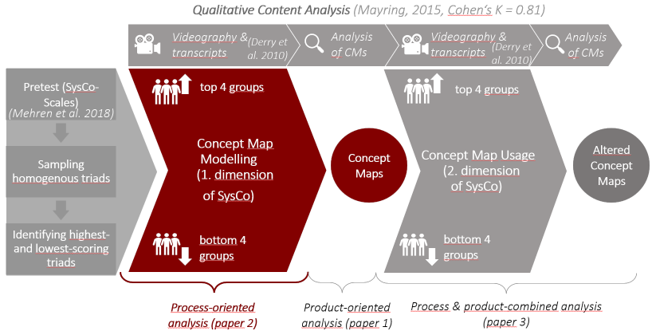
Developing students’ systems competence is a central goal of geography education, as it enables them to recognise, describe, and model complex human-environment systems. Previous research has mainly focused on the products of systemic reasoning, such as the quality of students’ concept maps, whereas the underlying processes through which systems competence develops have remained largely unexplored. This paper therefore takes a process-oriented perspective to analyse how students with high and low levels of systems competence engage in collaborative systems modelling. The data are based on video recordings of eight student groups working on a mystery-based geography task. Using qualitative content analysis, five interrelated dimensions of systemic reasoning were derived: information processing, concept and connection formation, dealing with advanced systemic features, collaborative dynamics, and metacognitive strategies. The results reveal clear differences between high- and low-performing groups. High-performing groups demonstrate strategic information management, causal reasoning, and metacognitive monitoring, while low-performing groups show fragmented processing and linear reasoning. These findings highlight that systemic reasoning in geography is not only a cognitive activity, but also a communicative and metacognitive process. The study provides insights into the dynamic development of systems competence and offers implications for teaching, diagnostic assessment, and further research in geography education.
Highlights:
- Introduces a process-oriented, variance-maximising approach to systems modelling
- Identifies five interrelated dimensions of collaborative systems modelling
- High-performing groups show strategic information management and metacognitive regulation
- Low-performing groups display fragmented processing and linear reasoning
Downloads




References
- Ammoneit, R., Göhner, M., Bielik, T., & Krell, M. (2024). Why most definitions of modeling competence in science education fall short: Analyzing the relevance of volition for modeling. Science Education, 108(2), 443–466. https://doi.org/10.1002/sce.21841
- Aufschnaiter, C., von, Münster, C., & Beretz, A. K. (2018). Zielgerichtet und differenziert diagnostizieren. MNU Journal, 71(6), 382–387.
- Benninghaus, J. C., Mühling, A., Kremer, K., & Sprenger, S. (2019a). The mystery method reconsidered - A tool for assessing systems thinking in education for sustainable development. Education Sciences, 9(4), 260. https://doi.org/10.3390/educsci9040260
- Benninghaus, J. C., Mühling, A., Kremer, K., & Sprenger, S. (2019b). Complexity in education for sustainable consumption - An educational data mining approach using mysteries. Sustainability, 11(3), 722. https://doi.org/10.3390/su11030722
- Ben-Zvi Assaraf, O., & Orion, N. (2005). Development of system thinking skills in the context of earth system education. Journal of Research in Science Teaching, 42(5), 518–560. https://doi.org/10.1002/tea.20061
- Ben-Zvi Assaraf, O., Dodick, J., & Tripto, J. (2013). High School Students’ Understanding of the Human Body System. Research in Science Education, 43, 33–56. https://doi.org/10.1007/s11165-011-9245-2
- Bienert, N., Scholten, N., & Mehren, R. (2024). Unterrichtsqualität in der Geographie – Eine fachspezifische Sekundäranalyse der sächsischen Schulevaluation. Zeitschrift für Geographiedidaktik (ZGD), 51(3), 123–142. https://doi.org/10.60511/51184
- Biggs, J. B., & Collis, K. F. (1982). Evaluating the quality of learning: The SOLO taxonomy (Structure of the Observed Learning Outcome). Academic Press.
- Cañas, A. J., Reiska, P., & Shvaikovsky, O. (2023). Improving learning and understanding through concept mapping. Knowledge Management & E-Learning, 15(3), 369–380. https://doi.org/10.34105/j.kmel.2023.15.021
- Chang, C.-C., Liu, G.-Y., Chen, K.-J., Huang, C.-H., Lai, Y-M., & Yeh, T.-K. (2017). The Effects of a Collaborative Computer-based Concept Mapping Strategy on Geographic Science Performance in Junior High School Students. Eurasia Journal of Mathematics, Science and Technology Education, 13(8), 5049 – 5060. https://doi.org/10.12973/eurasia.2017.00981a
- Cox, M., Elen, J., & Steegen, A. (2022). A Test to Measure students’ Systems Thinking Abilities in Geography. European Journal of Geography, 9(1), 105-120. https://www.eurogeojournal.eu/index.php/egj/article/view/102
- Demssie, Y. N., Biemans, H. J. A., Wesselink, R., & Mulder, M. (2023). Fostering students’ systems thinking competence for sustainability by using multiple real-world learning approaches. Environmental Education Research, 29 (2), 261-286. https://doi.org/10.1080/13504622.2022.2141692
- Derry, S. J., Pea, R. D., Barron, B., Engle, R. A., Erickson, F., Goldman, R., Hall, R., Koschmann, T., Lemke, J. L., Sherin, M. G., & Sherin, B. L. (2010). Conducting video research in the learning sciences: Guidance on selection, analysis, technology, and ethics. Journal of the Learning Sciences, 19(1), 3–53. https://doi.org/10.1080/10508400903452884
- Flavell, J. H. (1979). Metacognition and cognitive monitoring: A new area of cognitive-developmental inquiry. American Psychologist, 34(10), 906–911. https://doi.org/10.1037/0003-066X.34.10.906
- Göhner, M. F., Bielik, T., & Krell, M. (2022). Investigating the dimensions of modeling competence among preservice science teachers: Meta-modeling knowledge, modeling practice, and modeling product. Journal of Research in Science Teaching, 59(8), 1354-1387. https://doi.org/10.1002/tea.21759
- Hempowicz, J. (2021). Systemorganisationskompetenz im Geographieunterricht: Videobasierte Fallanalysen von Schüler*innen im Rahmen der Mystery-Methode (Vol. 75). BoD–Books on Demand.
- Karkdijk, J. (2021). Mysteries to support geographical relational thinking in secondary education [Doctoral dissertation, Vrije Universiteit Amsterdam]. Quaeris Media BV.
- Karkdijk, J., van der Schee, J., & Admiraal, W. (2021). Strategies used by small student groups to understand a geographical mystery. Journal of Research and Didactics in Geography, 1, 5–21.
- Karkdijk, J., Admiraal, W., & van der Schee, J. (2019). Small-group work and relational thinking in geographical mysteries. Review of International Geographical Education Online, 9(2), 402–425. https://doi.org/10.33403/rigeo.588661
- Khajeloo, M., & Siegel, M. A. (2022). Concept map as a tool to assess and enhance students' system thinking skills. Instructional Science, 50, 571-597. https://doi.org/10.1007/s11251-022-09586-5
- Kleemann, F., Krähnke, U., & Matuschek, I. (2009). Interpretative Sozialforschung: Eine praxisorientierte Einführung. VS Verlag für Sozialwissenschaften.
- Kuckartz, U., & Rädiker, S. (2022). Qualitative Inhaltsanalyse. Methoden, Praxis, Computerunterstützung: Grundla-gentexte Methoden (5th ed.). Juventa Verlag.
- Kwon, S. Y., & Cifuentes, L. (2009). The comparative effect of individually-constructed vs. collaboratively-constructed computer-based concept maps. Computer & Education, 52 (2), 365 – 375. https://doi.org/10.1016/j.compedu.2008.09.012
- Lamb, C. M. T. (2009). Collaborative systems thinking: An exploration of the mechanisms enabling systems thinking. [Doctoral dissertation, Massachusetts Institute of Technology].
- Leat, D. (1998). Thinking through geography. Chris Kington Publishing.
- Leat, D., & Nichols, A. (1999). Mysteries make you think. Chris Kington Publishing.
- Leat, D., & Nichols, A. (2000). Brains on the Table: Diagnostic and formative assessment through observation. Assessment in Education: Principles, Policy & Practice 7(1), 103–121. https://doi.org/10.1080/713613327
- Lenski, S., Elsner, S., & Großschedl, J. (2022). Comparing construction and study of concept maps – an intervention study of learning outcome, self-evaluation and enjoyment through training and learning. Frontiers in Education, 7, 892312. https://doi.org/10.3389/feduc.2022.892312
- Li, R., & Li, G. (2023). Exploring Lower-Secondary School Students' Systems Thinking Performance in Ecological Issue. Journal of Baltic Science Education, 22(5), 865–880. https://doi.org/10.33225/jbse/23.22.865
- Liang, J. (2015). Live video classroom observation: an effective approach to reducing reactivity in collecting observational information for teacher professional development. Journal of Education for Teaching, 41(3), 235–253. https://doi.org/10.1080/02607476.2015.1045314
- Lincoln, Y. S., & Guba, E. G. (1985). Naturalistic inquiry. Sage Publications.
- Mayring, P. (2015). Qualitative Inhaltsanalyse: Grundlagen und Techniken. Beltz.
- Meadows, D. H. (2008). Thinking in systems: A primer. Chelsea Green Publishing.
- Mehren, R., Rempfler, A., Buchholz, J., Hartig, J., & Ulrich-Riedhammer, E. M. (2018). System competence modelling: Theoretical foundation and empirical validation of a model involving natural, social and human–environment systems. Journal of Research in Science Teaching, 55(5), 685 - 711. https://doi.org/10.1002/tea.21436
- Meister, J. (2020). Systemisches Denken bei Schülerinnen und Schülern unterschiedlicher Kompetenzstufen. Eine qualitative Prozess- und Produktanalyse am Beispiel der Bearbeitung eines geographischen Mysterys [Doctoral dissertation, Justus-Liebig-Universität Gießen]. JLUpub. http://dx.doi.org/10.22029/jlupub-9837
- Mercer, N. (2002). Words and minds: How we use language to think together. Routledge. https://doi.org/10.4324/9780203464984
- Mercer, N., & Howe, C. (2012). Explaining the dialogic processes of teaching and learning: The value and potential of sociocultural theory. Learning, Culture and Social Interaction, 1(1), 12–21. https://doi.org/10.1016/j.lcsi.2012.03.001
- Nielsen, S. S., & Nielsen, J. A. (2021). A competence-oriented approach to models and modelling in lower secondary science education: Practices and rationales among Danish teachers. Research in Science Education, 51(Suppl 2), 565-593. https://doi.org/10.1007/s11165-019-09900-1
- Pivarníková, V. (2025). Utilisation of Concept Maps in Geography Education Research: A Systematic Review. European Journal of Geography 16(2), 169-184. https://doi.org/10.48088/ejg.v.piv.16.2.169.183.
- Rempfler, A., & Uphues, R. (2011). Systemkompetenz im Geographieunterricht – Die Entwicklung eines Kompetenzmodells. In Geographische Bildung: Kompetenzen in didaktischer Forschung und Schulpraxis (pp. 36–48).
- Rieckmann, M. (2012). Future-oriented higher education: Which key competencies should be fostered through university teaching and learning? Futures, 44(2), 127–135. https://doi.org/10.1016/j.futures.2011.09.005
- Roczen, N., Fischer, F., Fögele, J., Hartig, J., & Mehren, R. (2021). Measuring system competence in education for sustainable development. Sustainability, 13(9), 4932. https://doi.org/10.3390/su13094932
- Schuler, S., Fanta, D., Rosenkraenzer, F., & Riess, W. (2018). Systems thinking within the scope of education for sustainable development (ESD) – a heuristic competence model as a basis for (science) teacher education. Journal of Geography in Higher Education, 42(2), 192-204. https://doi.org/10.1080/03098265.2017.1339264
- Schwarz, C. V., Reiser, B. J., Davis, E. A., Kenyon, L., Achér, A., Fortus, D., Shwartz, Y., Hug, B., & Krajcik, J. (2009). Developing a learning progression for scientific modeling: Making scientific modeling accessible and meaningful for learners. Journal of Research in Science Teaching, 46(6), 632–654. https://doi.org/10.1002/tea.20311
- Sterman, J. D. (2002). System dynamics: Systems thinking and modeling for a complex world. [Massachusetts Institute of Technology. Engineering Systems Division]. https://dspace.mit.edu/handle/1721.1/102741
- Tripto, J., Ben-Zvi Assaraf, O., Snapir, Z., & Amit, M. (2017). How is the body’s systemic nature manifested amongst high school biology students. Instructional Science, 45, 73-98. https://doi.org/10.1007/s11251-016-9390-0
- Tuma, R., Schnettler, B., & Knoblauch, H. (2013). Videographie: Einführung in die interpretative Videoanalyse sozialer Situationen. Springer VS.
- Upmeier zu Belzen, A., van Driel, J., & Krüger, D. (2019). Introducing a Framework for Modeling Competence. In Towards a Competence-Based View on Models and Modeling. In A. Upmeier zu Belzen, D. Krüger, & J. van Driel (Eds.): Towards a Competence-Based View on Models and Modeling in Science Education. Models and Modeling in Science Education (pp. 3-19). Springer . https://doi.org/10.1007/978-3-030-30255-9_1
- Vygotsky, L. S. & Kozulin, A. (1986). Thought and Language. Cambridge, MA: MIT Press.
- Waters Center for Systems Thinking (2020). Habits of a systems thinker, Thinking Tools Studio: Habits of a Systems Thinker. Available at: https://thinkingtoolsstudio.waterscenterst.org/cards (Accessed: 06 July 2026).
- Yoon, S. A., & Hmelo-Silver, C. (2017). Introduction to special issue: models and tools for systems learning and instruction. Instructional Science, 45, 1–4. https://doi.org/10.1007/s11251-017-9404-6
- Zohar, A., & Dori, Y. J. (Eds.). (2012). Metacognition in science education: Trends in current research. Springer. https://doi.org/10.1007/978-94-007-2132-6