
Published 2026-03-19
Keywords
- truthfulness,
- post truth,
- racial literacy,
- future 3,
- geography education
How to Cite
Copyright (c) 2026 David Lambert, Kelly León

This work is licensed under a Creative Commons Attribution 4.0 International License.
Accepted 2026-03-15
Published 2026-03-19
Abstract
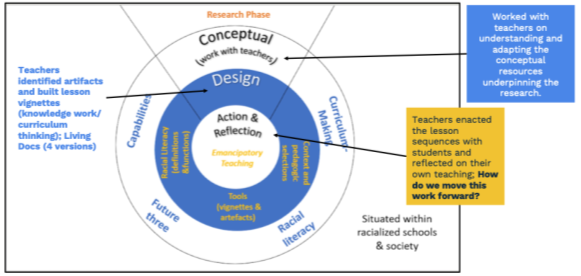
In this paper we address the question of truthfulness in education. How can a concern for truthfulness be preserved (or restored) in an age of post-truth discourse which enables the politics of denial? While acknowledging that such issues raise matters far beyond the scope of geography educators alone to ‘fix’ in any meaningful way, we argue that teachers can and must respond to the fundamental challenge these matters provide for what even counts as educational today. The paper analyses the challenge conceptually before reporting on a collaborative research initiative developed with teachers in a mid-western state of the U.S. This project focused on racial literacy as an element of truth telling in geography and social studies teaching. It explored with serving teachers the practical enactment of “future 3” (F3) curriculum scenarios. The work, which took place over the period of eighteen months, is presented as a case study of teachers’ knowledge work which engages directly with the proposition that developing racial literacy is an essential component of F3 curriculum making.
Highlights:
- Collaborative and reciprocal research methodology with school-teachers
- Conceptually explorative, examining an educational response to “post-truth” discourse
- Illustrates racial literacy as a generative component of teachers’ “knowledge work”
Contribution to the Special Issue Topics: This article contributes to the special issue through its overarching theme which is to develop (through F3 thinking) the epistemic capabilities of teachers and students. The argument is that through their knowledge work teachers and students are empowered to navigate complex societal changes. The article focusses on the prevailing socio-political condition of “post-truth” and how educators can and must retain and develop a concern for truthfulness in teaching geography.
Downloads




References
- An, S. (2022). Re/Presentation of Asian Americans in 50 states’ K–12 US history standards. The Social Studies, 113(4), 171-184. https://doi.org/10.1080/00377996.2021.2023083
- Baker, C. K., & Bitto, L. E. (2022). Interrogating the tensions of becoming antiracist mathematics teacher educators via critical friendship and rehearsals. Studying Teacher Education, 18(1), 80-97. https://doi.org/10.1080/17425964.2021.1997737
- Ball, S. J. (1993) Education, Majorism and ‘the Curriculum of the Dead’, Curriculum Studies, 1:2, 195-214, DOI: https://doi.org/10.1080/0965975930010202
- BBC (2025) Don’t blindly trust what AI tells you says Google’s Sundar Pichai. https://www.bbc.co.uk/news/articles/c8drzv37z4jo
- Béneker, T., Bladh, G. and Lambert, D. (2024). ‘Exploring “Future three” curriculum scenarios in practice: learning from the GeoCapabilities project’, The Curriculum Journal, 35, 3, pp. 396–411. https://doi.org/10.1002/curj.240
- Béneker, T. and Lambert, D. (2024). ‘GeoCapabilities in geography education’, Oxford Bibliographies. https://doi.org/10.1093/obo/9780199874002-0282
- Berman, M. (1983). All that is solid melts into the air: the experience of modernity. London: Verso.
- Bernstein, B. (1970). Education cannot compensate for society. New Society, 387, pp. 344-347.
- Bhaskar, R. (2017). The Order of Natural Necessity: A kind of introduction to Critical Realism. London: Gary Hawke.
- Biesta, G. (2017). The rediscovery of teaching. Taylor & Francis.
- Biesta, G. (2015). Beautiful risk of education. Routledge.
- Biesta, G. (2025). ‘From the point where I stand to the place where I can be found: the critique of perspectival reason as philosophy of education’, Educational Philosophy and Theory, 57, 9, pp. 821–35. https://doi.org/10.1080/00131857.2024.2435336
- Brown, C. and Handscomb, G. (Eds) (2025) Demagogues, Populism and Misinformation. A guide to combatting dark ideas. Leeds: Emerald Publishing.
- Bruner, J. S. (2009). The process of education. Harvard University Press.
- Coghlan, D. (2019). Doing action research in your own organization. Sage.
- Corbin, J. & Holt, N.J. (2005). Grounded theory. In B. Somekh and C. Lewin (Eds.), Research Methods in the Social Sci-ences (pp. 113-120). Sage.
- Dalal, F. (2002). Race, Colour and the Processes of Racialization: New Perspectives from Group Analysis, Psychoanalysis and Sociology (1st ed.). Routledge. https://doi.org/10.4324/9780203768679
- Deng, Z. (2022). Powerful knowledge, educational potential, and knowledge-rich curriculum: pushing the boundaries. Journal of Curriculum Studies, 54, 5, 599-617. https://doi.org/10.1080/00220272.2022.2089538
- Deng, Z. (2025). Knowledge and curriculum: towards an educational and Didaktik/curriculum way of thinking and theo-rizing. Journal of Curriculum Studies, 57(1), 64–77. https://doi.org/10.1080/00220272.2025.2455690
- Firth, R. (2011). Making geography visible as an object of study in the secondary school curriculum, Curriculum Journal, 22, 3, 289-316. http://dx.doi.org/10.1080/09585176.2011.601209
- Firth, R. (2018). Recontextualising geography as a school subject. In Jones, M. and Lambert, D. (Eds) Debates in Geog-raphy Education (2nd Edition). Abingdon: Routledge.
- Fricker, M. (2015). Epistemic Contribution as a Central Human Capability. In: Hull, G., (ed.) The Equal Society: Essays on Equality in Theory and Practice. Lexington Books, pp. 73-90. ISBN 9781498515719
- Guinier, L. (2003). Admissions rituals as political acts: Guardians at the gates of our democratic ideals. Harvard Law Review, 117(1), 114-224. http://www.jstor.org/stable/4093402
- Healy, G. (2026). Developing recognition for teachers’ intellectual work: A view on recontextualisation that starts from the teacher. In Healy, G., Swift, D. and Barrett, B. (Eds) Knowledge Production, Policy and Practice in Education: Social Realist Explorations of Curriculum, Teaching and Research. Routledge.
- Hicks, D. (2014). A geography of hope. Geography, 99, 1, 5–12. https://doi.org/10.1080/00167487.2014.12094385
- Hudson, B. (2019). Epistemic quality for equitable access to quality education in school mathematics. Journal of Cur-riculum Studies, 51(4), 437–456. https://doi.org/10.1080/00220272.2019.1618917
- Huckle, J. (2019). Powerful geographical knowledge is critical knowledge underpinned by critical realism. International Research in Geographical and Environmental Education, 28, 1 70-84. https://doi.org/10.1080/10382046.2017.1366203
- Ichikawa, J. and Steup, M. (2024). "The Analysis of Knowledge", The Stanford Encyclopedia of Philosophy (Fall 2024 Edition), Edward N. Zalta & Uri Nodelman (eds.). https://plato.stanford.edu/archives/fall2024/entries/knowledge-analysis/
- Jones, B. L. (2022). Feeling fear as power and oppression: An examination of Black and white fear in Virginia’s US histo-ry standards and curriculum framework. Theory & Research in Social Education, 50(3), 431-463. https://doi.org/10.1080/00933104.2022.2069529
- Kavanagh, R. & Rich, M. (2018). Truth Decay: A Threat to Policymaking and Democracy. https://www.rand.org/pubs/research_briefs/RB10002.html
- King, L. J. (2022). Racial Literacies and Social Studies: Curriculum, Instruction, and Learning. Research and Practice in Social Studies Series. Teachers College Press. 1234 Amsterdam Avenue, New York, NY 10027.
- Lambert, D. (2009). Geography in Education: lost in the post? Inaugural professorial lecture. London: Institute of Edu-cation.
- Lambert, D. and León, K. (2023). The value of geography to an individual's education, in Hammond, L., Biddulph, M., Catling, S., and McKendrick, J. H. (Eds) Children, Education and Geography Rethinking Intersections. London: Routledge.
- Lambert, D., Béneker, T., Bladh, G. and Mitchell, D. (2025). Curriculum making in an age of crisis: the contribution of the capabilities approach. Geography 110, 3, 147-157. https://doi.org/10.1080/00167487.2025.2558440
- León, K. (2025). Ethnic Studies for Secondary Schooling: Collaborative Curricular Insights from a Working Collective. Unpublished PhD thesis, University of San Diego. https://digital.sandiego.edu/dissertations/1056/
- Masalha N (2003). The Politics of Denial: Israel and the Palestinian refugee problem. London: Pluto Press.
- McPhail, G., Pountney, R. and Wheelahan, L. (eds) (2024). Emerging Perspectives from Social Realism on Knowledge and Education. New York, NY: Routledge.
- Milburn, M. A. and Conrad, S. D. (1996). The Politics of Denial. Cambridge MA: MIT Press.
- Mitchell, D., Hanus, M., Béneker, T., Biddulph, M., Leininger-Frézal, C., Zwartjes, L. and Donert, K. (2022) ‘Enhancing teachers’ expertise through curriculum leadership – lessons from the GeoCapabilities 3 project’, Journal of Geog-raphy, 121, 5–6, 162–72. https://doi.org/10.1080/00221341.2022.2149838
- Morgan, J. (2012). Teaching Secondary Geography: as if the planet matters. Abingdon: Routledge.
- Morgan, J. (2018). ‘Michael Young, knowledge, and the crises of capitalism’. In D. Guile, D. Lambert and M. Reiss (eds), Sociology, Curriculum Studies and Professional Knowledge: New perspectives on the work of Michael Young. London: Routledge.
- Morgan, J. (2021). From the Fossil Curriculum to the Post-Carbon Curriculum: Histories and Dilemmas. In: Green, B., Roberts, P., Brennan, M. (eds) Curriculum Challenges and Opportunities in a Changing World. Curriculum Studies Worldwide. Palgrave Macmillan, Cham. https://doi.org/10.1007/978-3-030-61667-0_19
- Morgan, J. (2022) ‘Knowledge, culture and the curriculum in Britain, 1944 to the present’. London Review of Education, 20 (1), 34. https://doi.org/10.14324/LRE.20.1.34
- Morgan, J. (forthcoming). The Brave New Worlds of Educational Technology, in Robertson, M. (ed.) (in press/2026). Youth, AI, identity and moral purpose. Springer (Netherlands)
- Morgan, J. and Lambert, D. (2023). Race, Racism and the Geography Curriculum. London: Bloomsbury.
- Muller, J. (2022). Powerful knowledge, disciplinary knowledge, curriculum knowledge: Educational knowledge in ques-tion. International Research in Geographical and Environmental Education, 32, 20–34. https://doi.org/10.1080/10382046.2022.2058349
- Nussbaum, M., & Sen, A. (Eds.). (1993). The quality of life. Clarendon Press.
- Pantić, N. (2015). A model for study of teacher agency for social justice. Teachers and Teaching, 21(6), 759–778. https://doi.org/10.1080/13540602.2015.1044332
- Priestley, M., & Biesta, G. (2013). Introduction: The new curriculum. Reinventing the curriculum: New trends in curricu-lum policy and practice, 1-12. London: Bloomsbury.
- Priestley, M., Biesta, G., & Robinson, S. (2015). Teacher Agency: An Ecological Approach. Bloomsbury. https://doi.org/10.5040/9781474219426
- Priestley, M., & Drew, V. (2019). Professional enquiry: An ecological approach to developing teacher agency. In An eco-system for research-engaged schools (pp. 154-169). Routledge.
- Rolón-Dow, R., Flynn, J. E. & Worden, L. J. (2021). Racial Literacy: A Productive Framework for Engaging Race and Rac-ism in Teacher Education. Thresholds 44, 1, 22-40.
- Seldon, A. (2025). Foreword. In Brown, C. and Handscomb, G. (Eds) Demagogues, Populism and Misinformation. A guide to combatting dark ideas. Leeds: Emerald Publishing.
- Shelton, J. (2023). The Education Myth: how human capital trumped social democracy. New York: Cornell University Press.
- Tinoca, L., Piedade, J., Santos, S., Pedro, A., & Gomes, S. (2022). Design-based research in the educational field: A sys-tematic literature review. Education Sciences, 12(6), 4.
- Wadley, D. (2008). The Garden of Peace. Annals of the Association of American Geographers, 98(3), 650–685. https://doi.org/10.1080/00045600802099162
- Walker, M. (2019). Defending the Need for a Foundational Epistemic Capability in Education. Journal of Human Devel-opment and Capabilities, 20(2), 218–232. https://doi.org/10.1080/19452829.2018.1536695
- Young, M. (2008). Bringing knowledge back in: From social constructivism to social realism in the sociology of educa-tion. Routledge.
- Young, M., Lambert, D., Roberts, C., & Roberts, M. (2014). Knowledge and the future school: Curriculum and social justice. Bloomsbury Publishing.
- Young, M., & Muller, J. (2010). Three educational scenarios for the future: Lessons from the sociology of knowledge. European Journal of Education, 45(1), 11-27. https://doi.org/10.1111/j.1465-3435.2009.01413.x
- Zuckerman, E. (2025). Truth in the age of confidently wrong AI. Prospect. Issue 343. Dec 2025, pp 34-35.