
Students’ Perceptions of Stakeholders and Opinions on Democratic Negotiation in Urban Climate-Change Decision-Making
Published 2026-04-29
Keywords
- climate change education,
- student perceptions,
- education for sustainable development,
- local democratic competence,
- participatory competence
- political geography education ...More
How to Cite
Copyright (c) 2026 Marine Simon, Alexandra Budke

This work is licensed under a Creative Commons Attribution 4.0 International License.
Accepted 2026-04-26
Published 2026-04-29
Abstract
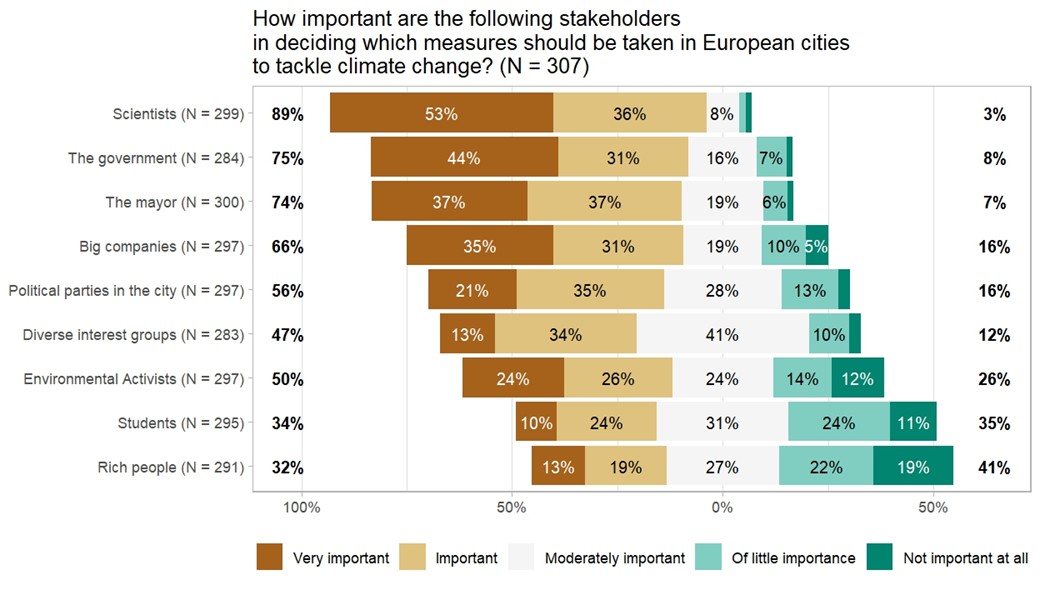
European cities are central arenas of climate mitigation and adaptation, yet local climate policy-making is shaped by complex multilevel governance involving diverse stakeholders. However, a gap remains between this complexity and public perceptions of who is responsible for addressing climate change. At the same time, democratic dissatisfaction among younger generations is growing towards national politics, raising questions about how they perceive local climate decision-making. Geography education, which integrates political and democratic competences, requires empirical insights into students’ perceptions and opinions to strengthen their skills in understanding stakeholder roles, governance processes and local negotiations over climate policies. This study addresses these gaps through a survey of 307 students aged 14–20 from France, Germany, Italy, and Spain. The analysis examines students’ perceptions of local political actors and stakeholders responsible for climate action, as well as their views on decision-making procedures at the city level via sets of Likert scales and items. Frequency distribution analysis and correlation calculations allow to show that students identify a variety of local stakeholders as important but tend to not consider their own role as decisive. Students mostly support democratic decision-making processes, although being interested in climate change and being a female student are correlated with more democratic positions. However, governance processes seem to not be really well known among students. This study, thus, offers exploratory insights that can inform geography education aimed at fostering informed, participatory engagement with urban climate governance.
Highlights:
- Students’ perceptions of stakeholders responsible for local climate policy are multilateral.
- Students’ opinions on local processes of decision-taking are mostly democratic.
- Female students and students interested in climate change supported more democratic opinions.
- Students seem to have difficulties understanding local climate governance.
- Geography education needs to address deficits in local climate governance in an empowering manner
Contribution to the Special Issue Topics: This article aims to inform researchers and geography educators about the perceptions and opinions of secondary school pupils in four European countries, within a geopolitical and democratic context characterised by uncertainty and fragmentation. It highlights the need to empower students to understand and influence climate policy and democratic decision-making at a local level.
Downloads




References
- Aboagye, P. D., & Sharifi, A. (2024). Urban climate adaptation and mitigation action plans: A critical review. Renewable and Sustainable Energy Reviews, 189, 113886. https://doi.org/10.1016/j.rser.2023.113886
- Angelucci, D., Carrieri, L., & Improta, M. (2025). ‘No Participation Without Representation’: The Impact of Descriptive and Substantive Representation on the Age-Related Turnout Gap. Political Studies, 73(1), 126–148. https://doi.org/10.1177/00323217241229316
- Ariely, G., & Davidov, E. (2011). Can we Rate Public Support for Democracy in a Comparable Way? Cross-National Equivalence of Democratic Attitudes in the World Value Survey. Social Indicators Research, 104(2), 271–286. https://doi.org/10.1007/s11205-010-9693-5
- Bedock, C. (2024). Qui doit gouverner ? Jeunesse(s) et soutien à différents modes de gouvernement en France. Agora Débats/Jeunesses, n° 98(3), 7–24. https://doi.org/10.3917/agora.098.0007
- Belchior, A. M. D. C., & Teixeira, C. P. (2024). Breaking with mainstream politics while engaging with polarized: Determinants of young Europeans’ support for democracy. Journal of Youth Studies, 27(7), 986–1005. https://doi.org/10.1080/13676261.2023.2187693
- Bergman, M. M. (1998). A Theoretical Note on the Differences Between Attitudes, Opinions, and Values. Swiss Political Science Review, 4(2), 81–93. https://doi.org/10.1002/j.1662-6370.1998.tb00239.x
- Bofferding, L., & Kloser, M. (2015). Middle and high school students’ conceptions of climate change mitigation and adaptation strategies. Environmental Education Research, 21(2), 275–294. https://doi.org/10.1080/13504622.2014.888401
- Brock, A., Williams, I., & Kemp, S. (2023). “I’ll take the easiest option please”. Carbon reduction preferences of the public. Journal of Cleaner Production, 429, 139398. https://doi.org/10.1016/j.jclepro.2023.139398
- Brockmüller, S. (2019). Erfassung und Entwicklung von Systemkompetenz – Empirische Befunde zu Kompetenzstruktur und Förderbarkeit durch den Einsatz analoger und digitaler Modelle im Kontext raumwirksamer Mensch-Umwelt-Beziehungen. Pädagogische Hochschule Heidelberg.
- Budke, A. (2016). Potentiale der Politischen Bildung im Geographieunterricht. In A. Budke & M. Kuckuck (Eds), Politische Bildung im Geographieunterricht (pp. 11–23). Franz Steiner Verlag. https://elibrary.steiner-verlag.de/book/99.105010/9783515113250
- Bulkeley, H. (2010). Cities and the Governing of Climate Change. Annual Review of Environment and Resources, 35(Volume 35, 2010), 229–253. https://doi.org/10.1146/annurev-environ-072809-101747
- Bulkeley, H., Broto, V. C., Hodson, M., & Marvin, S. (Eds). (2010). Cities and Low Carbon Transitions. Routledge. https://doi.org/10.4324/9780203839249
- Choi, S., Niyogi, D., Shepardson, D. P., & Charusombat, U. (2010). Do Earth and Environmental Science Textbooks Promote Middle and High School Students’ Conceptual Development About Climate Change?: Textbooks’ consideration of students’ misconceptions. Bulletin of the American Meteorological Society, 91(7), 889–898. https://doi.org/10.1175/2009BAMS2625.1
- Ciftci, S. (2010). Modernization, Islam, or Social Capital: What Explains Attitudes Toward Democracy in the Muslim World? Comparative Political Studies, 43(11), 1442–1470. https://doi.org/10.1177/0010414010371903
- Cohen, B. H. (2008). Explaining Psychological Statistics. John Wiley & Sons.
- Cohen, J. (1988). Statistical Power Analysis for the Behavioral Sciences (2.). Lawrence Erlbaum Associates.
- Cohen, J., Cohen, P., West, S. G., & Aiken, L. S. (2013). Applied Multiple Regression/Correlation Analysis for the Behavioral Sciences (3rd edn). Routledge. https://doi.org/10.4324/9780203774441
- Cooper, C. B. (2011). Media Literacy as a Key Strategy toward Improving Public Acceptance of Climate Change Science. BioScience, 61(3), 231–237. https://doi.org/10.1525/bio.2011.61.3.8
- Crandon, T. J., Scott, J. G., Charlson, F. J., & Thomas, H. J. (2022). A social–ecological perspective on climate anxiety in children and adolescents. Nature Climate Change, 12(2), 123–131. https://doi.org/10.1038/s41558-021-01251-y
- Crisol-Moya, E., Romero-López, M. A., & Caurcel-Cara, M. J. (2020). Active Methodologies in Higher Education: Perception and Opinion as Evaluated by Professors and Their Students in the Teaching-Learning Process. Frontiers in Psychology, 11. https://doi.org/10.3389/fpsyg.2020.01703
- Croasmun, J. T., & Ostrom, L. (2011). Using Likert-Type Scales in the Social Sciences. Journal of Adult Education, 40(1), 19–22.
- Crookall, D. (2010). Serious Games, Debriefing, and Simulation/Gaming as a Discipline. Simulation & Gaming, 41(6), 898–920. https://doi.org/10.1177/1046878110390784
- de Rivas, R., Vilches, A., & Mayoral, O. (2024). Secondary School Students’ Perceptions and Concerns on Sustainability and Climate Change. Climate, 12(2), 17. https://doi.org/10.3390/cli12020017
- Denemark, D., Donovan, T., & Niemi, R. (2016). The Advanced Democracies: The Erosion of Traditional Democratic Citizenship (pp. 181–206). https://doi.org/10.1515/9781626375567-010
- Dorsch, C., & Kanwischer, D. (2019). Mündigkeitsorientierte Bildung in der geographischen Lehrkräftebildung – Zum Potential von E-Portfolios. Zeitschrift für Geographiedidaktik (ZGD), 47(3), 98–116. https://doi.org/10.18452/21264
- Dowler, E., Bauer, M. W., Green, J., & Gasperoni, C. (2006). Assessing public perception: Issues and methods. In C. Dora (Ed.), Health, Hazard and Public Debate: Lessons for Risk Communication from the Bse/Cjd Saga (pp. 40–60). WHO Regional Office for Europe. https://researchonline.lshtm.ac.uk/id/eprint/7224/
- Easton, D. (1975). A Re-Assessment of the Concept of Political Support. British Journal of Political Science, 5(4), 435–457.
- Enke, K. A., & Budke, A. (2023). Preparing students for a changing world: How geography curricula in Europe are tackling climate change. Frontiers in Education, 8, 1216780. https://doi.org/10.3389/feduc.2023.1216780
- European Commission. Directorate General for Climate Action. (2025). Climate change: Eurobarometer report. Publications Office. https://doi.org/10.2834/3928510
- Fernández Galeote, D., Rajanen, M., Rajanen, D., Legaki, N.-Z., Langley, D. J., & Hamari, J. (2021). Gamification for climate change engagement: Review of corpus and future agenda. Environmental Research Letters, 16(6), 063004. https://doi.org/10.1088/1748-9326/abec05
- Filho, W. L., Yayeh Ayal, D., Wall, T., Shiel, C., Paco, A., Pace, P., Mifsud, M., Lange Salvia, A., Skouloudis, A., Moggi, S., LeVasseur, T., Vinuesa Antonio, G., Azeiteiro, U. M., Ioannis, N., & Kovaleva, M. (2023). An assessment of attitudes and perceptions of international university students on climate change. Climate Risk Management, 39, 100486. https://doi.org/10.1016/j.crm.2023.100486
- Foa, R. S., & Mounk, Y. (2016). The Danger of Deconsolidation: The Democratic Disconnect. Journal of Democracy, 27(3), 5–17.
- Foa, R. S., & Mounk, Y. (2017). The Signs of Deconsolidation. Journal of Democracy, 28(1), 5–15.
- Fögele, J., Mehren, R., & Rempfler, A. (2020). Tipping Points – Schlüssel zum tiefgründigen Verständnis komplexer dynamischer Systeme bei Lernenden? https://doi.org/10.18452/22030
- Forchtner, B. (2019). Climate change and the far right. WIREs Climate Change, 10(5), e604. https://doi.org/10.1002/wcc.604
- Franke, H., Hebenstreit, J., Holtmann, E., Jaeck, T., Pollak, R., Reiser, M., Sand, M., & Zissel, P. (2026). Deutschland-Monitor ’25. Gesellschaftliche und politische Einstellungen. Themenschwerpunkt: Wie Veränderungsbereit ist Deutschland? Zentrum für Sozialforschung Halle e.V. an der Martin-Luther-Universität Halle-Wittenberg, Institut für Politikwissenschaft, Friedrich-Schiller-Universität Jena, & GESIS-Leibniz-Institut für Sozialwissenschaften.
- Frick, V., Gossen, M., Holzhauer, B., & Winter, F. (2023). Zukunft? Jugend fragen! 2021 (p. 130). Umweltbundesamt. https://www.umweltbundesamt.de/publikationen/zukunft-jugend-fragen-2021-0
- Friedrichs, W. (2020). Demokratie ist Politische Bildung (pp. 9–30). https://doi.org/10.1007/978-3-658-29556-1_2
- Frith, C. D. (2014). Action, agency and responsibility. Neuropsychologia, 55, 137–142. https://doi.org/10.1016/j.neuropsychologia.2013.09.007
- Gorman, B., Naqvi, I., & Kurzman, C. (2019). Who Doesn’t Want Democracy? A Multilevel Analysis of Elite and Mass Attitudes. Sociological Perspectives, 62(3), 261–281. https://doi.org/10.1177/0731121418785626
- Grafakos, S., Trigg, K., Landauer, M., Chelleri, L., & Dhakal, S. (2019). Analytical framework to evaluate the level of integration of climate adaptation and mitigation in cities. Climatic Change, 154(1), 87–106. https://doi.org/10.1007/s10584-019-02394-w
- Grahn, T., & Jaldell, H. (2019). Households (un)willingness to perform private flood risk reduction – Results from a Swedish survey. Safety Science, 116, 127–136. https://doi.org/10.1016/j.ssci.2019.03.011
- Grassi, E., Portos, M., & Felicetti, A. (2024). Young People’s Attitudes towards Democracy and Political Participation: Evidence from a Cross-European Study. Government and Opposition, 59(2), 582–604. https://doi.org/10.1017/gov.2023.16
- Gryl, I. (2025). Demokratiebildung in der geographischen Bildung. In S. Achour, M. Sieberkrob, D. Pech, J. Zelck, & P. Eberhard (Eds), Handbuch Demokratiebildung und Fachdidaktik. Band 2: Fachperspektiven (pp. 141–151). Wochenschau Verlag.
- Gryl, I., & Budke, A. (2016). Bildung für nachhaltige Entwicklung - zwischen Utopie und Leerformel? Potentiale für die politische Bildung im Geographieunterricht. In Budke, Alexandra & M. Kuckuck (Eds), Politische Bildung im Geographieunterricht (pp. 57–75). Franz Steiner Verlag.
- Hanke, M., Graulich, D., Felzmann, D., Klüsener, C., Pettig, F., Siegmund, A., Sprenger, S., & Uxa, M. (2025). Kontroversen und Konsensus in der Klimabildung aus Perspektive der Geographiedidaktik: Bericht von einer Podiumsdiskussion. OpenSpaces: Zeitschrift für Didaktiken der Geographie, 2025, 65. https://doi.org/10.17185/DUEPUBLICO/84617
- Harada, A. (2023). How to involve a diverse group of young people in local government decision making: A case study of Danish youth councils. Compare: A Journal of Comparative and International Education, 53(5), 820–836. https://doi.org/10.1080/03057925.2021.1976615
- Hegewald, S. (2024). Locality as a safe haven: Place-based resentment and political trust in local and national institutions. Journal of European Public Policy, 31(6), 1749–1774. https://doi.org/10.1080/13501763.2023.2291132
- Held, D. (2006). Models of Democracy. Polity Press.
- Helwig, C. C., Arnold, M. L., Tan, D., & Boyd, D. (2003). Chinese Adolescents’ Reasoning About Democratic and Authority-Based Decision Making in Peer, Family, and School Contexts. Child Development, 74(3), 783–800. https://doi.org/10.1111/1467-8624.00568
- Hendriks, F. (2010). Vital Democracy: A Theory of Democracy in Action. OUP Oxford.
- Henn, M., & Weinstein, M. (2006). Young people and political (in)activism: Why don’t young people vote? Policy & Politics, 34(3), 517–534. https://doi.org/10.1332/030557306777695316
- Hickman, C., Marks, E., Pihkala, P., Clayton, S., Lewandowski, R. E., Mayall, E. E., Wray, B., Mellor, C., & Susteren, L. van. (2021). Climate anxiety in children and young people and their beliefs about government responses to climate change: A global survey. The Lancet Planetary Health, 5(12), e863–e873. https://doi.org/10.1016/S2542-5196(21)00278-3
- Himmelmann, G. (2005). Was ist Demokratiekompetenz? Ein Vergleich von Kompetenzmodellen unter Berücksichtigung internationaler Ansätze (p. 66 pages). BLK : Berlin. https://doi.org/10.25656/01:257
- Hui, E. S. Y. E. (2024). Who’s environmentally responsible for climate change? An analysis of international school students’ views. Education 3-13, 0(0), 1–12. https://doi.org/10.1080/03004279.2024.2447326
- Improta, M., & Mannoni, E. (2025). Ghosted by politics? Young generations and the crisis of representation in Italy. Contemporary Italian Politics, 1–19. https://doi.org/10.1080/23248823.2025.2561482
- IPCC. (2023a). Sections. In H. Lee & J. Romero (Eds), Climate Change 2023: Synthesis Report. Contribution of Working Groups I, II and III to the Sixth Assessment Report of the Intergovernmental Panel on Climate Change (pp. 35–115). IPCC.
- IPCC. (2023b). Urban Systems and Other Settlements. In P. R. Shukla, J. Skea, R. Slade, A. Al Khourdajie, R. van Diemen, D. McCollum, M. Pathak, S. Some, P. Vyas, R. Fradera, M. Belkacemi, A. Hasija, G. Lisboa, S. Luz, & J. Malley (Eds), Climate Change 2022—Mitigation of Climate Change. Contribution of Working Group III to the Sixth Assessment Report of the Intergovernmental Panel on Climate Change (1st edn, pp. 861–952). Cambridge University Press. https://doi.org/10.1017/9781009157926.010
- Jekel, T., Gryl, I., Lauffenburger, M., Kanwischer, D., Budke, A., & Schulze, U. (2025). Reflection, Argumentation, and Participation through Geomedia: A Model of Emancipatory Use for Teacher Training. Journal of Geography, 124(1), 12–21. https://doi.org/10.1080/00221341.2024.2432933
- Jolly, R., & Budke, A. (2023). Assessing the Extent to Which Players Can Build Sustainable Cities in the Digital City-Builder Game “Cities: Skylines”. Sustainability, 15(14), 10780. https://doi.org/10.3390/su151410780
- Kabisch, N., Korn, H., Stadler, J., & Bonn, A. (Eds). (2017). Nature-Based Solutions to Climate Change Adaptation in Urban Areas: Linkages between Science, Policy and Practice. Springer International Publishing. https://doi.org/10.1007/978-3-319-56091-5
- Kern, K., Alber, G., & Energy, S. (2008). Governing climate change in cities: Modes of urban climate governance in multi-level systems. Competitive Cities and Climate Change, 171, 171–195.
- Klein, J., Araos, M., Karimo, A., Heikkinen, M., Ylä-Anttila, T., & Juhola, S. (2018). The role of the private sector and citizens in urban climate change adaptation: Evidence from a global assessment of large cities. Global Environmental Change, 53, 127–136. https://doi.org/10.1016/j.gloenvcha.2018.09.012
- Klemm, W., Lenzholzer, S., & van den Brink, A. (2017). Developing green infrastructure design guidelines for urban climate adaptation. Journal of Landscape Architecture, 12(3), 60–71. https://doi.org/10.1080/18626033.2017.1425320
- Krapp, A. (2000). Interest and Human Development During Adolescence: An Educational-Psychological Approach. In Advances in Psychology (Vol. 131, pp. 109–128). North-Holland. https://doi.org/10.1016/S0166-4115(00)80008-4
- Kuckuck, M. (2014). Konflikte im Raum: Verständnis von gesellschaftlichen Diskursen durch Argumentation im Geographieunterricht. Monsenstein und Vannerdat.
- Kuckuck, M. (2015). Die Rezeptionsfähigkeit von Schülerinnen und Schülern bei der Bewertung von Argumentationen im Geographieunterricht am Beispiel von raumbezogenen Konflikten. Humboldt-Universität zu Berlin. https://doi.org/10.18452/23295
- Kuss, P., & Nicholas, K. A. (2022). A dozen effective interventions to reduce car use in European cities: Lessons learned from a meta-analysis and transition management. Case Studies on Transport Policy, 10(3), 1494–1513. https://doi.org/10.1016/j.cstp.2022.02.001
- Liarakou, G., Athanasiadis, I., & Gavrilakis. (2011). What Greek secondary school students believe about climate change? International Journal of Environmental and Science Education, 6(1), 79–98.
- Lijphart, A. (1984). Democracies. Yale University Press.
- Linke, S., Erlwein, S., Van Lierop, M., Fakirova, E., Pauleit, S., & Lang, W. (2022). Climate Change Adaption between Governance and Government—Collaborative Arrangements in the City of Munich. Land, 11(10), 1818. https://doi.org/10.3390/land11101818
- Lorente, J., & Jiménez-Bravo, I. (2025). A future of authoritarian citizens? Explaining why Spanish youth are losing faith in democracy. Frontiers in Political Science, 7, 1553307. https://doi.org/10.3389/fpos.2025.1553307
- Lütje, A., & Budke, A. (2021). „Es sind doch Begegnungen, wonach wir suchen“. GW-Unterricht, 1, 35–50. https://doi.org/10.1553/gw-unterricht161s35
- Lux, J.-D., & Budke, A. (2020). Alles nur ein Spiel? Geographisches Fachwissen zu aktuellen gesellschaftlichen Herausforderungen in digitalen Spielen. GW-Unterricht, 1, 22–36. https://doi.org/10.1553/gw-unterricht160s22
- Lux, J.-D., & Budke, A. (2023). Reflexives Spielen? Wie junge Spielende Repräsentationen gesellschaftlicher Themen in digitalen Spielen reflektieren. MedienPädagogik: Zeitschrift für Theorie und Praxis der Medienbildung, 188–211. https://doi.org/10.21240/mpaed/00/2023.06.04.X
- Maier, V., & Budke, A. (2016). The Use of Planning in English and German (NRW) Geography School Textbooks. Rigeo, 6(1), 8–31.
- McNeill, K. L., & Vaughn, M. H. (2012). Urban High School Students’ Critical Science Agency: Conceptual Understandings and Environmental Actions Around Climate Change. Research in Science Education, 42(2), 373–399. https://doi.org/10.1007/s11165-010-9202-5
- Mi, Z., Guan, D., Liu, Z., Liu, J., Viguié, V., Fromer, N., & Wang, Y. (2019). Cities: The core of climate change mitigation. Journal of Cleaner Production, 207, 582–589. https://doi.org/10.1016/j.jclepro.2018.10.034
- Monroe, M. C., Plate, R. R., Oxarart, A., Bowers, A., & Chaves, W. A. (2019). Identifying effective climate change education strategies: A systematic review of the research. Environmental Education Research, 25(6), 791–812. https://doi.org/10.1080/13504622.2017.1360842
- Nieuwelink, H., Dekker, P., Geijsel, F., & Ten Dam, G. (2016). ‘Democracy always comes first’: Adolescents’ views on decision-making in everyday life and political democracy. Journal of Youth Studies, 19(7), 990–1006. https://doi.org/10.1080/13676261.2015.1136053
- Nieuwelink, H., ten Dam, G., Geijsel, F., & Dekker, P. (2018). Growing into politics? The development of adolescents’ views on democracy over time. Politics, 38(4), 395–410. https://doi.org/10.1177/0263395717724295
- Ouariachi, T., Li, C.-Y., Elving, W. J. L., Ouariachi, T., Li, C.-Y., & Elving, W. J. L. (2020). Gamification Approaches for Education and Engagement on Pro-Environmental Behaviors: Searching for Best Practices. Sustainability, 12(11). https://doi.org/10.3390/su12114565
- Özdem, Y., Dal, B., Öztürk, N., Sönmez, D., & Alper, U. (2014). What is that thing called climate change? An investigation into the understanding of climate change by seventh-grade students. International Research in Geographical and Environmental Education, 23(4), 294–313. https://doi.org/10.1080/10382046.2014.946323
- Persson, E., Knaggård, Å., & Eriksson, K. (2021). Public Perceptions concerning Responsibility for Climate Change Adaptation. Sustainability, 13(22), 12552. https://doi.org/10.3390/su132212552
- Rajeev Gowda, M. V., Fox, J. C., & Magelky, R. D. (1997). Students’ Understanding of Climate Change: Insights for Scientists and Educators. Bulletin of the American Meteorological Society, 78(10), 2232–2240. https://doi.org/10.1175/1520-0477-78.10.2232
- Ratinen, I. (2021). Students’ Knowledge of Climate Change, Mitigation and Adaptation in the Context of Constructive Hope. Education Sciences, 11(3), 103. https://doi.org/10.3390/educsci11030103
- Reckien, D., Salvia, M., Heidrich, O., Church, J. M., Pietrapertosa, F., De Gregorio-Hurtado, S., D’Alonzo, V., Foley, A., Simoes, S. G., Krkoška Lorencová, E., Orru, H., Orru, K., Wejs, A., Flacke, J., Olazabal, M., Geneletti, D., Feliu, E., Vasilie, S., Nador, C., … Dawson, R. (2018). How are cities planning to respond to climate change? Assessment of local climate plans from 885 cities in the EU-28. Journal of Cleaner Production, 191, 207–219. https://doi.org/10.1016/j.jclepro.2018.03.220
- Rempfler, A., & Uphues, R. (2011). Systemkompetenz und ihre Förderung im Geographieunterricht. In Geographie und Schule (Vol. 33, Issue 189, pp. 22–26; 31–33).
- Rutherford, J., & Jaglin, S. (2015). Introduction to the special issue – Urban energy governance: Local actions, capacities and politics. Energy Policy, 78, 173–178. https://doi.org/10.1016/j.enpol.2014.11.033
- Sass, W., Boeve-de Pauw, J., Olsson, D., Gericke, N., De Maeyer, S., & Van Petegem, P. (2020). Redefining action competence: The case of sustainable development. The Journal of Environmental Education, 51(4), 292–305. https://doi.org/10.1080/00958964.2020.1765132
- Schahn, J. (1999). Skalensystem zur Erfassung des Umweltbewusstseins (SEU3). Zusammenstellung sozialwissenschaftlicher Items und Skalen (ZIS). https://doi.org/10.6102/ZIS167
- Schnaudt, C. (2013). Politisches Vertrauen. In J. W. van Deth & M. Tausendpfund (Eds), Politik im Kontext: Ist alle Politik lokale Politik? Individuelle und kontextuelle Determinanten politischer Orientierungen (pp. 297–328). Springer Fachmedien. https://doi.org/10.1007/978-3-531-19249-9_11
- Schönstein, R. F., & Budke, A. (2024). Teaching action competence in education for sustainable development – a qualitative study on teachers’ ideas, opinions, attitudes and self-conceptions. Frontiers in Education, 8. https://doi.org/10.3389/feduc.2023.1256849
- Schulz, W., Ainley, J., Fraillon, J., Losito, B., Agrusti, G., Damiani, V., & Friedman, T. (2025). Education for Citizenship in Times of Global Challenge: IEA International Civic and Citizenship Education Study 2022 International Report. Springer Nature Switzerland. https://doi.org/10.1007/978-3-031-65603-3
- Shepardson, D. P., Niyogi, D., Choi, S., & Charusombat, U. (2011). Students’ conceptions about the greenhouse effect, global warming, and climate change. Climatic Change, 104(3), 481–507. https://doi.org/10.1007/s10584-009-9786-9
- Shtjefni, D., Ulpiani, G., Vetters, N., Koukoufikis, G., & Bertoldi, P. (2024). Governing climate neutrality transitions at the urban level: A European perspective. Cities, 148, 104883. https://doi.org/10.1016/j.cities.2024.104883
- Škodová, M., Madleňák, T., & Mihoková, M. (2025). Critical Spots and Misconceptions in Students’ Understanding of Problems and Challenges in Europe. European Journal of Geography, 16(2), 406–418. (Slovakia). https://doi.org/10.48088/ejg.m.sko.16.2.406.418
- Somer, M., & McCoy, J. (2019). Transformations through Polarizations and Global Threats to Democracy. The ANNALS of the American Academy of Political and Social Science, 681(1), 8–22. https://doi.org/10.1177/0002716218818058
- Storbjörk, S., Hjerpe, M., & Glaas, E. (2019). “Take It or Leave It”: From Collaborative to Regulative Developer Dialogues in Six Swedish Municipalities Aiming to Climate-Proof Urban Planning. Sustainability, 11(23), 6739. https://doi.org/10.3390/su11236739
- Suldovsky, B. (2017). The Information Deficit Model and Climate Change Communication. In Oxford Research Encyclopedia of Climate Science. https://doi.org/10.1093/acrefore/9780190228620.013.301
- Taber, K. S. (2018). The Use of Cronbach’s Alpha When Developing and Reporting Research Instruments in Science Education. Research in Science Education, 48(6), 1273–1296. https://doi.org/10.1007/s11165-016-9602-2
- Thaler, T., & Levin-Keitel, M. (2016). Multi-level stakeholder engagement in flood risk management—A question of roles and power: Lessons from England. Environmental Science & Policy, 55, 292–301. https://doi.org/10.1016/j.envsci.2015.04.007
- Tiberj, V. (2017). Les citoyens qui viennent. Comment le renouvellement générationnel transforme la politique en France. Presses Universitaires de France. https://doi.org/10.3917/puf.tiber.2017.03
- Trell, E.-M., & Van Geet, M. T. (2019). The Governance of Local Urban Climate Adaptation: Towards Participation, Collaboration and Shared Responsibilities. Planning Theory & Practice, 20(3), 376–394. https://doi.org/10.1080/14649357.2019.1629573
- Tsatsanis, E., Borghetto, E., Freire, A., & Montero, J. R. (2021). Generational and Ideological Gaps in Democratic Support: Seeds of Deconsolidation in Post-Crisis Southern Europe? South European Society and Politics, 26(2), 209–237. https://doi.org/10.1080/13608746.2021.2016245
- Tucci, I., Recotillet, I., Berthet, T., & Bausson, S. (2021). Conseils de jeunes et participation: Étude auprès des collectivités et de jeunes engagés (No. INJEPR-2021/05; INJEP NOTES & RAPPORTS, p. 65). Institut national de la jeunesse et de l’éducation populaire (INJEP).
- Vasiljuk, D., & Budke, A. (2021). Multiperspectivity as a Process of Understanding and Reflection: Introduction to a Model for Perspective-Taking in Geography Education. European Journal of Investigation in Health, Psychology and Education, 11(2), 529–545. https://doi.org/10.3390/ejihpe11020038
- Weber, E. U. (2010). What shapes perceptions of climate change? WIREs Climate Change, 1(3), 332–342. https://doi.org/10.1002/wcc.41
- Wuttke, A., Gavras, K., & Schoen, H. (2020). Leader of the free world or pioneer in democracy’s decline? Examining the democratic deconsolidation hypothesis on the mass level in East and West Germany. Research & Politics, 7(1), 2053168019900822. https://doi.org/10.1177/2053168019900822
- Wuttke, A., Gavras, K., & Schoen, H. (2022). Have Europeans Grown Tired of Democracy? New Evidence from Eighteen Consolidated Democracies, 1981–2018. British Journal of Political Science, 52(1), 416–428. https://doi.org/10.1017/S0007123420000149
- Wynes, S., Nicholas, K. A., Zhao, J., & Donner, S. D. (2018). Measuring what works: Quantifying greenhouse gas emission reductions of behavioural interventions to reduce driving, meat consumption, and household energy use. Environmental Research Letters, 13(11), 113002. https://doi.org/10.1088/1748-9326/aae5d7
- Yaar-Waisel, T., & Leininger-Frézal, C. (2025). Bridging Geopolitics and Environmental Issues in Geography Education: Exploratory Teachers’ Insights from France and Israel. European Journal of Geography, 16(2), 184–196. https://doi.org/10.48088/ejg.t.yaa.16.2.184.196
- Zagórski, P., Rama, J., & Cordero, G. (2021). Young and Temporary: Youth Employment Insecurity and Support for Right-Wing Populist Parties in Europe. Government and Opposition, 56(3), 405–426. https://doi.org/10.1017/gov.2019.28
- Zumbrunn, A., & Freitag, M. (2023). The geography of autocracy. Regime preferences along the rural-urban divide in 32 countries. Democratization, 30(4), 616–634. https://doi.org/10.1080/13510347.2023.2171995